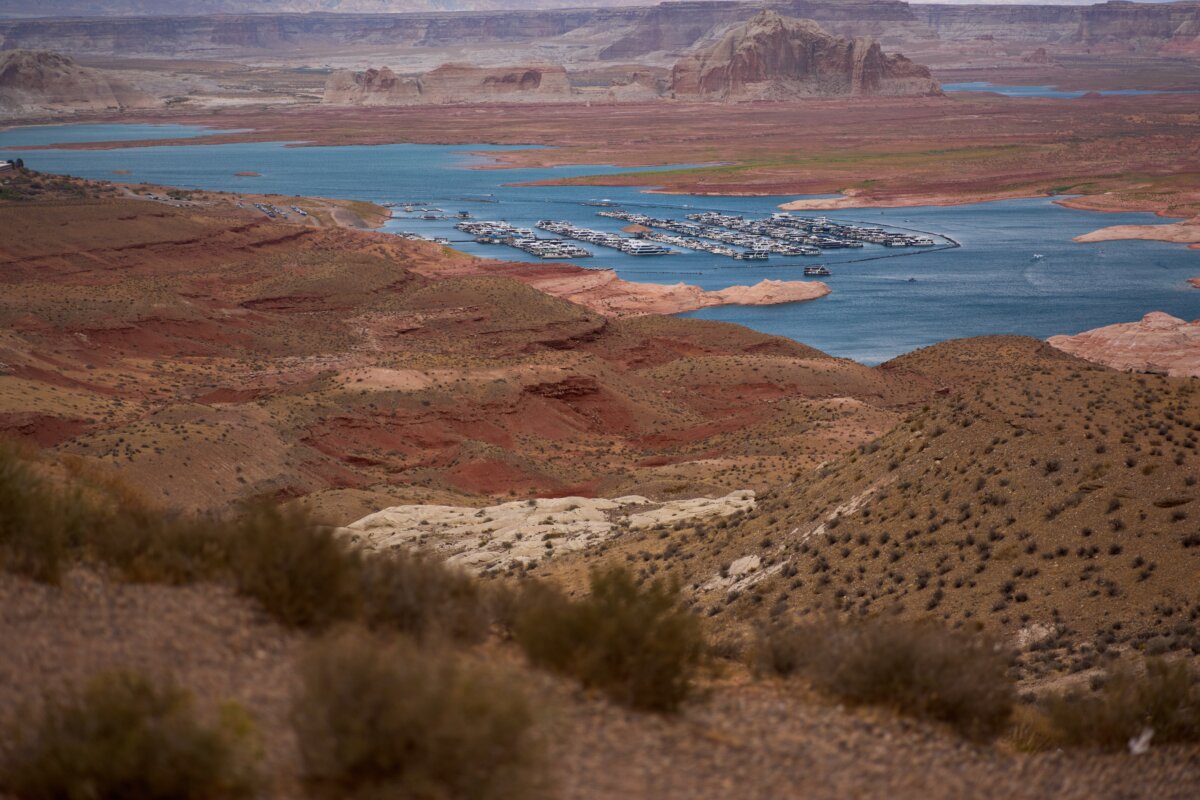

The amount of water in the United States’ second-largest reservoir, Lake Powell, has fallen to a record low level, according to the U.S. Bureau of Reclamation (USBR).
It comes only days after the announcement that the country’s largest reservoir, Lake Mead, had fallen to record lows due to the drought in the western states.
Lake Mead and Lake Powell both store water from the Colorado River system, which is used by homes and businesses in California, Arizona, Nevada, New Mexico, Utah, Wyoming and Colorado.
The Colorado River Basin has been in a so-called megadrought for more than 20 years.
The waters of Lake Powell—which straddles the Utah–Arizona border—reached 3,519.91 feet above sea level on Aug. 15, according to the Bureau of Reclamation, lower than the previous record of 3,519.92 feet in April 2023.
The lake is more than 20 feet lower than it was at the start of the year, and 60 feet lower than it was in January 2025, according to USBR data.
The Colorado River Basin supplies water to more than 40 million people in seven states and provides hydropower, both of which are affected by low water levels.
In 1999, Lake Powell averaged a water elevation of almost 3,681 feet, and Lake Mead was near capacity at 1,220 feet near the Hoover Dam.
Less Water for 3 States
On July 31, USBR published a Final Environmental Impact Statement that includes a 10-year water-sharing plan proposing significant consumption cuts for Arizona, California, and Nevada, while maintaining supplies to the other four states.
Interior Secretary Doug Burgum said the framework, which had been proposed, provided the flexibility to respond to changing hydrologic conditions while the seven states supplied by the Colorado River work toward “durable, consensus-based solutions.”
“The Department has a responsibility to ensure the Colorado River system remains reliable and resilient for the millions of Americans, communities and industries that depend on it,” Burgum said in a statement.
USBR issued a statement after Burgum met with the governors of the seven Colorado Basin states on April 17 to discuss the threat to water and power supplies.
“Long-term drought has reduced Colorado River system storage to about 36 percent of capacity, and the combination of the lowest snowpack on record and record-breaking March heat has further intensified drought conditions across the Basin,” USBR said.
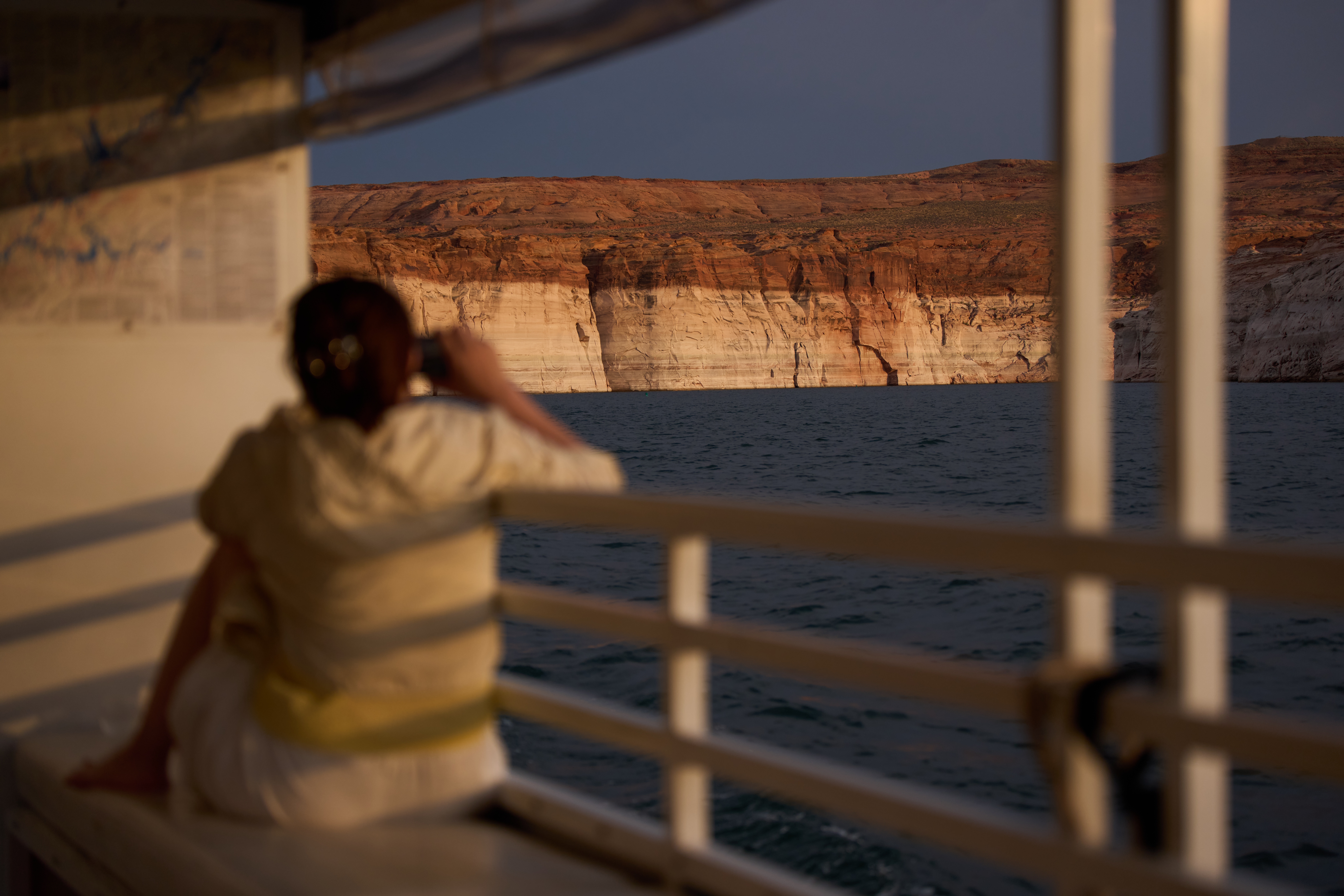 A person takes a picture during a tour on Lake Powell at the Glen Canyon National Recreation Area, near Page, Ariz., on July 15, 2026. (John Locher/AP)
The water levels in Lake Powell are still 30 feet above that most dire of predictions.
Lake Powell was created in 1963, following the construction of Glen Canyon Dam.
Its depleted water levels have affected its marinas, which have temporarily relocated to deeper waters.
The megadrought has been accompanied by persistent overuse of the Colorado River water, exacerbated by population pressures.
Arizona and Nevada both rank near the top of states for growth in recent years.
Water Row With Mexico
The United States and Mexico have been at odds over the sharing of waters from the Colorado River and the Rio Grande.
In April 2025, President Donald Trump threatened Mexico with possible sanctions and additional tariffs unless it delivered water to Texas as required by a 1944 water-sharing treaty.
Under the treaty, the United States is required to deliver 1.5 million acre-feet of water from the Colorado River to Tijuana, Mexico, each year.
But Trump said that Mexico had violated the treaty, under which it is obligated to deliver 1.75 million acre-feet of water from the Rio Grande to the United States every five years.
The Associated Press contributed to this report.
 Friends Read Free
Copy
Facebook
Tweet
Friends Read Free
Copy
Facebook
Tweet