
PARIS—Thousands of Europeans were driven from their homes on Aug. 14 as wildfires fanned by strong winds burned simultaneously in France, Germany, Spain, Greece, and Croatia, after weeks of heat and drought left forests across the continent primed to burn.
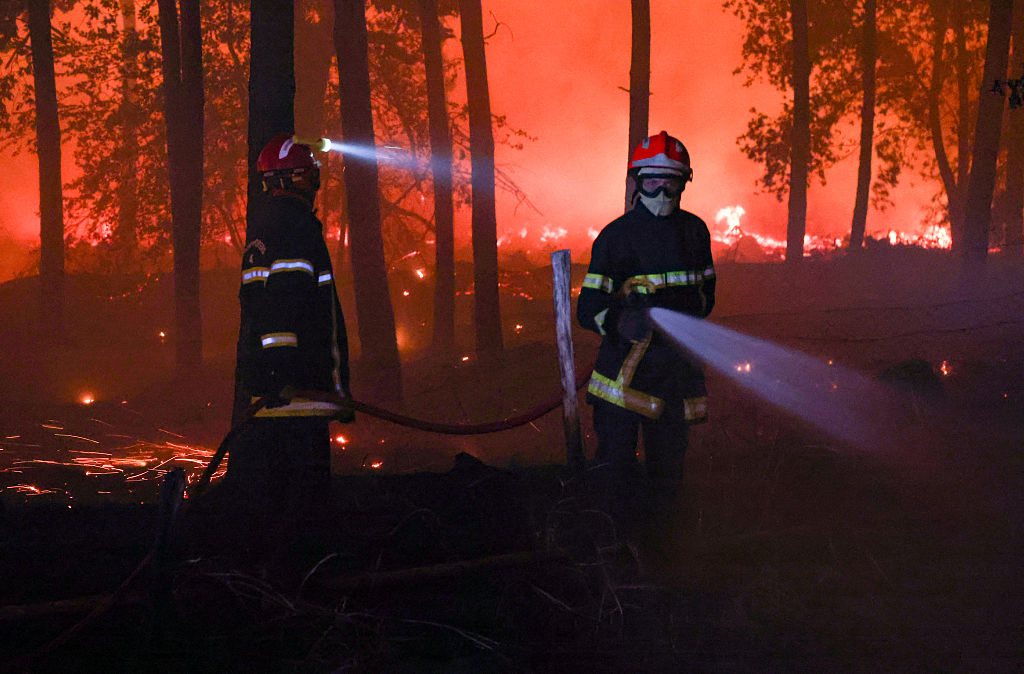
In southwestern France, a blaze that broke out early on the afternoon of Aug. 13 near Luglon, a village in the pine forests of the Landes department south of Bordeaux, had burned through some 1,300 hectares (about 3,200 acres) by Friday evening without destroying any homes, according to local officials.
Gilles Clavreul, the prefect of the Landes, said the 550 firefighters deployed had contained the fire’s advance without completely halting it, as its two fronts, southwest and southeast of the village, drew closer to each other.
The fire spread rapidly on shifting winds Thursday afternoon, according to the prefecture, which ordered the preventive evacuation of Luglon’s roughly 400 inhabitants that evening as the flames burned out of control about a mile from the village center.
In all, 550 people from Luglon and neighboring Garein were moved to nearby towns. The cause has not been established, and Clavreul said several hypotheses are being examined.
Crews are supported by eight fixed-wing water bombers and three helicopters, including a heavy-lift Chinook lent by Australia and guided onto priority targets by a Bell 412. The blaze comes only weeks after a late-July fire at Biscarrosse, elsewhere in the Landes, destroyed 3,700 hectares of forest and some 200 houses and other buildings.
Cavreul, who runs a community cafe in the center of Luglon, watched the fire take hold as he returned from the coast on Thursday, the smoke “already very heavy” by early evening.
“From 8 p.m., we were discreetly warned: ‘Don’t say it yet, but we are going to start evacuating the whole village.’ And that is what happened,” he told The Epoch Times.
Cavreul stayed on that night, tracking the flames on an app while the wind blew away from his home, the cars packed in case he had to leave.
After bringing vegetables to the firefighters on Friday morning, with the town hall’s agreement, he planned to return in the evening to help cook for the crews.
“There is a real spirit of solidarity,” he said. “The fire is advancing: it is making jumps of two kilometers (1.2 miles), and rescuers fear the two fronts will merge.”
Flames Reach a World War II Battlefield in Germany
In western Germany, more than 2,000 people were evacuated before dawn on Friday as a wildfire closed in on Gey, a village in the Hürtgen Forest near the Belgian border.
At around 4 a.m., local authorities told residents to leave immediately, carrying identification and essential medicines, and go to a shelter in a neighboring village.
The fire grew from roughly 25 hectares to some 300 hectares (about 740 acres) during the day, and officials warned that weather conditions would complicate the fight, with evacuated homes still under threat.
Army tracked vehicles cleared access lanes through the forest while helicopters dropped water. “This forest fire threatens to hit the local community hard,” Mona Neubaur, deputy premier of North Rhine-Westphalia, wrote on X.
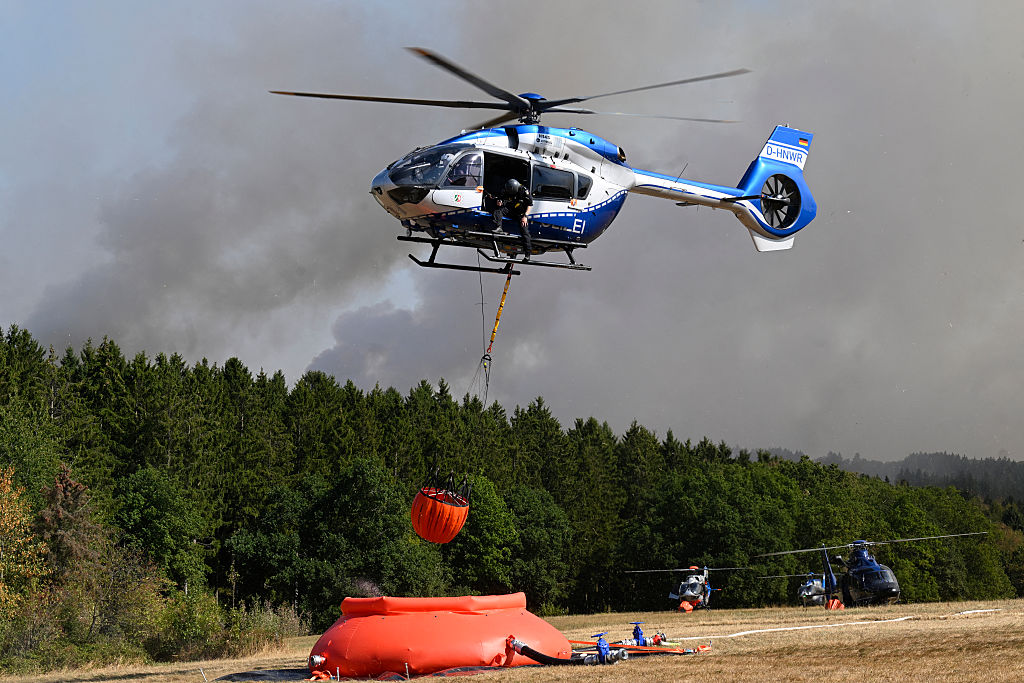 Police helicopters load water to fight a forest fire in Huertgenwald, western Germany on Aug. 14, 2026. Around 1,800 people had to leave their homes in western Germany overnight as a wildfire spread nearby, officials said, with helicopters and army equipment deployed to help battle the flames. (Roberto Pfeil/AFP via Getty Images)
Firefighters reported hearing occasional detonations as the flames spread overnight toward a former munitions depot near the town of Dueren.
Stephan Cranen, mayor of Huertgenwald municipality which contains Gey, said the situation remained critical, with the fire some 300 meters (1,000 feet) from the village.
Spain’s 31,000-Hectare Blaze Loses Strength
In southern Spain, the fire burning since Aug. 6 around Niebla, in the Huelva province west of Seville, has scorched more than 31,000 hectares (nearly 77,000 acres), and its perimeter now stretches some 120 kilometers (75 miles).
Spain’s Military Emergency Unit reported that the daily spread has slowed sharply, from 12,000 hectares a day earlier in the week to 3,000, while 658 residents across nine municipalities remain under preventive removal orders.
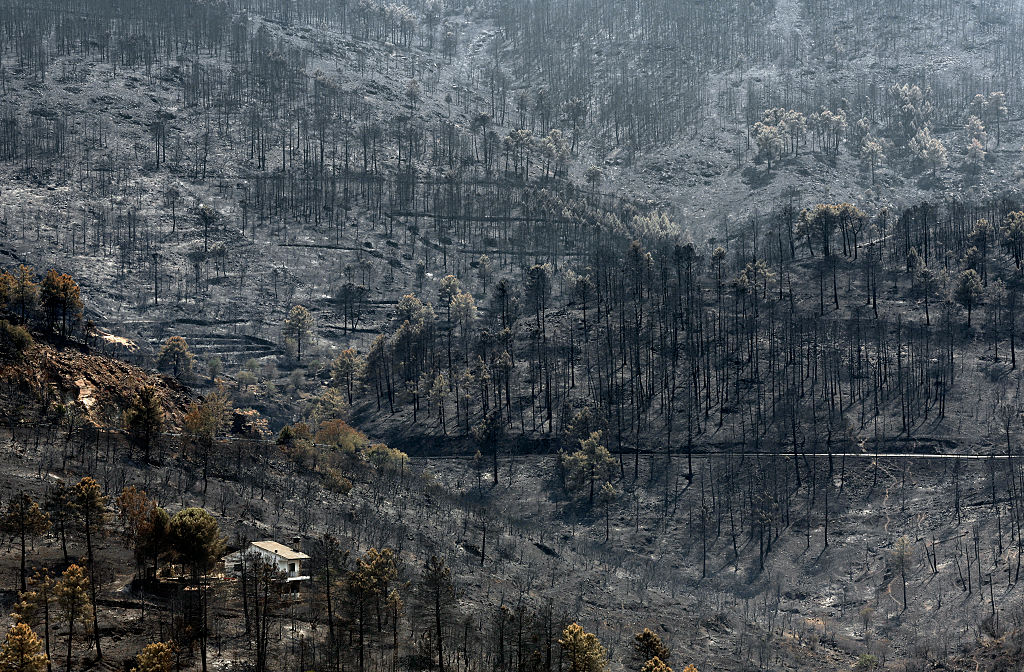 A house in the Iruelas Valley is surrounded by mountain slopes scorched by a wildfire, near El Tiemblo, 80 kilometers west of Madrid, on July 29, 2026. (Pierre-Philippe Marcou/AFP via Getty Images)
The blaze adds to a Spanish season that has already seen a 50,000-hectare fire near Madrid in July and a deadly blaze in Almeria that claimed 14 lives.
Greece on Maximum Alert as Winds Peak
In northern Greece, crews contained the fire that had sent beachgoers fleeing by sea a day earlier, when a fleet of small boats and coast guard vessels evacuated about 500 tourists from the resorts of Siviri and Fourka on the Halkidiki peninsula, south of Thessaloniki.
Two injured firefighters were hospitalized, according to the fire service.
By Friday morning, officials reported no active fire front at Siviri, though 227 firefighters remained on scene to smother scattered hot spots.
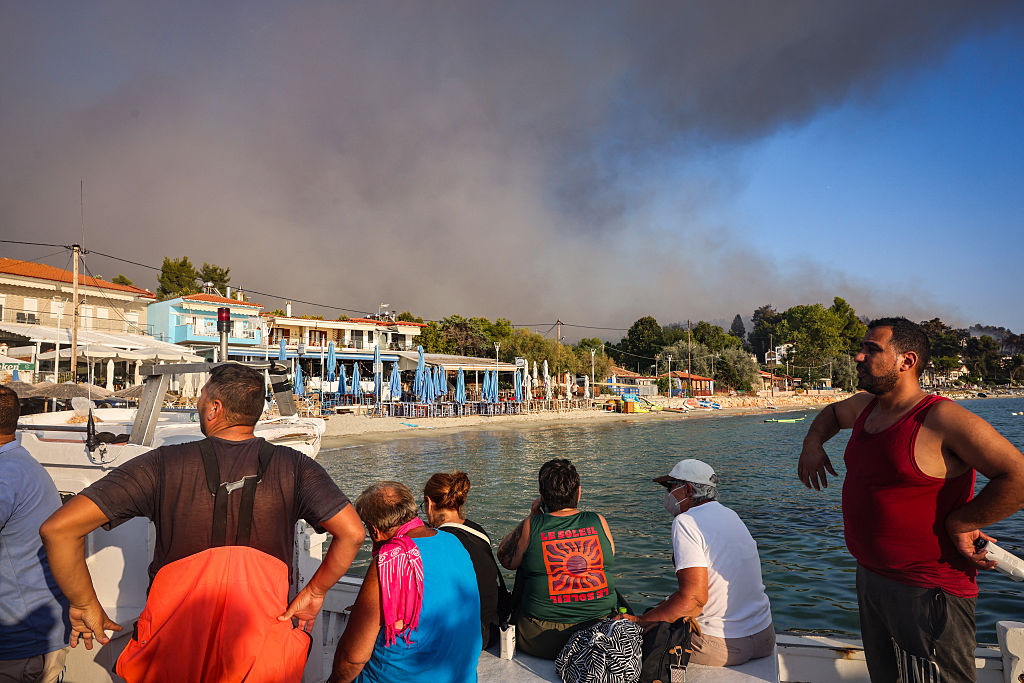 People evacuate on small boats during a wildfire as a plume of smoke rises into the sky near the village of Siviri, northern Greece, on Aug. 13, 2026. A fleet of small boats evacuated hundreds of tourists from beaches in northern Greece as a forest fire bore down on two popular resorts. (Vasilis Ververidis/AFP via Getty Images)
The fire service says more than 500 wildfires have broken out nationwide since Aug. 1.
Fire Turns Night Sky Red on Croatia’s Coast
In Croatia, a wind-driven fire descended overnight on Omis, a tourist town on the Dalmatian coast about 25 kilometers (15 miles) south of Split, engulfing homes and sweeping across more than 1,000 hectares (about 2,500 acres).
Roughly 1,000 people spent the night in emergency shelters, and of the 36 people treated by ambulance services, 14 were hospitalized, seven of them with life-threatening injuries, according to health officials.
“It was a strong fire. It swept everything on its way,” Chief Fire Commander Slavko Tucakovic said, reporting extensive material damage.
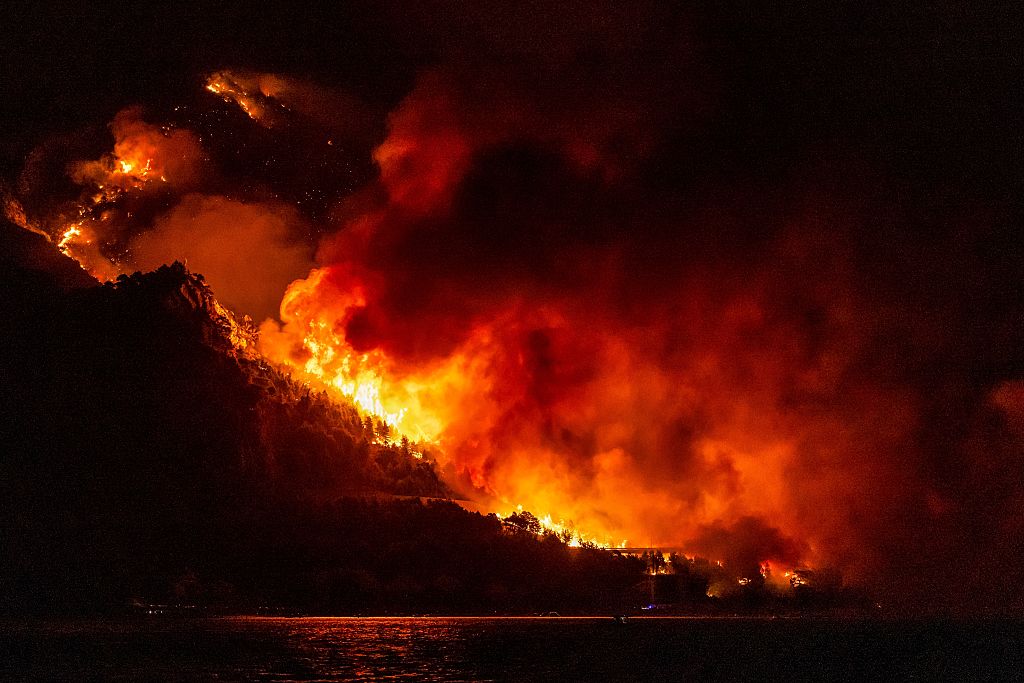 This photograph shows a wooden area engulfed in flames during a raging wildfire near the town of Omis, some 30 kilometers south of Split on Aug. 14, 2026. Croatian firefighters battled overnight with “one of the worst” wildfires in the country’s history, authorities said on Aug. 14, 2026. (Miroslav Lelas/AFP via Getty Images)
The simultaneous fires cap a summer in which Western Europe has logged its hottest June and July on record, according to the European Union’s Copernicus Climate Change Service, and in which France alone evacuated some 220,000 people from fire zones in July, an operation Interior Minister Laurent Nunez described in late July as “very likely” the country’s largest civilian evacuation outside wartime.
 Friends Read Free
Copy
Facebook
Tweet
Friends Read Free
Copy
Facebook
Tweet