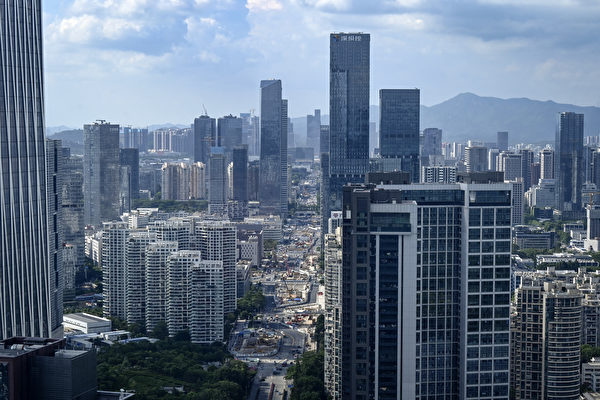

China’s office market is under mounting strain, as vacancy rates in major cities climb to multi-year highs and rents continue to fall, offering a stark window into broader economic weakness.
Across the country’s top commercial hubs, office vacancies have exceeded 20 percent in major cities such as Beijing and Shanghai, while Chinese online news platform NetEase reported on April 28 that office vacancies were close to 30 percent in some of Shenzhen’s commercial districts.
Landlords, facing dwindling demand, are cutting rents and extending rent-free periods nationwide.
Data from leading global real estate firm Cushman & Wakefield underscore the scale of the imbalance.
According to the firm’s March report, vacancy rates for Grade A office inventory for 2025 were about 29.4 percent in Shenzhen, 20.7 percent in Guangzhou, and roughly 15.9 percent in Beijing.
In Beijing, rents have fallen by 16 percent over the past year, according to the report.
Going by real estate advertising on social media, the situation is often worse outside major cities; vacancy rates in newly developed business districts in many second-tier markets exceed 30 percent, according to the report.
According to real estate consultancy Savills, rents for grade-A offices in Beijing, Shanghai, Guangzhou, and Shenzhen have fallen by about 20 percent to 40 percent since 2020. Many commercial property developers have been offering services such as subsidies for charging electric vehicles in addition to lower rent in order to attract tenants.
In Shanghai specifically, Chinese financial news media outlet Caixin reported that in 2025, the city’s commercial property transactions dropped to their lowest level in 11 years in 2025, as falling rents and elevated vacancy rates offset strong demand for prime assets.
The result is a market increasingly dominated by renters, who now have the leverage to negotiate down prices, even in traditionally high-demand business districts, according to a Shanghai-based financial scholar who spoke to The Epoch Times on the condition of anonymity out of fear of reprisal.
The scholar said the downturn reflects not just cyclical pressure but also a deeper erosion of demand.
“Shanghai has long been seen as the engine of China’s economy, and office rents are a direct indicator of business activity,” the scholar said. “What we’re seeing now is not just falling rents, it’s disappearing demand.”
The scholar attributed the shift in part to the departure of foreign firms.
“American, Japanese, and Korean companies once maintained their China headquarters here. Many of those headquarters are now leaving,” he said. “Domestic companies are also relocating as business conditions become more difficult.”
A China-based real estate researcher said, “It’s now a tenant-driven market.”
“Companies can keep pushing prices down, and that feeds into broader declines across the sector,” he told The Epoch Times.
A scholar based in central China said the problem is worse in those regimes because of years of real estate development driven more by policy than market demand.
“Local governments score political points by building office buildings and selling land, but many of these projects were never aligned with real business needs,” the scholar told The Epoch Times. “They can’t be rented out or sold, leading to persistently high vacancies.”
He added that financial stress is spreading through the system.
“Developers were brought in, banks issued loans, but now some of those loans can’t be repaid,” he said. “In some cases, developers have simply walked away.”
Wang Yibo contributed to this report.
 Friends Read Free
Copy
Facebook
Tweet
Friends Read Free
Copy
Facebook
Tweet