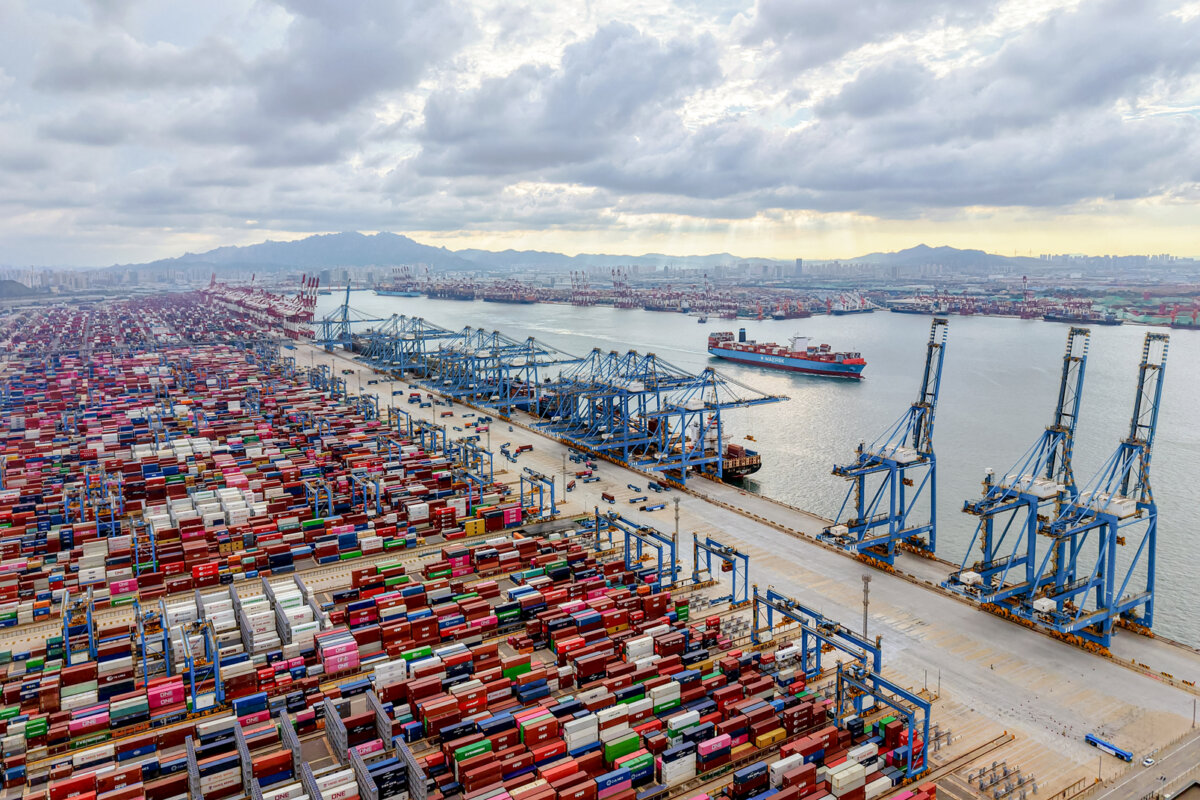

China’s export growth slowed to its lowest level in five months as market watchers monitor the global economic fallout from the war in Iran that began seven weeks ago.
Exports rose 2.5 percent year over year to $321.03 billion, customs data released on April 14 showed. This is sharply down from the February spike of almost 40 percent.
Last month’s reading fell short of the consensus estimate of 8.3 percent and was the weakest reading since October 2025.
But although a slowdown could relate to the war’s effects on global trade, it could also reflect seasonal factors from the Lunar New Year holiday and a high base effect from the 2025 tariff-driven acceleration.
Before U.S. President Donald Trump’s sweeping trade agenda, U.S. companies accelerated their purchases of Chinese goods to avoid the global tariffs early last year.
U.S.–China trade relations remain a clear hurdle for the world’s second-largest economy.
Exports to the United States are down by more than 16 percent year over year, which is “the clear outlier in what otherwise still looks like solid export growth across the board,” said Lynn Song, chief economist for Greater China at ING.
Conversely, external demand elsewhere was robust, and exports to China’s key markets—the European Union, Japan, and South Korea, for example—registered solid growth.
“We expect the drag from the US to fade [year over year] in the coming months, as last April’s Liberation Day tariffs led to a notable decline in trade,” Song said in an April 14 note.
“With the drag from the US expected to ease—assuming no new tariff shocks, which cannot be fully ruled out—external demand should remain an important driver of growth this year.”
In the first quarter, overall Chinese exports remained up almost 15 percent year over year.
Imports soared nearly 30 percent in March from the 13.8 percent increase in the previous month. This came in higher than the market forecast of 11.1 percent.
In total, China’s trade surplus narrowed to $51.13 billion from nearly $91 billion in February—far lower than economists’ expectations of $112 billion.
China’s economy is forecast to grow by 4.4 percent in 2026 and 4 percent in 2027, according to the International Monetary Fund’s latest World Economic Outlook report released on April 14.

The Chinese regime is expected to publish first-quarter gross domestic product data on April 16. Early estimates suggest the economy grew by 4.8 percent during the January–March period, slightly better than the 4.5 percent growth in the fourth quarter.
However, the ruling Chinese Communist Party tightly censors information and has a record of issuing falsified data. The Epoch Times is unable to independently verify official figures.
US, China, and Iran
Trump will meet with Chinese leader Xi Jinping next month.
U.S. Trade Representative Jamieson Greer, speaking at a Hudson Institute event on April 7, said the president will aim to maintain a stable economic and trade relationship with Beijing.
“What we are not looking for is massive confrontation or anything like that,” Greer said. “When we think about what to expect for the president’s meeting, we’re looking to maintain that stability. We’re looking to ensure we can continue to get rare earths from the Chinese.”
The wild card between Washington and Beijing could be Iran.
The Chinese regime has been able to weather the economic storm from soaring crude oil prices through a mix of strategic stockpiles and price controls. However, because its economy is dependent on exports, it is vulnerable to slower economic growth.
Foreign Ministry spokesman Guo Jiakun criticized the U.S. blockade in the Strait of Hormuz at a press conference on April 14 and urged all parties to honor ceasefire arrangements.
Twenty percent of the world’s oil passes through the narrow waterway between Iran and the Arabian Peninsula. Most of that crude is then shipped to Asia, most notably China.
Even though tanker traffic in the global choke point has crawled to a standstill, global energy prices have eased sizably this week.
The price of Brent, an international benchmark for oil prices, fell by 5 percent to below $89 per barrel in overseas trading on April 14. The price of U.S. crude declined by about 8 percent to about $91 per barrel on the New York Mercantile Exchange.
Another choke point now drawing attention is the Strait of Malacca, the busy passage between Indonesia and Malaysia.
Although the Strait of Hormuz remains the second‑largest route for oil shipments, the Strait of Malacca handles even more traffic, moving about a quarter of all seaborne crude.
U.S. Secretary of War Pete Hegseth met with Indonesian Defense Minister Sjafrie Sjamsoeddin this week to craft a “Major Defense Cooperation Partnership.”
 Friends Read Free
Copy
Facebook
Tweet
Friends Read Free
Copy
Facebook
Tweet