
Amid fierce competition between the United States and Beijing, analysts said the Chinese humanoid robotics sector—a major, prioritized part of China’s artificial intelligence industry—is facing overcapacity and structural problems.
President Donald Trump has said that he would discuss AI at the state summit with China’s leader Xi Jinping this week. Both countries are racing to build separate AI supply chains, aiming to dominate what is regarded as a crucial sector.
Chinese companies accounted for roughly 90 percent of global humanoid robot shipments in 2025, and that dominance increased to more than 97 percent in the first half of 2026.
There are currently more than 150 humanoid robot companies in China, and that number continues to grow.
Meanwhile, the sector is also facing problems in finding buyers, as its manufacturing capacity greatly exceeds demand.
Unitree Robotics, a leading Chinese robotics company, reported its market capitalization on Sept. 22 at about 200.1 billion yuan—a drop of about RMB 244.8 billion yuan from its peak on the first day of public trading a month ago.
According to Cailian Press, a Chinese state-owned financial news agency based in Shanghai, regulators have issued informal “window guidance” to certain investment banks and investment institutions indicating that the threshold for IPO reviews for humanoid robotics companies will be raised.
Professionals across various investment banks told Cailian that some staff have received internal alerts noting that IPOs in some tech sectors—including robotics—could face delays or obstacles if the companies do not hold a sufficiently prominent industry position.
The current state of China’s humanoid robot industry is characterized by an investment boom driven by policy, which outweighs actual technological breakthroughs, Shen Ming-shih, a research fellow at Taiwan’s Institute for National Defense and Security Research, told The Epoch Times.
“We see many humanoid robots performing flashy feats—like sprinting or martial arts demonstrations,” he said. “But we don’t know if these choreographed movements of the robots are remotely controlled by someone behind the scenes.”
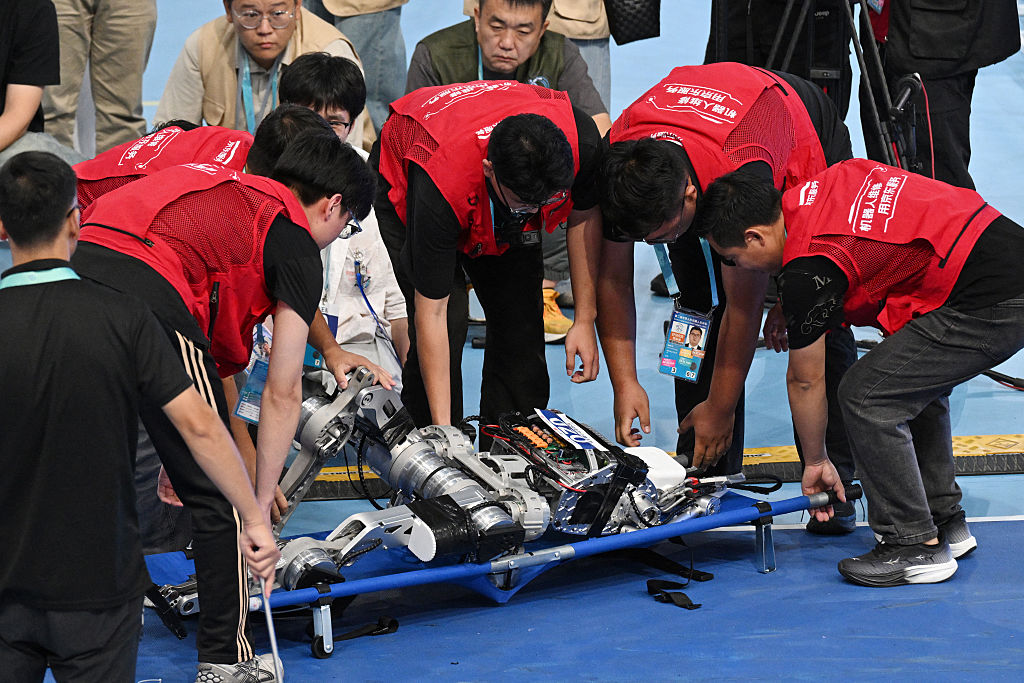
In the second World Humanoid Robot Games held in Beijing in August, Chinese humanoid robots malfunctioned in several instances.
A Chinese humanoid robot failed to correct its course in time while turning and crashed head-on into a trackside power distribution box during a pre-race sprint test. The impact damaged the robot’s waist joint and sent sparks flying.
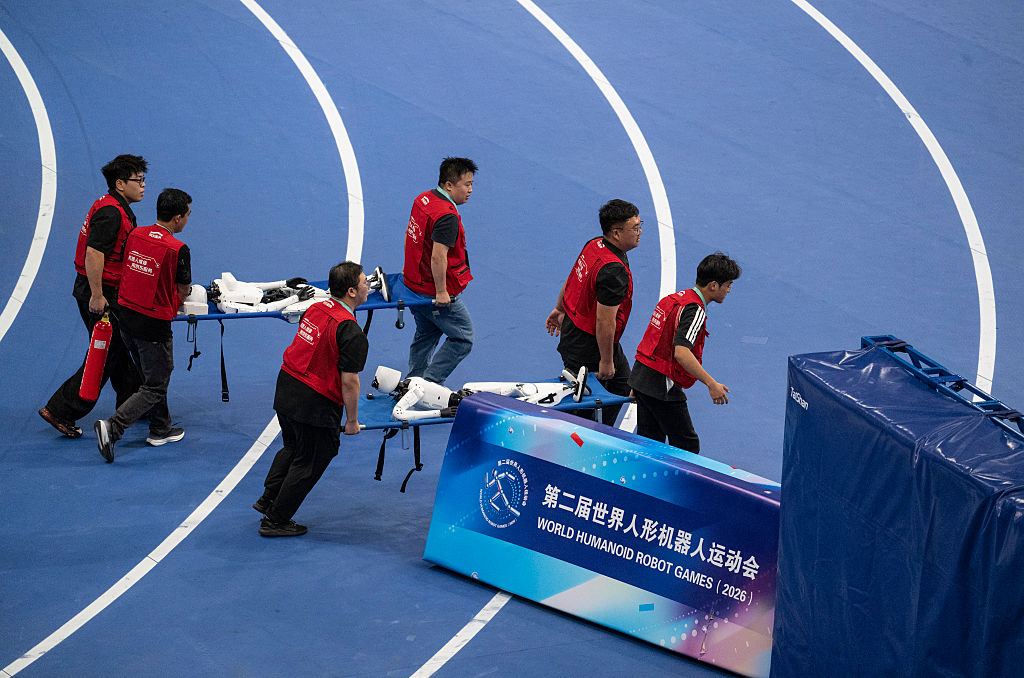
Another Chinese humanoid robot was carried away after falling during the long jump event at the games.
During a weightlifting competition, a robot from the Chinese Tianzhuo team began to tremble after lifting the barbell to chest height.
It lost its balance while attempting to lift the weight further, then swung its robotic arm toward the judges’ table before collapsing and being carried away on a stretcher by staff.
 A humanoid robot is carried away after falling during the long jump competition at the 2nd World Humanoid Robot Games at the National Speed Skating Oval in Beijing on Aug. 26, 2026. (Greg Baker/AFP via Getty Images)
“The Chinese humanoid robots’ work efficiency is only 20 percent that of a human, so there is still some way to go before true commercialization,” Shen said.
Davy J. Wong, a U.S.-based independent political economist, told The Epoch Times that China has made “rapid progress” in areas such as motors, speed reducers, batteries, sensors, supply chains, and mass manufacturing for humanoid robots.
However, Wong said, the most significant problem is that “the pace of capital investment and production capacity expansion has clearly outstripped commercial demand.”
To evaluate this industry, “you shouldn’t look at whether the robots can run, dance, or do kung fu; instead, you need to look at whether they can operate reliably for eight or even 24 hours a day, and whether the costs are lower than those of human labor or traditional automation equipment,” Wong said.
The number of humanoid robots deployed in industrial and professional services globally remains limited, he noted.
Wong believes that this round of the Chinese regime’s regulation signals a shift in the industry from the early “land-grab” phase to a stage of consolidation and shakeout, rather than a 180-degree turn in policy direction.
“Ultimately, the companies that truly succeed may well not be the 150 or so companies operating today, but rather the few that remain after price wars, technological competition, and capital-driven consolidation have run their course.”
Dependence on Government Funding
Both analysts pointed out that the current Chinese humanoid robotics industry is heavily relying on government funds and is not market-driven.
“Local governments shoulder a significant portion of the initial investment,” Wong said. “The government funds the establishment of training centers, which then purchase robots and generate demand for data and services, thereby creating orders and revenue for enterprises.”
“The Chinese government shoulders approximately 90 percent of the investment; specifically, local governments cover 80 percent to 90 percent of the initial investment,” Shen said.
It is necessary to observe “how much sustainable and repeatable market-based revenue is left after excluding government subsidies, government procurement and policy projects,” Wong said.
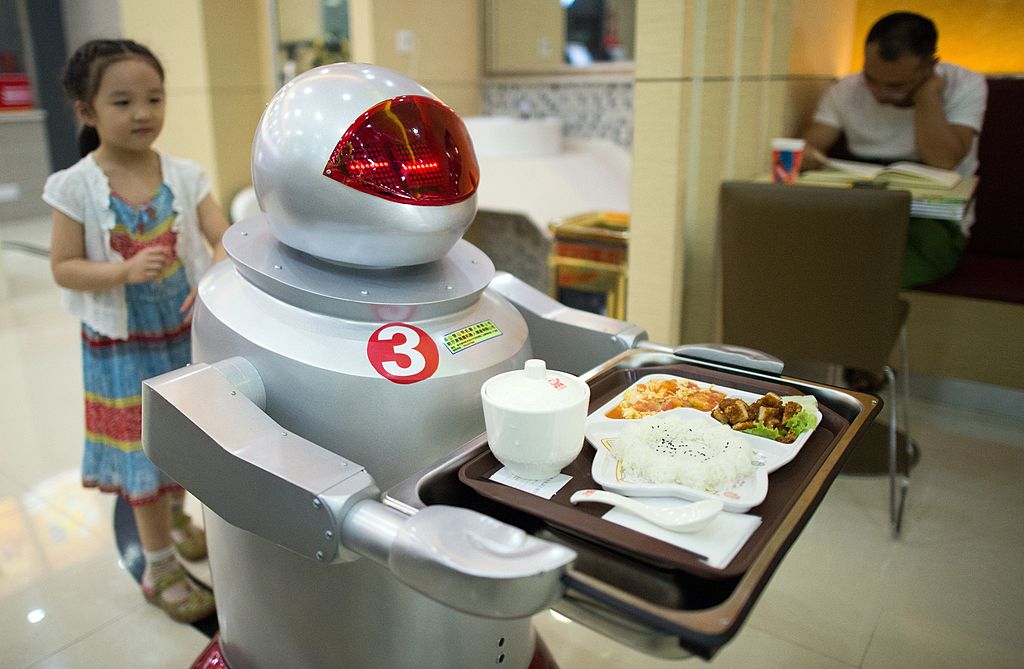 A robot carrying food to customers in a restaurant in Kunshan on Aug. 13, 2014. (Johannes Eiselle/AFP via Getty Images)
If one excludes the non-commercial revenue derived from local government funding, “the actual valuations of some of these robotics companies could face a precipitous drop—potentially shrinking by 60 percent to 70 percent,” Shen estimated.
Structural Problem
The humanoid robot industry reflects China’s overall industrial policy model, “once the central government designates a specific technology as a strategic priority, local governments, state-owned enterprises, state-backed funds, banks, and private capital tend to rapidly converge in that same direction,” Wong said.
“This results in massive supply chains, extensive redundant investment, and fierce price competition.”
“Errors can also be rapidly amplified” in such a system, he said.
“Investors are the first to bear the losses, but the situation can escalate into a broader misallocation of resources.”
When the regime’s gamble on certain industries goes wrong, the costs are borne not only by investors but potentially also by local government finances, banks, residents, and other public needs that could have otherwise benefited from those resources, Wong said.
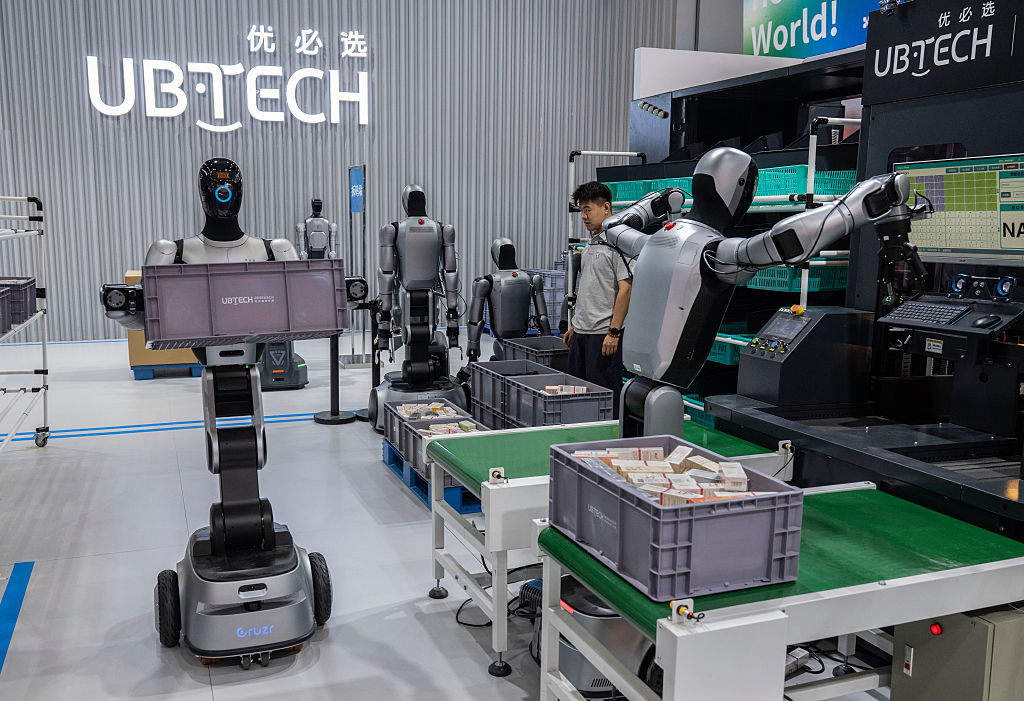 A technician watches over humanoid robots from Chinese company UBTECH as they demonstrate working skills in a mock factory warehouse style environment at the World Robot Conference in Beijing, China, on Aug. 20, 2026. (Kevin Frayer/Getty Images)
“This is particularly relevant given the current context of strained local government finances, declining revenue from real estate and land, and sluggish household consumption,” Wong said of the current Chinese economic situation.
If fiscal, credit, and social resources continue to be concentrated on government-designated production sectors, “it could further exacerbate the structural imbalance between supply capacity and insufficient domestic demand,” he said.
Luo Ya and Reuters contributed to this report.
 Friends Read Free
Copy
Facebook
Tweet
Friends Read Free
Copy
Facebook
Tweet