
The European Union, the United States, and 13 other countries marked the 10th anniversary of the 2016 South China Sea arbitration ruling by reaffirming that the decision is final and legally binding on China and the Philippines under the U.N. Convention on the Law of the Sea.
“We reaffirm our unwavering commitment to maintaining a free and open Indo-Pacific that is peaceful, stable, and rules-based, anchored in international law, and commemorate the 10th anniversary of the July 12, 2016, Arbitral Tribunal’s landmark and unanimous decision on the South China Sea,” the U.S. State Department said in a July 11 statement.
The department said the statement also represented the views of Australia, Canada, Estonia, Germany, Italy, Japan, Latvia, Lithuania, New Zealand, the Republic of the Philippines, Romania, Slovenia, and the UK.
The EU called on the parties to respect and fully implement the ruling, emphasized the importance of freedom of navigation and overflight, and said the U.N. Convention on the Law of the Sea provides the legal framework governing activities at sea.
The EU statement also expressed support for ongoing negotiations between the Association of Southeast Asian Nations, a 10-member regional political and economic organization, and China on a legally binding South China Sea Code of Conduct.
The EU urged all disputes to be resolved peacefully through dialogue and international law, and it voiced concern over rising tensions and dangerous incidents in the region while opposing unilateral actions that threaten regional stability.
“The EU is deeply concerned by the steady increase of tensions and dangerous incidents in the South China Sea and firmly opposes any unilateral actions that threaten to undermine regional stability and the international order based on international law and the rule of law, and remains steadfast in its commitment to safe, free and open maritime routes in the Indo-Pacific and beyond,” the EU stated.
An estimated 20 percent to 33 percent of global maritime trade passes through the South China Sea each year, including energy shipments to U.S. allies such as Japan, South Korea, and Taiwan, according to a December 2025 report by the Congressional Research Service. The region also contains significant oil and natural gas reserves, along with valuable fisheries, coral reefs, and other marine resources.
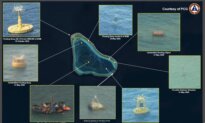
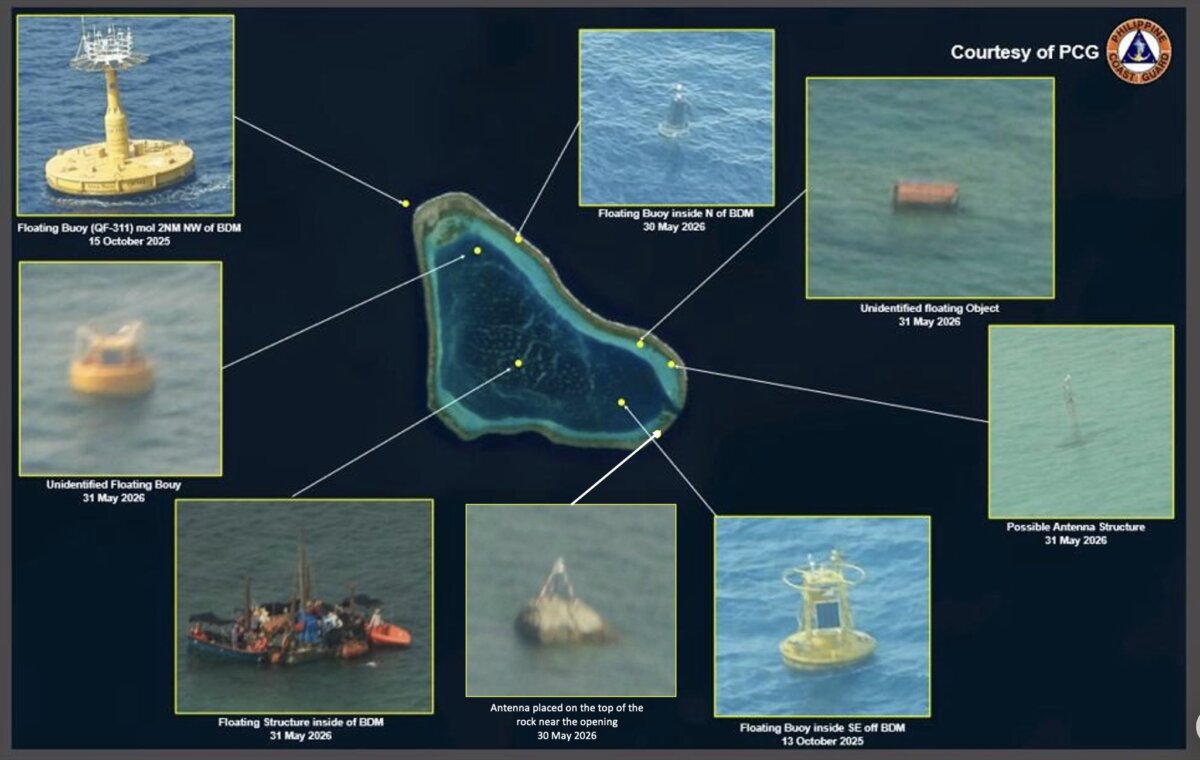
Philippine officials urged China to remove a floating platform, buoys, and related structures from the disputed Scarborough Shoal, saying they were installed without Manila’s consent and violate Philippine sovereignty. The Philippines filed diplomatic protests, warned against further development of the shoal, and said it continues monitoring Chinese vessels and activities.
The South China Sea Arbitration was an international arbitration between the Republic of the Philippines and the People’s Republic of China conducted under Annex VII of the U.N. Convention on the Law of the Sea. The Philippines initiated the proceedings on Jan. 22, 2013, seeking rulings on the legal basis of maritime rights and entitlements in the South China Sea, the legal status of certain maritime features, and the legality of actions taken by China in the disputed waters.
The arbitration did not address questions of territorial sovereignty over islands or maritime boundary delimitation, matters that fall outside the tribunal’s jurisdiction.
The ruling was issued by a five-member panel.
 Friends Read Free
Copy
Facebook
Tweet
Friends Read Free
Copy
Facebook
Tweet