

A campus that is a joint venture between the UK’s University of Liverpool and a major Chinese technical school intertwined with the communist regime’s military has come under recent scrutiny for expanding collaboration with Russia and technical partnerships with China more broadly.
In November 2024, the Xi’an Jiaotong–Liverpool University (XJTLU), located in Suzhou in eastern China, opened its Centre for China–Russia Humanitarian Cooperation and Development.
In a June 3 report on XJTLU’s “previously unreported links to sanctions,” the Australian Strategic Policy Institute (ASPI) noted that the campus’s new center establishes ties with individuals and entities sanctioned for their involvement with the ongoing Russian invasion of Ukraine.
Meanwhile, ASPI observed “risks posed by foreign science, technology and academic partnerships in China in a period of heightened geopolitical rivalry, intensifying technological competition,” as well as risks associated with Sino–Russian cooperation, particularly in critical fields of research that have both military and civilian applications.
Taiwanese security experts recently told the Chinese-language edition of The Epoch Times that XJTLU highlights the long-running approach of the Chinese Communist Party (CCP) in using academic collaboration to circumvent foreign tech restrictions.
Institutions such as XJTLU are “effectively under the full control of the CCP and can be made to align with its policy directives,” said Chung Chih-tung, research fellow at Taiwan’s government-run Institute for National Defense and Security Research.
Global Partnerships Under Scrutiny
XJTLU was established in 2006 and has since grown to include more than 24,000 students and more than 1,000 academic staff, according to its official website. Its Chinese parent institution, Xi’an Jiaotong University, is one of China’s major national defense research colleges, founded in the 1950s by the State Administration of Science, Technology, and Industry for National Defense and the Shaanxi provincial authorities.
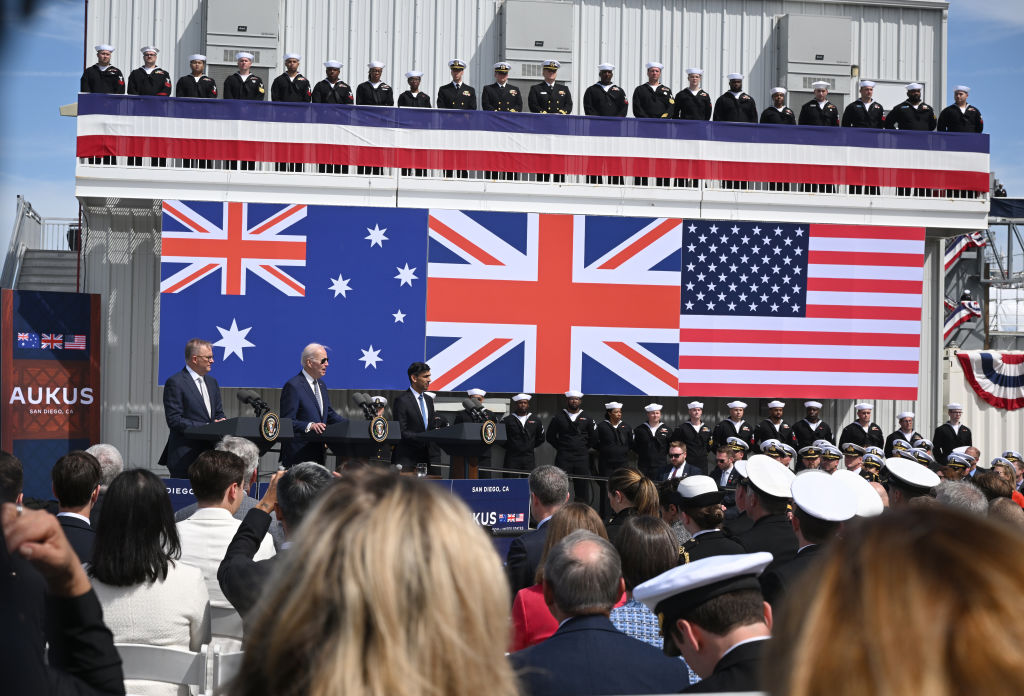
The University of Liverpool—a leading research university in the UK and a member of the Russell Group, a collection of the country’s 24 top research institutions—receives funding from Western governments for defense, security, and intelligence projects, according to ASPI. In September 2024, the university won the inaugural AUKUS Electronic Warfare Innovation Challenge.
AUKUS is a security partnership between Australia, the UK, and the United States aimed at bolstering the allies’ stance in the Indo-Pacific. Although not explicitly described as such, AUKUS is widely seen as a strategic move to counter the Chinese regime’s growing aggression in the region.
Responding to an inquiry by ASPI, the University of Liverpool claimed that it had “no involvement” with XJTLU’s China–Russia center and emphasized that all collaborative research adheres to the UK’s rigorous due diligence protocols. However, public reports show that the university’s vice-chancellor still serves as vice-chair of XJTLU’s board and many senior administrators participate in its management.
Chung, the Taiwanese policy researcher, described how this model of cooperation allows for technology transfer while it enables Beijing to “whitewash the brand” of its state-funded research by providing a prestigious foreign name.
Undergraduates at XJTLU receive degrees from both the Suzhou school and the University of Liverpool, while postgraduates earn degrees from Liverpool only.
Given the risks of communist China acquiring technologies through academic collaboration, Western nations have begun treating such partnerships as national security issues. For instance, U.S. schools such as the University of Michigan and Georgia Institute of Technology have taken steps to cut back or terminate their joint academic programs with China. In April, the U.S. Department of Education launched a probe into the University of California–Berkeley for allegedly failing to disclose funding from a CCP-linked entity.
Due Diligence
The University of Liverpool, in its response to ASPI, said all its joint research with XJTLU is subject to “rigorous due diligence policies” to ensure compliance with the UK’s Export Control Act and its National Security and Investment Act.
The Epoch Times contacted the University of Liverpool for comment but did not receive a response by publication time.
The new China–Russia center is headed by co-directors Chao Qiuling and Artyom Semenov. The latter serves as an adviser to the Moscow regional government and is a member of Rossotrudnichestvo, a public advisory council under European Union sanctions for its role in promoting the Kremlin’s political and cultural narratives about Ukraine.
Chao introduced the Centre for China–Russia Humanitarian Cooperation and Development in a press release on the XJTLU website as providing “an innovative platform for collaboration in education, culture, research, arts and trade” between Russia and China. ASPI quoted Chao as saying the institution will “develop specialised courses and training programmes” and “support Chinese businesses, particularly those in Jiangsu province, in expanding into Russian markets.”
Suzhou, where XJTLU is based, is an affluent metropolis with about 8.5 million people in southern Jiangsu Province, east of Shanghai. XJTLU hosts robotics and advanced semiconductor research institutes and boasts a supercomputing center.
While officially neutral in the Russia–Ukraine conflict, China has close ties with Russia that both Chinese leader Xi Jinping and Russian President Vladimir Putin describe as a “no-limits partnership.”
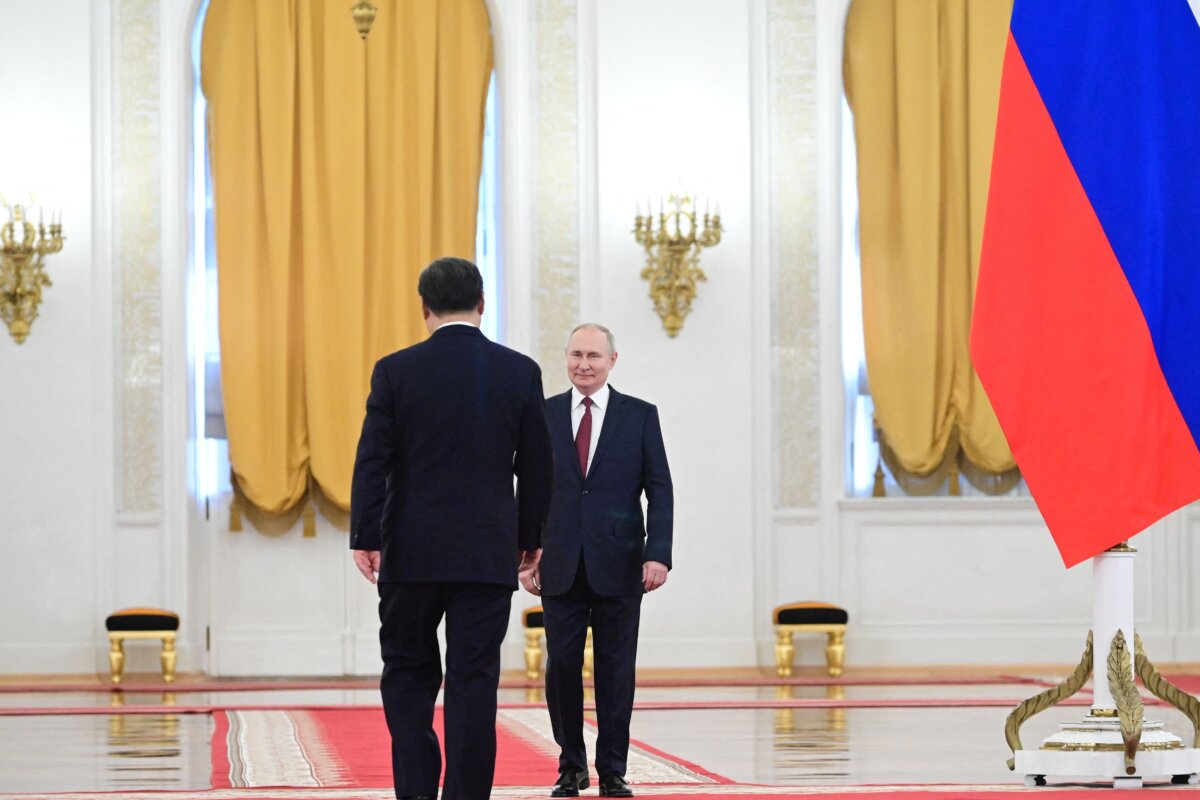
Although China has not openly provided weapons or munitions for the Russian military’s use, Western governments have criticized Beijing for supplying Russia with large quantities of industrial products and raw goods—including electronic components critical for producing tanks and missiles—that fuel the Kremlin’s defense industry.
The APSI report notes the growth of XJTLU’s Russia links, including a visit to the Suzhou campus by multiple former members of the Russian government during the opening of the China–Russia center.
According to Chao and Semenov, the partnerships between XJTLU and Russia aim to boost technological and commercial development in Russia and bilateral cooperation.
Financial Incentives, National Security
Wang Hsiu-wen, assistant research fellow at the Chinese Military Affairs and Operational Concepts Division of the Institute for National Defense and Security Research, told The Epoch Times that partnerships such as that enjoyed by XJTLU may provide Beijing ways to “bypass the restrictions of the U.S. Entity List and continue accessing critical technologies such as chip design and manufacturing.”
The ASPI said in its report that much of the activity at and surrounding XJTLU “appears to be at odds with the British government’s own defence, foreign policy and national security positions and policies spanning its relationships with the United States and EU and strong support for Ukraine.”
“It is also inconsistent with Britain’s broader security partnerships, including AUKUS,” the report states.
Wang said she expects institutions and programs partnering with China to come under increasing scrutiny as the U.S.–China tech competition escalates and Western governments hope to further reduce the risks of unwanted technology transfers to the CCP. Foreign universities must strike a balance between financial incentives and national security, she said.
Chung said many Western universities cooperate with the CCP in exchange for financial support to ease their operational burdens.
“Western countries emphasize academic independence and separation from political influence, but when universities face financial difficulties, their profit-oriented nature makes them more likely to accept the CCP’s ‘olive branch’ through joint ventures,” Chung said.
In the process, he said, these institutions may be compelled to provide Beijing access to sensitive information, ultimately facilitating the CCP’s acquisition of advanced technologies.
Wang noted that the trend of Chinese funding of foreign academic institutions and joint research projects has accelerated since the 2008 financial crisis.
Chung said he believes that with the growing rift between Beijing, the United States, and governments aligned with Washington, Western authorities and institutions will increasingly perceive the risks of unvetted academic cooperation with China.
He noted that even collaborations in the humanities and social sciences may come under review. He cited the example of Harvard University’s Kennedy School, which has trained so many Chinese regime officials that it has gained a reputation among the Chinese as being the CCP’s “second Party school.”
“Now Western nations recognize that ‘knowledge is power,’” Chung said. “Education is tied to technology, and technology is the key to economic development; therefore, education has become a matter of national security.”
Li Jing and Luo Ya contributed to this report.
 Friends Read Free
Copy
Facebook
Tweet
Friends Read Free
Copy
Facebook
Tweet