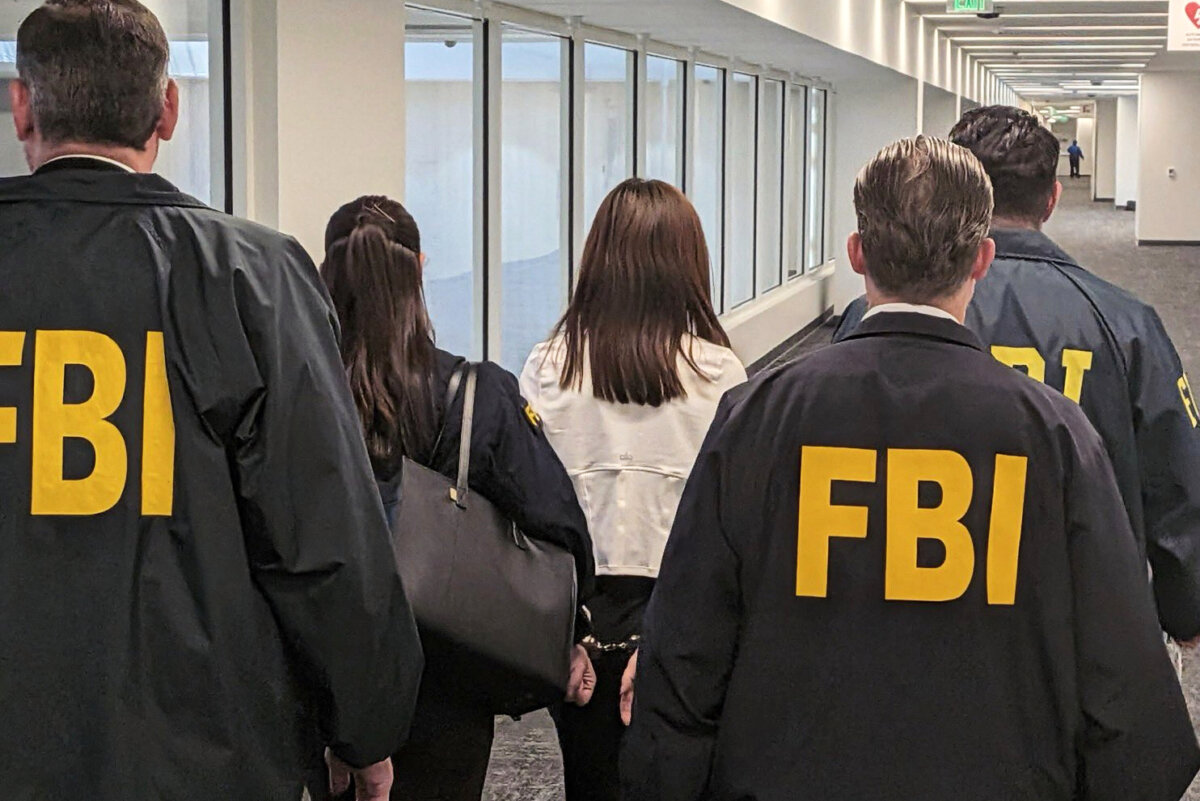

A group of U.S. lawmakers is urging Congress to pass bipartisan legislation to counter foreign governments’ efforts to intimidate and surveil individuals on U.S. soil, after the FBI arrested an alleged Chinese agent earlier this week.
The Congressional-Executive Commission on China (CECC), a bipartisan and bicameral panel, made the appeal on Oct. 6, two days after the FBI arrested California realtor Zhang Wanying on a charge of acting as an unregistered agent of a foreign government.
In a post on X, the commission said that “transnational repression has no place on American soil.”
“Congress must now do its part: pass the bipartisan Transnational Repression Policy Act (S. 2525/H.R. 4829) to protect Americans from intimidation and surveillance by foreign governments and their agents,” it said.
Zhang, a naturalized U.S. citizen who also goes by “Heather,” is accused of surveilling Lai Ting-yu, the U.S.-based son of Taiwanese President Lai Ching-te, at the request of her Chinese Communist Party (CCP) handlers.
According to an FBI affidavit, Zhang and an accomplice traveled to Seattle in September 2025 and waited in a rented vehicle outside the target’s home. When Lai and his family arrived, the two allegedly photographed and filmed them, later sending images, video, and license-plate information to a Chinese official.
The affidavit also claimed that Zhang may have been tasked with gathering information about the residents of an Irvine address in California that had previously been associated with a Taiwanese elected official “with vocal anti-CCP views.”
In Taiwan, Presidential Office spokesperson Karen Kuo responded to Zhang’s arrest by calling her alleged activity a “typical case of transnational repression.”
“[Taiwan] strongly condemns such barbaric acts that disregard human rights and the sovereignty of nations, and seek to oppress, intimidate, or even harm people who advocate for freedom and democracy, as well as their family members,” Kuo said in an Oct. 5 statement. “Such behavior should not be tolerated in the civilized world.”
Wang Ting-yu, a Taiwanese legislator from the ruling Democratic Progressive Party and a member of the Inter-Parliamentary Alliance on China, called Zhang’s alleged actions “deeply concerning,” according to an X post on Oct. 5.
“Beijing’s transnational repression must be taken seriously. Democracies must stand together against CCP intimidation,” Wang added.
Four lawmakers who serve on the CECC—Chair Sen. Dan Sullivan (R-Alaska), Co-Chair Rep. Chris Smith (R-N.J.), Sen. Jeff Merkley (D-Ore.), and Rep. Jim McGovern (D-Mass.)—introduced the Transnational Repression Policy Act in 2025.
A key provision of the legislation would require training to help federal, state, and local law enforcement officials recognize and counter acts of transnational repression, such as targeted online surveillance, threats, physical assaults, and coercion of family members.
Several other lawmakers have since co-sponsored the legislation, including Sens. Tim Kaine (D-Va.) and Richard Blumenthal (D-Conn.) and Reps. John Moolenaar (R-Mich.), Judy Chu (D-Calif.), and Thomas Suozzi (D-N.Y.).
In March, 35 groups—including China Aid, Freedom House, Uyghur American Association, Students for a Free Tibet, and Friends of Falun Gong USA—issued a joint statement urging four bipartisan leaders of the House and Senate committees on foreign affairs to mark up the legislation.
The groups argued that passing the legislation would “promote robust interagency coordination, and provide critical outreach to impacted communities.”
Zhang’s case has fueled criticism of China among several Republicans in Congress.
Moolenaar, chairman of the House Select Committee on the CCP, criticized the Chinese regime for violating U.S. sovereignty, in a statement on Oct. 6.
“Once again, the Chinese Communist Party (CCP) has been caught surveilling and harassing innocent people in the United States in another gross violation of our country’s sovereignty,” Moolenaar said.
Sens. Rick Scott (R-Fla.) and Pete Ricketts (R-Neb.), who serve on the Senate Foreign Relations Committee, reminded the public of the threats posed by China.
“Communist China continues to show its true colors with spies and deception on American soil. We must remain vigilant against the threat it poses to America,” Ricketts wrote in an X post on Oct. 5.
“Communist China is our ENEMY,” Scott wrote in an X post on Oct. 4. “This is only further PROOF of what we already know—they’re actively infiltrating our country and threatening our national security.”
 Friends Read Free
Copy
Facebook
Tweet
Friends Read Free
Copy
Facebook
Tweet