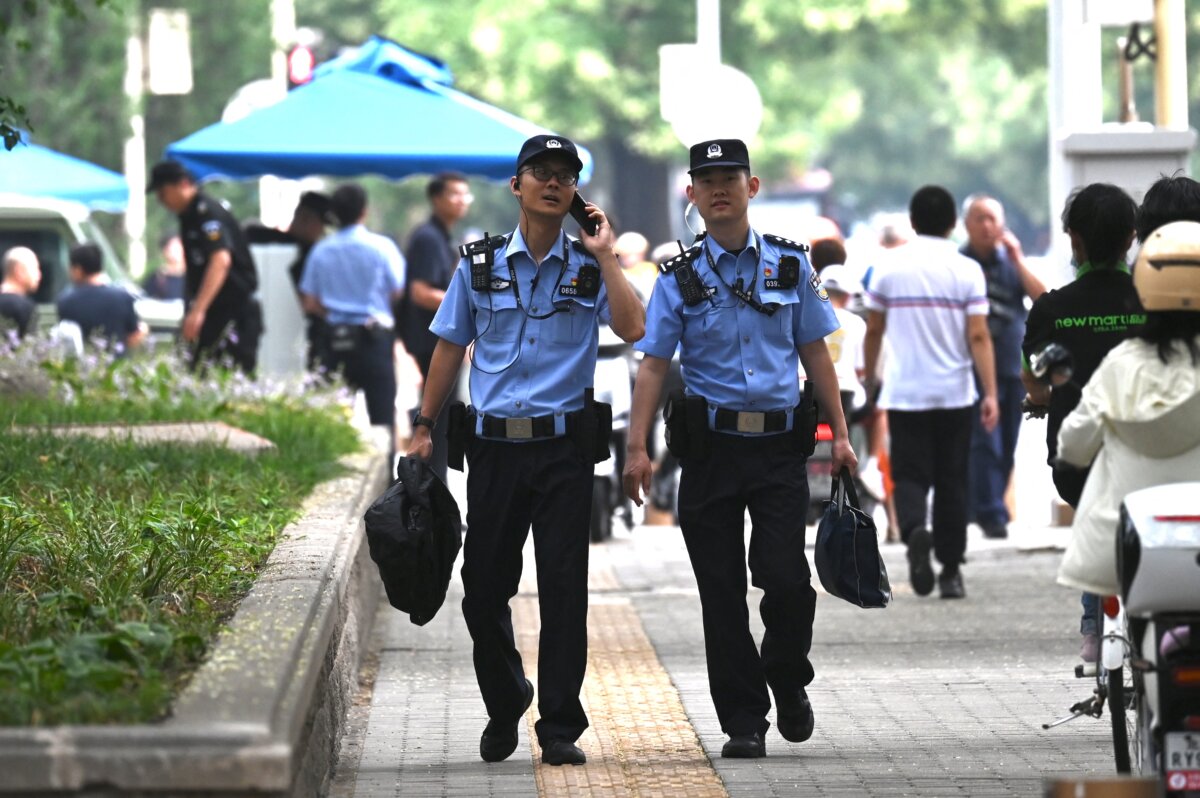

Violent attacks are occurring across China at a scale rarely seen by the public, according to people with knowledge of the country’s internal security system. While only a handful of cases reach official reports, insiders say far more incidents are happening behind the scenes—prompting concern at the highest levels of the Chinese Communist Party (CCP).
One insider said that assaults such as stabbings and vehicle rammings now number in the hundreds each day nationwide, with most cases suppressed before they ever reach public view.
Individuals interviewed by The Epoch Times requested anonymity or provided only their surnames out of fear of reprisal.
The claims point to a widening gap between what is happening on the ground and what authorities allow people to see. They also suggest Beijing’s response is focused on controlling information and tightening surveillance.
Concerns have increased over so-called “revenge against society” attacks—violent acts targeting random members of the public. An insider identified as Wei said these incidents are becoming both more frequent and more widespread.
“According to information internally available, hundreds of knife attacks occur across mainland China every day,” Wei told The Epoch Times. “Among them, dozens of serious random attacks also happen daily, but none of this is ever made public.”
Wei said the surge has alarmed senior officials, particularly within the CCP’s political-legal system, which oversees law enforcement and internal security. In response, the Political and Legal Affairs Commission and the Ministry of Public Security recently issued a joint internal notice ordering nationwide investigations.
Authorities have been told to identify and monitor individuals seen as potential risks, including petitioners, people with unresolved grievances, and those believed to be “harboring resentment” or showing “extreme tendencies,” he said.
At the same time, censorship has been tightened, Wei added. Officials are working to quickly remove videos, eyewitness accounts, and any internal information that could spread online or reach overseas platforms.
Rising Violence and Conflicting Accounts
Several recent incidents highlight the pattern described by insiders—violent attacks followed by limited or conflicting public information.
On April 19, a car drove into a crowd in Shuitou Town, Nan’an City, Fujian Province. Authorities said two people were killed and one injured, and that the driver was taken into custody.
However, purported eyewitness comments on Weibo suggested a higher toll, with some claiming “at least four people” showed no signs of life at the scene.
Videos circulating online appeared to show a white sedan speeding through an intersection before suddenly veering left into oncoming traffic, breaking through a road divider and crashing into several motorcycles.
Another major case occurred on March 29 in Beijing’s Fangshan District, where a driver used a bulldozer to ram into crowds at a busy rural market. Authorities have not publicly acknowledged the incident. However, multiple residents told The Epoch Times that something serious did happen at Dahanji market, a well-known and crowded gathering place.
Deleted witness accounts on Chinese social media described heavy casualties, with some claiming at least seven deaths and others suggesting the toll could be as high as 13, with about a dozen injured. Videos and reports about the incident were quickly removed.
Other attacks have also surfaced in scattered reports.
On March 26, two knife attacks in Shenzhen’s Luohu and Longgang districts left multiple casualties. In one case, a woman reportedly killed two people and injured three others, including a 14-year-old.
On March 31 in Wuhan’s Jiang’an District, a 44-year-old man surnamed Wu attacked pedestrians with a fruit knife, injuring four people, according to police. Witness accounts online claimed the actual casualties were much higher.
On April 4 in Shenyang’s Heping District, online reports described a particularly brutal attack near Taiyuan Street, with claims of six dead and more than 10 injured. The attacker later jumped from a building and died. Authorities have not confirmed those figures.
In many of these cases, the lack of official transparency and the rapid removal of online content have made it difficult to verify the full scale of casualties.
Pressure on Authorities
A retired civil servant in Shenzhen surnamed Pan said the recent cluster of attacks has placed heavy pressure on the CCP’s political-legal system.
“Higher authorities believe local governments failed to effectively carry out their duties and responded too slowly when dealing with social tensions at the grassroots level,” Pan told The Epoch Times. “They bear undeniable responsibility.”
Pan said local authorities are now under orders to prioritize stability, including stricter controls on information. Internal notices, he said, specifically call for preventing sensitive content from spreading abroad.
A Europe-based Chinese scholar surnamed Li said the violence reflects deeper, long-term pressures within Chinese society.
“Under the CCP’s authoritarian system, local officials focus on extracting money and do not respond to basic livelihood problems. This structural imbalance is pushing ordinary people, especially those at the bottom, closer and closer to the edge.” Li told The Epoch Times.
“As a result, acts of personal revenge against society are clearly increasing.”
Li said such patterns have historical precedent, where isolated acts of violence can signal broader unrest.
In his view, the current response—screening individuals, tightening control, and suppressing discussion—does not address the root causes.
“If those root problems continue to be suppressed, tighter control alone will not stop such attacks,” Li said. “These incidents will not stop. They will keep building up and keep happening again.”
Wu Fei contributed to this report.
 Friends Read Free
Copy
Facebook
Tweet
Friends Read Free
Copy
Facebook
Tweet