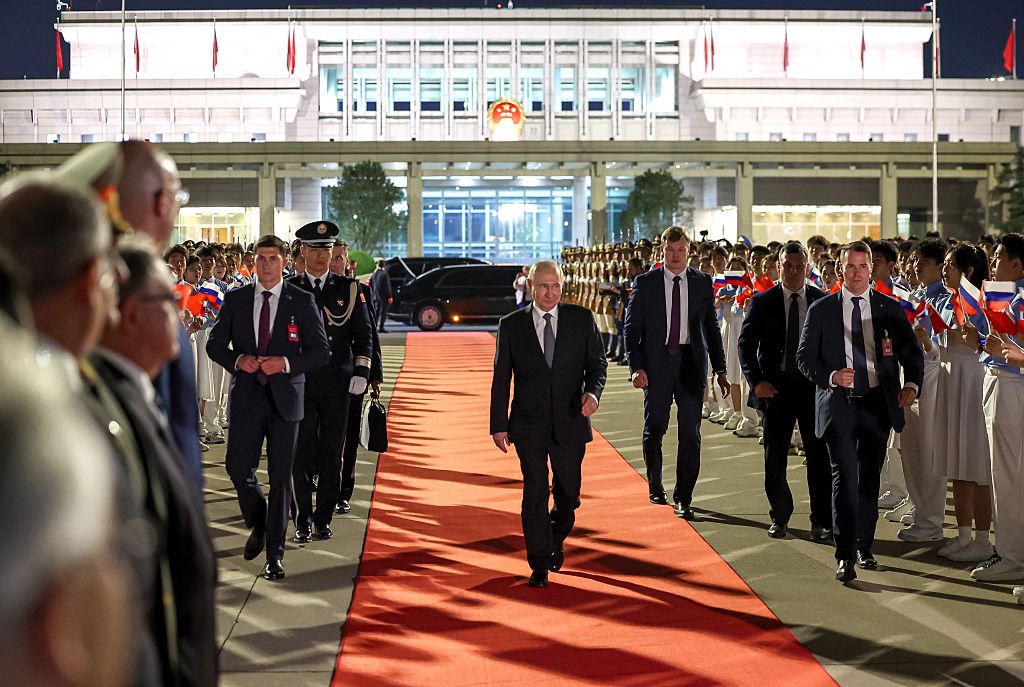

Russian President Vladimir Putin arrived in Beijing on May 19 for a meeting with Chinese leader Xi Jinping only days after U.S. President Donald Trump’s departure, and left the next day without signing an intended major natural gas deal with China.
According to analysts who spoke with The Epoch Times, Putin’s visit signals that Moscow and Beijing each have their own objectives and continue to use each other under U.S. pressure while harboring mutual distrust and discord.
Putin was accompanied by a 39-member delegation covering sectors such as energy, transportation, industry, and nuclear energy.
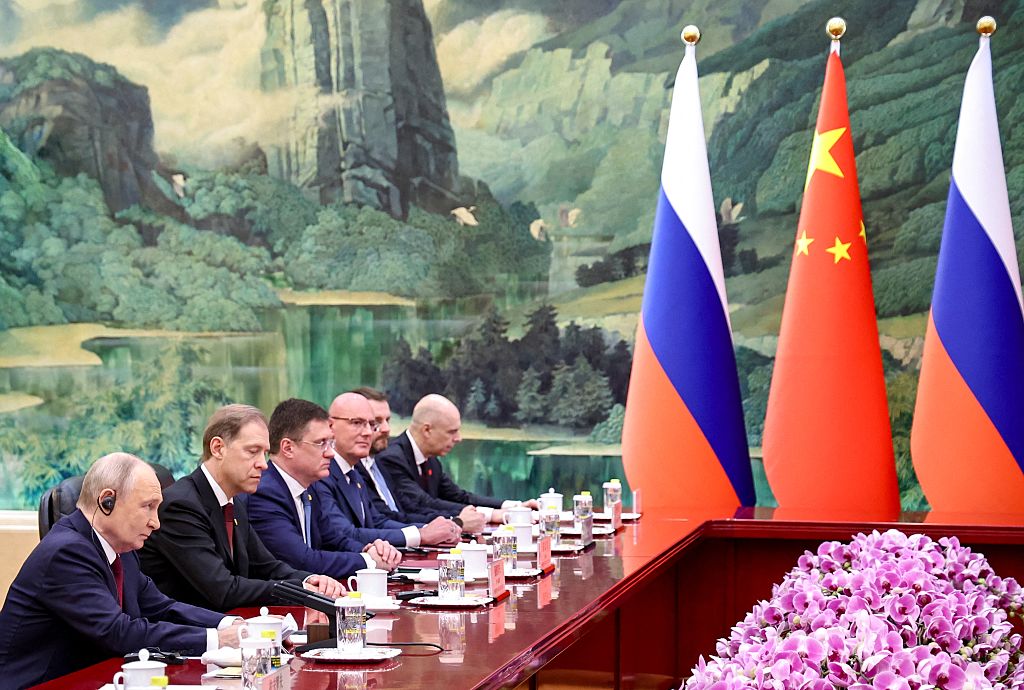
During the talks on May 20, China’s ruling Communist Party (CCP) leader called for “driving the development and revitalization of China and Russia through their comprehensive strategic coordination of even higher quality.” Putin described Russia–China relations as being at “an unprecedented level” and invited Xi Jinping to visit Russia next year, according to Chinese state media Xinhua.
Xi and Putin also announced the extension of the 2001 “Treaty of Good-Neighborliness and Friendly Cooperation between China and Russia,” which observers and many members of the Chinese public have criticized for validating prior land transfers between China and Russia.
Han Liming, an insider within the CCP’s system who used a pseudonym out of fear of reprisal from the Chinese regime, told The Epoch Times the Russian president’s sudden visit to Beijing stems from the fact that “the Russia–Ukraine war has left Putin overwhelmed and beleaguered.” Russia invaded Ukraine in February 2022.
“Recently, Putin has frequently dispatched envoys to Beijing to request assistance,” Han said.
“On this visit, he brought along several deputy prime ministers and a large delegation of business leaders to demonstrate his sincerity regarding further cooperation with China. The stated objective is to purchase Chinese-made goods—such as chips, drones, and missiles—thereby freeing up Russia’s own industrial capacity to focus on the production of military hardware,” he said
Fang Wei, a U.S.-based senior journalist, told The Epoch Times that the prospects of the Russia–Ukraine war appear grim, “even Moscow itself is now vulnerable to large-scale drone attacks by Ukraine. The conflict seems to be shifting course—a development that serves as a harbinger of crisis for Putin.”
“Given that Trump recently visited Beijing, Putin fears that Beijing might ‘sell him out’; consequently, he felt compelled to rush to China in an effort to project an image of extremely close relations between Russia and China,” Fang said.
An insider within the Chinese regime who requested anonymity out of fear of reprisal told The Epoch Times that one of the key objectives of Putin’s visit to Beijing was to obtain firsthand “information” regarding the Trump–Xi summit, specifically concerning the Russia–Ukraine war and the situation in the Middle East. Meanwhile, Moscow is concerned about potential shifts in Beijing’s policies, and also fears that any adjustments in U.S.–China relations could impinge upon Russia’s future strategic maneuvering space.
“Putin is making overtures, but the CCP doesn’t mind using this meeting to create the impression that major global powers are all vying to visit China,” Fang said.
Wang Yuanpeng, a Beijing-based scholar of international relations who used a pseudonym out of fear of reprisal, told The Epoch Times, “Putin is sending a message to the United States: China possesses manufacturing capabilities, while Russia possesses energy resources; by cooperating, the two nations can break through the economic and technological blockade imposed by the United States.”
However, Putin is also concerned that Xi and Trump might grow too close, he said. “Xi Jinping may well seek to reassure Putin, and China and Russia have signed a number of agreements. Yet, judging by past experience, very few of these are likely to be really implemented.”
No Deal on Natural Gas Project
Russia and China signed 20 cooperation documents during Putin’s visit. They did not, however, reach an agreement on the Russia-proposed “Power of Siberia 2” natural gas pipeline project, which is designed to transport up to 50 billion cubic meters of natural gas annually from Russia’s Arctic Yamal fields to China via Mongolia.
Key issues such as natural gas pricing remain unresolved, and negotiations could take several years.
Russia is becoming increasingly dependent on the CCP, as the Russia–Ukraine war drags on, Fang said. “The primary objective behind Putin bringing such a large delegation to Beijing is to establish the ‘Power of Siberia 2’ natural gas pipeline, as Putin is currently in dire need of funds,” he said.
“Furthermore, Russia’s oil exports—whether via the Black Sea or the Baltic Sea—have suffered heavy blows from Ukraine, severely impacting Russia’s national treasury. Consequently, Putin is attempting to divert the natural gas originally destined for Europe to China; the most effective way to achieve this is to construct ‘Power of Siberia 2,’ thereby ensuring the delivery of Siberian natural gas to China,” Fang said.
However, China does not necessarily need large quantities of natural gas from Russia at this moment, nor does it wish to cut off supplies from the Middle East, which is to avoid becoming overly dependent on Russia for energy, according to Fang.
Xi Extends Treaty with Russia
Putin and Xi did agree to extend the “Treaty of Good-Neighborliness and Friendly Cooperation between China and Russia” during their summit.
Signed in 2001 by former CCP leader Jiang Zemin and Putin, the treaty established a long-term strategic partnership between Russia and China. In the treaty, Jiang officially relinquished sovereignty claims over the Russian-occupied Chinese territories ceded by the Manchu ethnicity established Qing Dynasty, giving up at least 1.5 million square kilometers that had belonged to China since the Tang Dynasty to Russia, including Wulianghai, Sakhalin Island, and Vladivostok—an area equivalent to dozens of Taiwans.
U.S.-based current affairs commentator Li Linyi told The Epoch Times that Xi’s extension of the “treasonous” treaty signed between Jiang and Putin demonstrates that he has no intention of holding Jiang accountable for ceding national territory or rectify it, and he also seeks to use this arrangement to keep Putin engaged—leveraging his alliance with the Russian leader to counter the United States.

“The historical relationship between the CCP and Russia is not a chapter of which the CCP feels particularly proud,” Wang said.
“Xi Jinping is well aware that, without the CCP’s support, Russia would struggle to sustain the war against Ukraine over the long term. However, Russia possesses nuclear weapons, oil, and natural gas, while China has the market. The CCP hopes to leverage Russia to counter the United States—a relationship characterized by mutual dependence.”
According to Fang, going forward, one of two scenarios will unfold, “either Russia will abandon the CCP and align itself with the United States, or the CCP will abandon—and effectively sell out—Russia. However, the latter scenario is highly unlikely. Conversely, it is quite plausible that, at some point, Russia—feeling that the CCP is no longer providing it with sufficient benefits—will choose to switch its allegiance to the United States.”
Fang added that “Trump has treated Putin kindly, seeking to pull him away from the CCP. This constitutes the single greatest destabilizing factor in the China–Russia relationship.”
Luo Ya, Hu Ying, and Tang Bing contributed to this report.
 Friends Read Free
Copy
Facebook
Tweet
Friends Read Free
Copy
Facebook
Tweet