December 18, 2023
Frontline Health
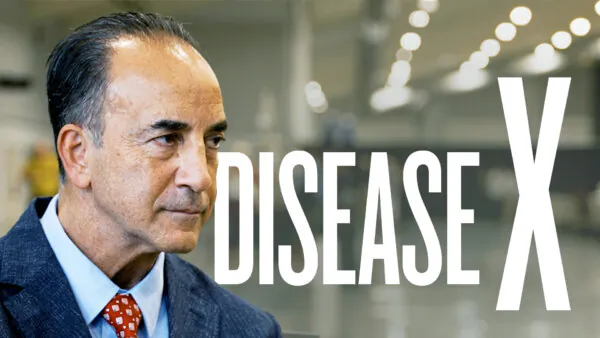
20,000 Drugs vs. 27 Virus Families—How to Counter the Next Pandemic: Dr. Steven Hatfill

Dr. Steven Hatfill, a former adviser to the Trump administration’s trade chief, says a “pretty good plan” is in the works by a “government in waiting” to counter what many experts see as a failed pandemic response. This strategy begins with repurposed drugs.
“There’s roughly about over 1,400 agents that cause human disease,” Dr. Hatfill said on Frontline Health. “Only about I would say 27 viral families have viruses that are … life-threatening.”
“Let’s look at these 20,000 drugs against 27 viral families. That’s something we could start tomorrow.”
In 2020, the Trump administration took steps in this direction by procuring a significant quantity of hydroxychloroquine for early outpatient treatment against the SARS-COV-2 virus.
“We [had] 62 million doses in the national stockpile,” said Dr. Hatfill.
But according to him, that caught the soon to be, Biden-appointed, FDA commissioner by surprise.
“She was head of drug safety and testing … You had to get rid of [hydroxychloroquine] or you couldn’t have Remdesivir and you couldn’t have the vaccines,” said Dr. Hatfill.
Drugs like hydroxychloroquine meant that there was an existing medication available for COVID-19 treatment. Under that scenario, any new drugs developed to treat COVID like Remdesivir or COVID vaccines would be subject to full, vigorous testing, Dr. Hatfill explained.
“And none of these were. Remedisivir … didn’t work. It was killing people,” Dr. Hatfill said.
This is just one example of why Dr. Hatfill says that a top-down government response to infectious disease does not work.
“The hospitals used to be the friends of the community. It’s all changed now because of the money,” he said.
Dr. Hatfill said a better approach starts at the local level and works its way up, and includes a national pandemic training program.
“Something like the Civil Air Patrol or the old civil defense, but pandemic volunteers that are trained up and they have a meeting once a month.”
Dr. Hatfill gave the example of how a community-level response worked in Dharavi, one of the largest slums in the world located in Mumbai, India.
“This was a biological disaster waiting to happen,” Dr. Hatfill said. The reason it didn’t was because, when COVID broke out, India had a team of 2,500 doctors and their assistants sweep into the slum, lock down a few select blocks, and treat the population with hydroxychloroquine, Dr. Hatfill explained.
“The trick for all of this is early drug treatment,” he said.
“As an outpatient, you don’t feel well. You go see your doctor, he gives you an antiviral drug. You stay at home, you don’t kiss the wife or the kids. Four or five days, you’re better and you have permanent immunity, very long-lasting.”
This is especially critical in big cities where a collapse of just one critical infrastructure due to a severe infectious disease outbreak could be disastrous.
“The complexities of our modern cities are so interconnected … There’s about 17 infrastructures. If you lose one of them—it’s like dominos tipping over—the whole thing collapses. So we have to keep the workforce for these large cities safe.”
And when it comes to the health care workforce, Dr. Hatfill gave an example of how back in the 1990s, the United States had a Hospital Preparedness Program that gave health care professionals training on how to respond during a public health emergency. But he says it wasn’t sustained.
“And if you don’t sustain something, it becomes useless, especially when budgets get a little tight. So you make it mandatory for federal aid to the hospitals that you will annually conduct a supervised exercise,” he said.
The other crucial peg is the ancillary staff in a hospital.
“So if the cooks don’t come down, if the cleaners don’t come out, the guy that takes out the trash doesn’t come in, you got a big problem,” said Dr. Hatfill.
“Nurses aides are very important. They have another name now, health assistants, … and train more of them in a hurry. Because we can have a nurse’s aide-aide with just good knowledge of biosafety—how do you handle wet items, blood, exposures, this type of thing. You could do that [training] in a day. And find a volunteer force that [is] willing to do that. And you can handle an amazing number of patients.”
As for individual Americans, Dr. Hatfill says that during an infectious disease outbreak, people need vitamin D and common sense.
“Don’t go into the pubs. If you’re going to eat, [do it] outdoors if you can. The viruses don’t like sunlight. It kills them within like a minute or so,” he said.
As for masks, he stressed that they don’t work because the virus can enter through the eyes.
“You’ve got a thin layer of fluid around [the eye] … Somebody coughed over there 1 to 5 micron particles, and it sticks to your eye within 20 minutes and it’s inside your nose.”
A better strategy is to wash hands and avoid touching your eyes, he said.
Follow Dan on 𝕏: @OnTheFrontline
Views expressed in this video are opinions of the host and guests, and do not necessarily reflect the views of The Epoch Times.
———–
Medical Disclaimer:
Frontline Health (the “Show”), its guests, and contributors provide the latest news on health and medical discoveries, and it is meant for informational purposes only. The Show does not provide medical advice, diagnosis, treatment, cures, mitigation, or prevention for any type of disease or medical condition. Similarly, it is not intended for self-diagnosis or self-treatment of any health-related condition.
The information on the Show is gathered from reputable sources; however, neither Frontline Health nor The Epoch Times Association Inc. are responsible for errors or omissions in reporting or explanation, and will not be liable for any direct, indirect, consequential, special, exemplary, or other damages arising therefrom.
Patients should always consult with a doctor or other health care professional for medical advice or information about diagnosis and treatment.
Views expressed in this article are the opinions of the author and do not necessarily reflect the views of The Epoch Times. Epoch Health welcomes professional discussion and friendly debate. To submit an opinion piece, please follow these guidelines and submit through our form here.
Read More
Popular









Related Videos


Frontline Health



Frontline Health


Frontline Health



Frontline Health

Frontline Health

Frontline Health

Frontline Health