
Commentary
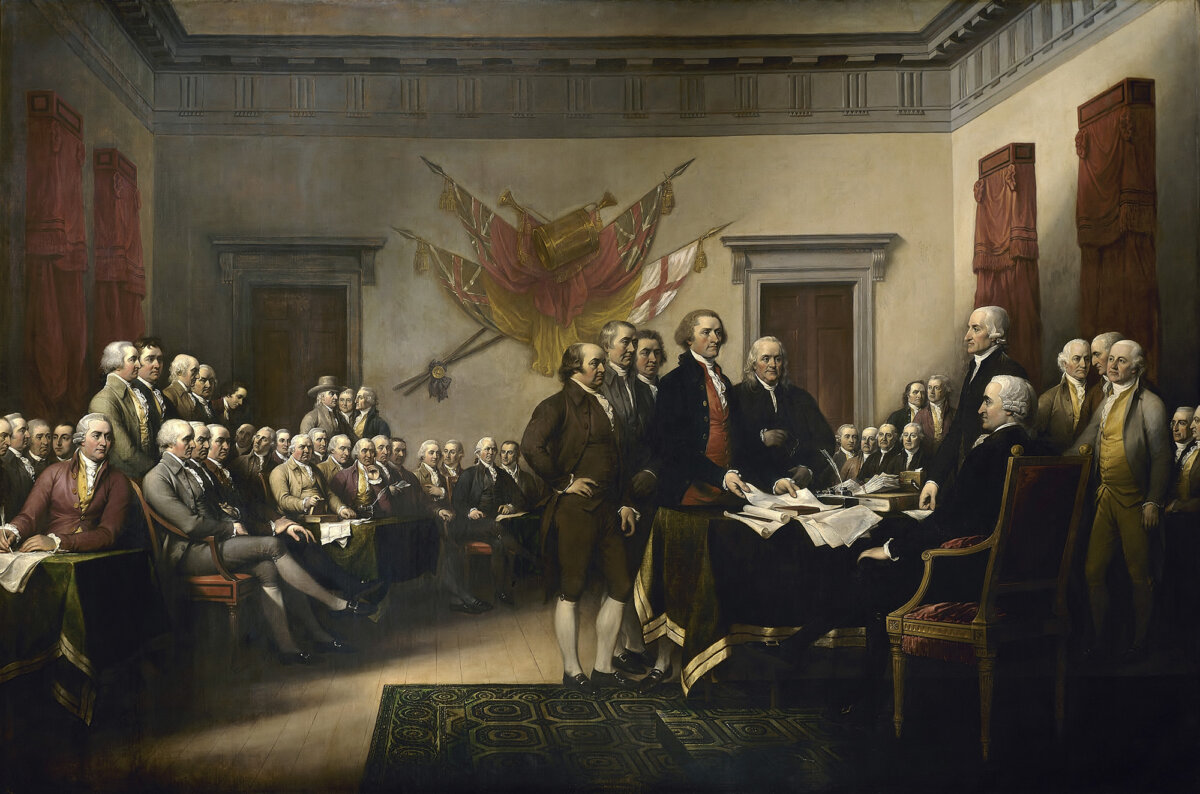
As the United States marks its 250th anniversary, the semiquincentennial, 1776 stands as the undisputed year of our nation’s birth. Yet 1776 was more than the year when America wrested independence from England; it was the year when the intellectual foundations of the First Amendment were first instantiated in the revolutionary state documents of Virginia and Pennsylvania.
As the colonies declared their independence, they simultaneously drafted new state constitutions to replace royal charters and dictates. In a time when governments viewed speech and religion as privileges granted or withheld by rulers, Virginia and Pennsylvania affirmed the spirit of the Declaration of Independence by declaring such rights to be natural, God-given, and inalienable.
Virginia led the way. On June 12, 1776, the Fifth Virginia Revolutionary Convention unanimously adopted the Virginia Declaration of Rights. Largely drafted by George Mason with crucial input from James Madison on religious liberty, this was the first comprehensive bill of rights attached to a state constitution in the new nation.
Section XII boldly declared: “That the freedom of the press is one of the greatest bulwarks of liberty and can never be restrained but by despotic governments.” Section XVI addressed religious freedom: “That religion, or the duty which we owe to our Creator and the manner of discharging it, can be directed by reason and conviction, not by force or violence; and therefore, all men are equally entitled to the free exercise of religion, according to the dictates of conscience; and that it is the mutual duty of all to practice Christian forbearance, love, and charity towards each other.”
Virginia’s vision proclaimed that individual beliefs and reason, not government edict, must guide actions. Pennsylvania further contributed to that vision. On Sept. 28, 1776, the Pennsylvania constitutional convention ratified a new state constitution with an even more explicit declaration of rights, with its Section II proclaiming: “That all men have a natural and unalienable right to worship Almighty God according to the dictates of their own consciences and understanding. … And that no authority can or ought to be vested in, or assumed by any power whatever, that shall in any case interfere with, or in any manner control, the right of conscience in the free exercise of religious worship.”
Section XII made free speech universal for citizens, stating: “That the people have a right to freedom of speech, and of writing, and publishing their sentiments; therefore, the freedom of the press ought not to be restrained.” This properly established freedom of the press as being predicated on the average citizen’s right to free speech.
Pennsylvania’s language challenged the governmental norms of the day, but it did not merely tolerate dissent; it affirmed the people’s affirmative right to speak, write, and publish as inherent God-given rights that exist with or without government concurrence. Influenced by men such as Benjamin Franklin, these provisions positioned Pennsylvania at the forefront of enlightened thought on the relationship between God, the individual, and the government. Together with Virginia, the states showed that they would not wait for a centralized national government to define freedom.
The men of these states supplied the intellectual and textual basis for the federal Bill of Rights. Indeed, when the Constitution was drafted in 1787 without explicit protections for individual liberties, Anti-Federalists warned of the dangers of centralized power. Madison, initially skeptical about enshrining individual rights, drew directly from Virginia and Pennsylvania to draft the Bill of Rights, ratified in 1791. This gave us the First Amendment: “Congress shall make no law respecting an establishment of religion, or prohibiting the free exercise thereof; or abridging the freedom of speech, or of the press; or the right of the people peaceably to assemble, and to petition the Government for a redress of grievances.”
What makes the First Amendment the foundation for the greatest governing document ever is its role as a barrier against opportunistic tyranny. It prevents those in power from decreeing what speech is “harmful” or “hateful” as a pretext to advance their ideology or consolidate control. History is replete with rulers who labeled criticism seditious or unpopular ideas dangerous. Sadly, we see the consequence of not having a First Amendment today in the UK, where those in power have been using opportunistic definitions of “harmful” and “hateful” speech to silence dissent.
Today, without First Amendment-type protections of free speech, the UK Parliament and police have criminalized and selectively prosecuted tweets, memes, jokes, and even silent prayer near abortion clinics under laws such as the Online Safety Act—an act that would never pass constitutional muster in our country. It enables the tyranny the American Founders foresaw, rejected, and designed a system to prevent.
In practice, America’s First Amendment has meant that abolitionists, suffragists, civil rights marchers, and countless others could challenge the status quo, knowing that the Constitution was on their side. It has allowed the marketplace of ideas, which is wonderful, messy, and sometimes even repulsive, but when it comes to protecting freedom, there is no better alternative.
In 2026, 1776 deserves to be doubly celebrated. It was not only the year we declared independence, but it was also the year we began codifying the liberties that would make that independence enduring. The people of Virginia and Pennsylvania enshrined speech and individual religious beliefs as constitutional imperatives from the outset. Their vision was instantiated in the First Amendment, ensuring that no future government could opportunistically weaponize labels such as “harmful” or “hateful” to entrench power. In an age when free speech is continuously under attack, this remains America’s most important gift to humanity—a governing framework that protects the rights of citizens to speak, argue, and worship freely.
That is why our founding documents remain the gold standard. With rights endowed by the Creator, our Founders did not merely launch a nation; they secured the intellectual architecture of liberty itself. As we honor our country’s semiquincentennial, let us reaffirm these principles—not as relics of the past, but as the living guarantees of our future as a people who will remain free of a dystopian government-dominated future.
Views expressed in this article are the opinions of the author and do not necessarily reflect the views of The Epoch Times.
 Friends Read Free
Copy
Facebook
Tweet
Friends Read Free
Copy
Facebook
Tweet