
Commentary
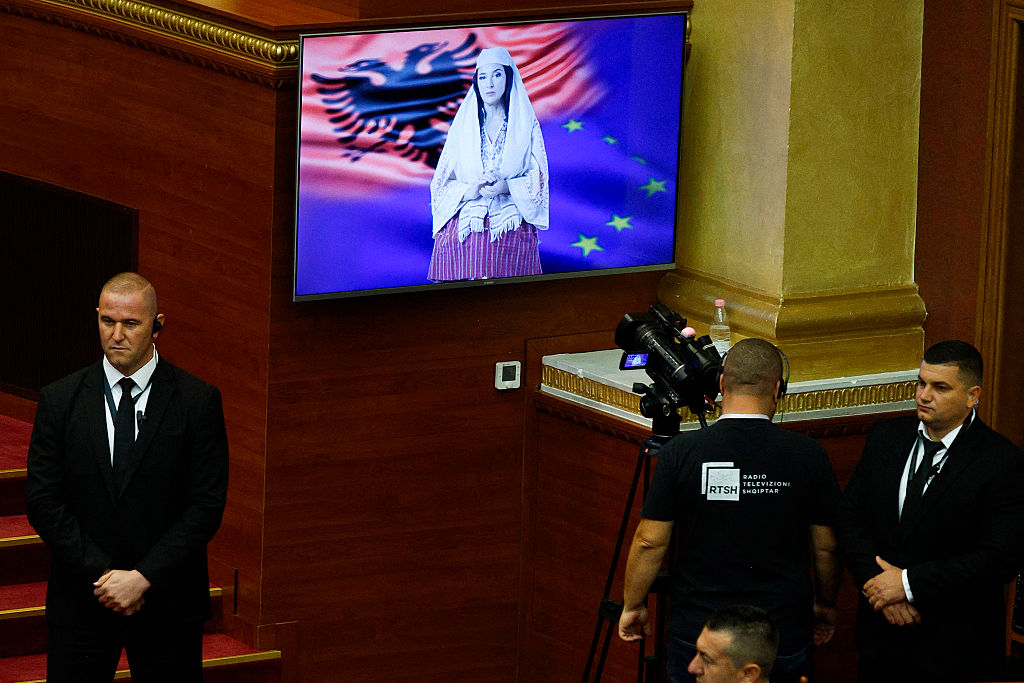
This is not a joke. Albania just appointed the world’s first government minister fully generated by artificial intelligence (AI). Her name is Diella, which is Albanian for sun, and she has been officially appointed as minister of state for AI with the task of overseeing public procurement, one of the country’s most corruption-plagued systems.
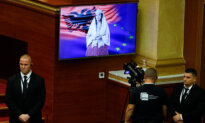
Diella is a digital avatar designed to interface between the public and the algorithms beneath her virtual skin. She appears wearing modest, traditional Albanian clothing and a headscarf. She moves her hands in natural-looking, human-like gestures. She speaks with a steady, reassuring tone in perfect Albanian. Sometimes her left eye doesn’t quite blink at the same time as her right eye—that’s the kind of glitch that is typical in AI-generated videos—but otherwise, she looks and sounds like a pleasant, middle-aged woman on a screen.
Diella addressed the Parliament of Albania for the first time in her ministerial role on Sept. 18 with a three-minute speech prepared to counter expected critics.
“The constitution speaks of institutions at the people’s service,” the avatar said. “It doesn’t speak of chromosomes, of flesh or blood. It speaks of duties, accountability, transparency, non-discriminatory service.
“I assure you that I embody such values as strictly as every human colleague, maybe even more. I am not here to replace people, but to help them.”
The chamber erupted in fury. Opposition members of parliament banged on their desks, shouted over her voice, and accused the government of staging a coup against the constitution.
The uproar grew so fierce, with members throwing papers, that the session was suspended. This was not Diella’s first appearance. Before her sudden promotion to minister, Diella had already been introduced quietly on the Albanian government’s website as a digital assistant, guiding citizens through information about public services. In hindsight, that early placement looks less like a novelty and more like a pilot program. The government was likely testing how the public would respond to her persona, which must have worked well enough because now, with hardly a pause, she has been promoted from website guide to Cabinet minister.
Albanian Prime Minister Edi Rama has staunchly defended Diella as an essential tool for innovation and transparency that will combat corruption. He has proclaimed that public tenders will now be “100 percent free of corruption” because Diella will oversee them.
“Diella never sleeps, she doesn’t need to be paid, she has no personal interests,” he said. “She has no cousins, because cousins are a big issue in Albania.”
Rama also told parliament that the European Union’s requirements for accession are so demanding that humans alone cannot meet them, and that Diella will play a vital role in the country’s goal of entering the EU by 2030. Although critics of Diella argue that such an avatar could potentially hide corruption in public finance, the opposition could not explain how that might actually work in practice. And now that a digital avatar for an AI system is the minister of state for artificial intelligence, it raises so many questions, such as: Which humans have enough knowledge and technical skills in AI to oversee the minister tasked with overseeing AI?
This is a world first. Some media outlets have called it a publicity stunt, while governments and other institutions are quietly observing the bold experiment to see how lawmakers and government contractors interact with an AI system with a human mask. AI systems are becoming ever more complex, so much so that even many of the best coders can no longer understand code generated by AI systems and instead need AI systems to interpret AI data into human language.
The avatar of Diella is one such system. This makes it easier and more comfortable to interact with an enormous AI data system calculating billions of data points for the nation’s 3 million citizens, but it is also a constant reminder that what is being interacted with is not actually a human. It is a shell for an AI interpreter translating AI data into human speech.
While this is very new territory, recent studies in psychology may shed some light on where this experiment may lead. A recent psychology study published in Nature found that people delegating choices to AI were more likely to behave dishonestly. In 13 experiments with more than 8,000 participants, researchers tested dice games, tax declarations, and financial tasks. Participants cheated far more often when a machine mediated the decision because they felt that the moral responsibility was shifted onto the system. When people let a machine act in their stead, they feel less responsible for the outcome. They shift the blame onto the system. And when AI is dressed in a mask that looks human, the moral distance only grows. It becomes easier to trust the mask and easier to excuse whatever happens behind it.
There is a striking paradox here. Public trust in AI globally is eroding, but governments and corporations are expanding its use at an accelerating pace. According to the 2024 Edelman Trust Barometer, global trust in AI companies fell from 61 percent in 2019 to 53 percent in 2024. In the United States, the decline has been even sharper: from 50 percent to just 35 percent. The gap between the promise of neutrality and the reality of hidden agendas corrodes public confidence. The paradox, or perhaps the irony, is that the more that people distrust AI, the more it is imposed on them.
Diella may be the first human mask on a government appointee, but she likely won’t be the last. India is preparing to train AI judges to carry out routine verdicts and move through a backlog of millions of cases, but apparently they won’t be donning robes or human faces. Efficiency, incorruptibility, and optimization are always the promises with AI systems, but the operations carried out in code are so alien to human language and culture that there will surely be more temptations to put human masks on AI systems to make them more palatable and understandable.
And as we delegate more knowledge, trust, responsibility, and decision-making to these non-human systems, there is an ever-growing list of questions about the future that humans don’t yet have answers to. I pray that we humans don’t delegate these questions to AI to answer. They are far too important.
Views expressed in this article are the opinions of the author and do not necessarily reflect the views of The Epoch Times.
 Friends Read Free
Copy
Facebook
Tweet
Friends Read Free
Copy
Facebook
Tweet