Commentary
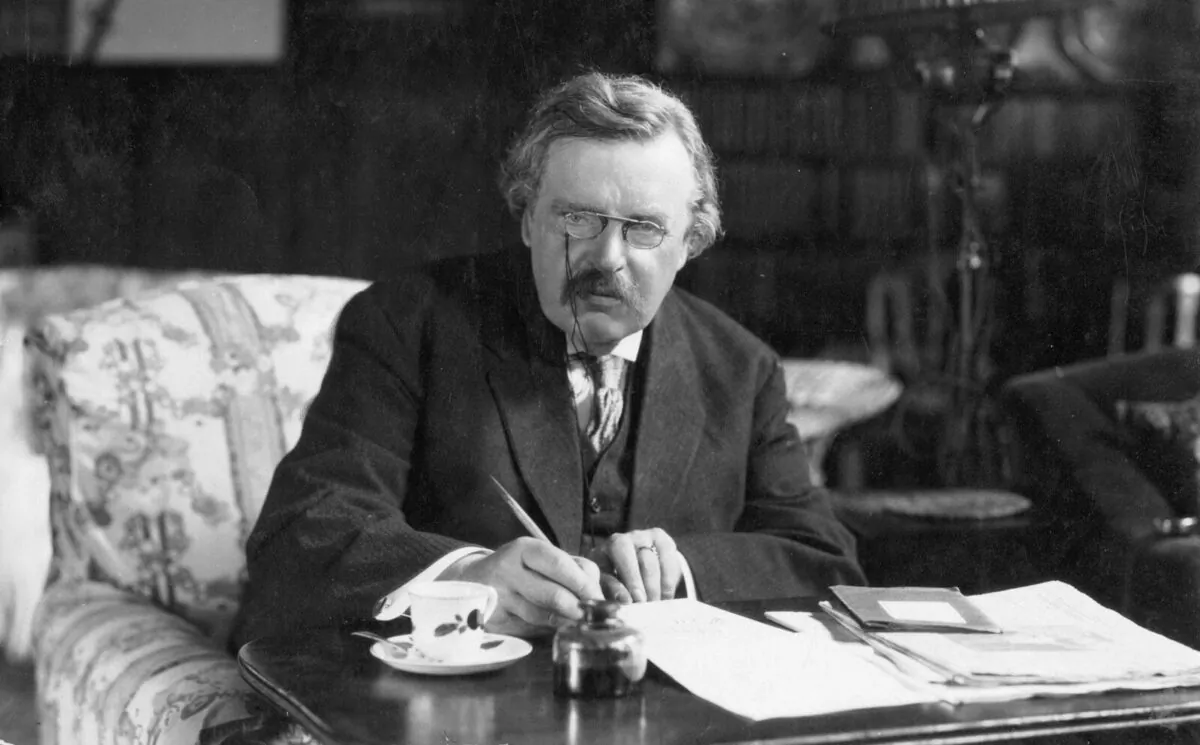
Early in 2025, for a mere $2.60, I added the complete works of legendary English author, poet, philosopher, and Christian apologist G.K. Chesterton to my Kindle Reader. These days, folks know Chesterton best for his crime-solving priest-detective character “Father Brown.”
Born in 1874, Chesterton lived through the disorienting effects of industrialization, the rise of totalitarian ideologies, the decline of religious belief, and the devastation of World War I. He wrote at a time when progress was presumed to be inevitable and tradition was often dismissed as an obstacle to human achievement.
Some 90 years after Chesterton’s death, we are still searching for a better way forward. Never before have we possessed such technological sophistication and material abundance, yet never before have we been so confused about first principles. Things once thought settled about freedom, family, nationhood, truth, and human kindness are more fiercely contested than ever.
What can we learn from a man who wrote more than a century ago? First of all, Chesterton was a staunch proponent of common sense—of the idea that individuals, families, and societies do best when they are rooted in moral realism and inherited wisdom. His relevance lies not in policymaking but in his assertion that civilization depends on limits, humility, and gratitude for what has been handed down.
Chesterton would have immediately recognized some of our worst modern failings. Among them is a lack of good judgment. Modern life is increasingly influenced by abstract theories that ignore lived experience. Chesterton famously observed that “the madman is not the man who has lost his reason, but the man who has lost everything except his reason.”
Today’s ideological activists exhibit precisely this pathology: a rigid internal logic disconnected from reality. Whether in criminal justice, education, or social policy, theories are defended even as evidence of their failure accumulates. Chesterton would not be surprised. He understood that when reason is cut loose from well-informed intuition, it ceases to be a guide and becomes a tyrant.
This paradox is related to a fashionable disdain for tradition itself. What today’s cultural elites call “progress” often amounts to little more than demolition. Statues are toppled, institutions delegitimized, and inherited norms treated as presumptively oppressive.
Chesterton’s view was simple. Tradition, he wrote, is “the democracy of the dead,” a way of allowing those who came before us to have a vote. In his opinion, the modern impulse to silence the past in the name of liberation is profoundly undemocratic—granting absolute authority to the small minority that is currently alive and in power.
Another issue introduced by Chesterton is the relentless centralization of authority. He distrusted large impersonal systems that reduced human beings to units to be managed. Long before the modern administrative state reached its current scale, he warned that remote bureaucracies would erode responsibility, initiative, and freedom. Today, as decisions affecting families, schools, and communities are increasingly made by distant organizations staffed by unaccountable experts, Chesterton’s defence of local life seems prophetic. He believed that liberty survives best when power is dispersed and rooted close to home.
Chesterton’s suspicion of growing technocracy also underscores his enduring relevance. Contemporary elites treat moral and political questions as purely technical problems to be solved by specialists. For example, during the COVID pandemic, dissent from official expertise was vigorously suppressed. Chesterton would have recognized this behaviour. “Experts,” he once quipped, “explain things that are obvious and know nothing about things that are mysterious.” His deeper point was that human beings are not machines, and societies cannot be engineered without regard for moral consequence. When policy becomes insulated from popular scrutiny, it becomes brittle—and ultimately cruel.
Our present moral confusion is well illustrated by the modern perception of freedom. Today, freedom is often regarded as the absence of restraint, especially moral restraint. Chesterton insisted that liberty exists for something, not from everything. “Men do not differ much about what things they will call evils,” he wrote, “but they differ enormously about what evils they will call excusable.” A culture that celebrates autonomy while rejecting accountability cannot sustain itself. The result is not liberation but loneliness, division, and disorder.
This crisis of modern freedom is closely connected to the weakening of the family. Chesterton regarded the family as the fundamental unit of society and a vital barrier against tyranny. Far from being a site of oppression, he viewed the family as a school of obligation, love, and independence. Today, public policy and cultural narratives treat family formation as optional, burdensome, or even suspect. Chesterton understood that societies that undermine the family inevitably increase dependence on the state. “The home is the only place of liberty,” he wrote, because it teaches loyalty without coercion.
Chesterton also offered insight into present-day debates over national identity. In much of the progressive West, patriotism is now viewed with suspicion, and national history is filtered through a lens of guilt. Chesterton rejected both chauvinism and self-loathing. He believed that love of country, properly understood, is an extension of gratitude rather than a claim of superiority. A nation, he argued, is a moral community, not merely an economic arrangement. When shared stories and civic loyalty disappear, social cohesion soon dissolves.
The exile of religion from the public square is another development Chesterton would find troubling. He warned that “when people stop believing in God, they don’t believe in nothing; they believe in anything.” In present-day “woke” moralism, one can see a secularized theology complete with doctrines, heresies, rituals of confession, and excommunication. What is missing is mercy. Chesterton believed Christianity tempered power by reminding leaders that they, too, are flawed. Without that humility, moral certainty hardens into callousness.
Uniting all of these concerns was the English philosopher’s profound understanding of human nature. He rejected the modern fantasy that human beings can be perfected through social engineering. Progress, for him, meant moral improvement within the bounds of human limitations. The great danger of modern ideologies—whether socialist or technocratic—is that they promise heaven on earth and deliver something closer to hell.
As we begin a year of reflection on the principles articulated in the American Declaration of Independence—principles grounded in natural law, human dignity, and moral restraint—it is worth remembering that these ideas did not arise in a vacuum. They were the product of an English-speaking civilization that understood both the greatness and the frailty of man.
Chesterton stood firmly behind the notion that common sense is not an obstacle, but a virtue. In an era intoxicated with novelty and moral arrogance, his blend of humility, wit, and wisdom is not only refreshing—but indispensable.
Views expressed in this article are the opinions of the author and do not necessarily reflect the views of The Epoch Times.
 Friends Read Free
Copy
Facebook
Tweet
Friends Read Free
Copy
Facebook
Tweet