
Commentary
Following Sept. 11, 2001, the U.S. Coast Guard (USCG) shifted from the Department of Transportation into the newly formed Department of Homeland Security (DHS) in order to bolster national security in the coastal areas, ports, and inland waterways. Its 11 statutory missions remained the same, but greater collaboration kicked in with the armed forces housed at the Pentagon. The DHS is a sprawling entity with several agencies all competing for adequate yearly funding.
In a number of venues in 2025, including the USCG Academy’s graduating class of newly minted ensigns, DHS Secretary Kristi Noem delivered remarks regarding a highly ambitious Force Design 2028 for the USCG. It’s common knowledge that the USCG is more often than not stretched to the limit in meeting its critical missions.
Former USCG Commandant Adm. Paul Zukunft noted that the Coast Guard punches far above its weight class yet is funded at the flyweight level. Several prior commandants, as well as current Commandant Adm. Kevin E. Lunday, have echoed that sentiment, but not much has been done to rectify the “doing more with less” mentality. Noem delineated a plan to change this ongoing challenge with Force Design 2028.
“The Coast Guard must not simply evolve,” Noem said. “It must revolutionize how it functions and operates to ensure decisive advantage over adversaries. This requires fundamental change. Force Design 2028 is the bold blueprint needed to drive urgent action and win.”
The way forward would include increases in funding ($25 billion for fiscal year 2026), which would ramp up active personnel numbers.
Noem’s objective to add 15,000 USCG service members could be difficult in light of the fact that active personnel figures have hovered near 40,000 for decades. However, 120 percent of recruiting goals were met in 2025, which is a morale boost. On the other hand, nearly doubling the yearly USCG budget could be a tall order because of budget constraints within DHS. However, Congress and the USCG could advocate for additional funding in an era of increasing challenges at sea.
Despite growing threats from drug cartels and foreign adversaries, underfunding is still a recurring reality. Similar to other federal agencies, the Coast Guard endures the roller coaster of government shutdowns and shifting budget allocations. During my tour, I witnessed the yearly reduction-in-force notices that were distributed, and even officers weren’t exempt from these notices.
A large portion of DHS’s annual funding in the years ahead will be directed toward border security and deportation operations. However, increased USCG funding could improve Coast Guard capabilities with additional cutters and icebreakers. This growth is necessary because at any given time, one-third of cutters are deployed, one-third are returning from patrols, and one-third are undergoing scheduled maintenance or repair. Consequently, drone systems, autonomous vehicles, and human–machine teaming can expand the USCG’s reach.
On a positive note, a recapitalization project in recent years has produced more than 60 fast response cutters on budget and on time, while several national security cutters have also been launched. At a much slower pace, additional offshore patrol cutters are in the works, along with a trilateral deal for 11 Arctic icebreakers in partnership with Canada and Finland, called the Icebreaker Collaboration Effort Pact.
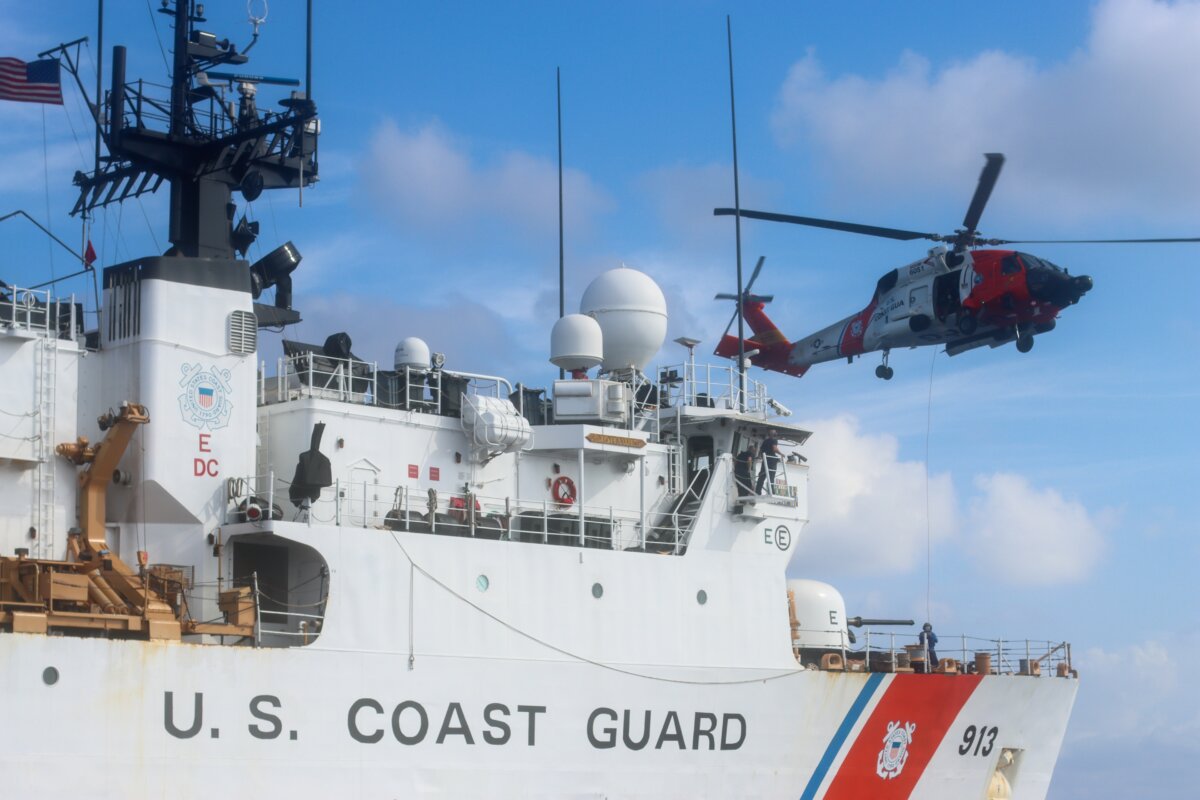
Canada, with its 21 icebreakers, can assist the USCG in monitoring both Chinese and Russian activities in the polar regions. Furthermore, aircraft upgrades have been implemented with modern helicopters that play a vital role in arms/drugs/human trafficking interdictions and search and rescue operations. Newer ships are equipped with more advanced communication and navigation systems (Starlink and GPS). Advanced 4CISR (command, control, communication, cyber, intelligence, surveillance, and reconnaissance) capabilities can serve for decades. However, proven navigation backups such as celestial, depth sounding, radar, and sonar navigation systems must be kept.
Part of Force Design 2028 is creating a nimbler acquisition and contracts process for Coast Guard platforms. This streamlining can reduce construction delays and cost overruns and modernize the logistics process. Partnering with efficient U.S. shipbuilders could expedite the process from design to delivery.
Furthermore, Force Design 2028 requires continuous academic and physical training for enlisted and officer personnel, as well as the reserve component. This mandate should improve the fitness, leadership skills, problem-solving, and situational awareness of USCG members to carry out the ever-expanding duties required in operations. Promotions must be based on competence and experience. These improvements could also strengthen collaboration with the Navy, the Marines, and global partner sea services in executing critical missions and seamless training scenarios.
Even if it is partially implemented, Force Design 2028 could be the answer to what the USCG has requested for decades. It attempts to bridge the gap between high expectations and realism in proactively defending the homeland. If the USCG is transformed into a more agile and deterrent force, it could better carry out its statutory missions in a challenging 21st-century environment.
Views expressed in this article are the opinions of the author and do not necessarily reflect the views of The Epoch Times.
 Friends Read Free
Copy
Facebook
Tweet
Friends Read Free
Copy
Facebook
Tweet