
Commentary
Sweeping revisions to national defense mobilization and exit ban laws and regulations in China are effectively preparing for the expropriation of civilian property, data, and persons to execute major military operations.
The new expropriation language applies to foreigners as much as to Chinese citizens and adds to capital controls that restrict financial flows from China. The new legal language and regulations further shut the doors to the world for Chinese citizens and, paradoxically, increase pressure for capital flight and brain drain from the country through any remaining openings.
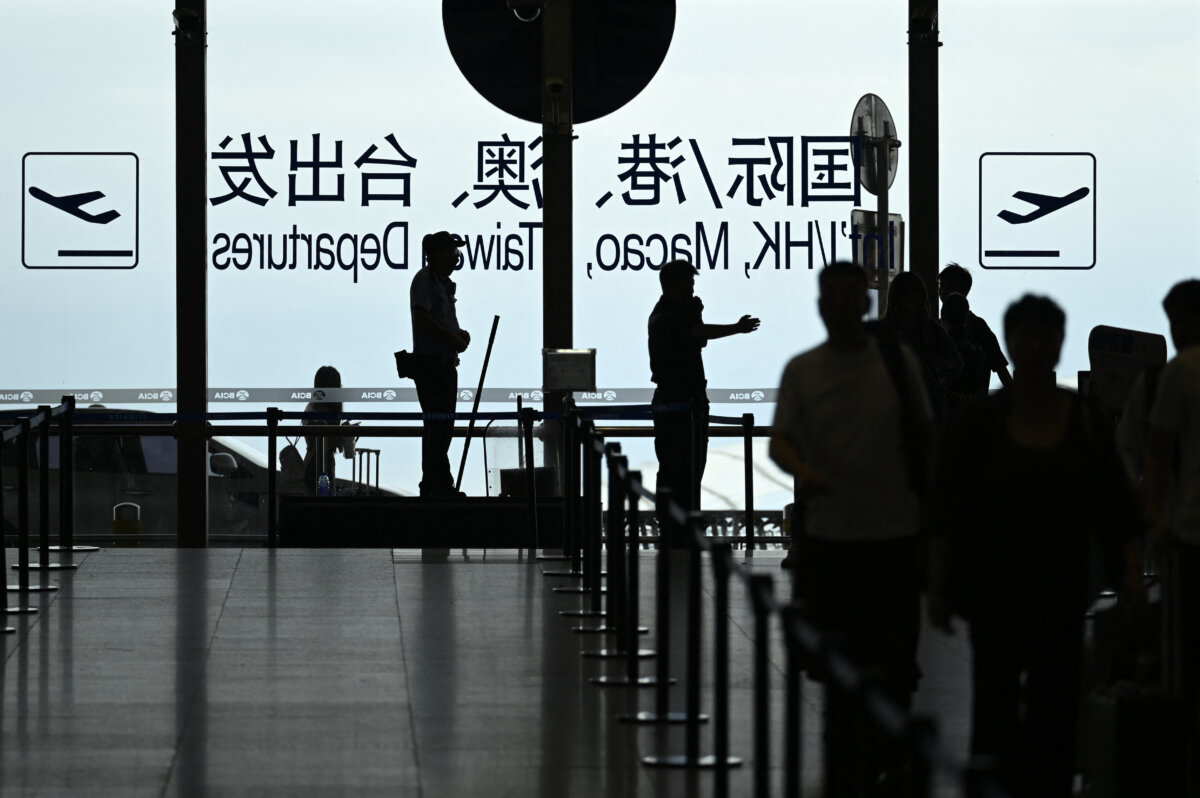
The exit ban regulations, which take effect on Sept. 15, formalize and expand an already existing regime practice of secret exit bans for national security reasons. Such exit bans have been imposed on Chinese citizens and foreign nationals in the past, including prominent business leaders, managers, and minority ethnicities such as the Uyghurs.
The regulations could also apply to individuals, for example, artificial-intelligence innovators, whose emigration would cause a major loss to the regime. Exit bans—or far worse—can be imposed on returning Chinese citizens who engage in so-called criminal activities while abroad, including support for Taiwan or Hong Kong independence.
A sweeping revision of the 2010 national defense mobilization law takes effect on Oct. 1. It allows for the “expropriation” of nearly any civilian property, including power plants, water facilities, financial infrastructure, factories, information networks, data, and transport means, by the regime “at or above the county level” for the planning and rapid execution of “national defense mobilization.”
The addition of the term “expropriation”—where “requisition” already existed in the law—implies permanent confiscation rather than temporary requisition. While the law does promise compensation, the Chinese Communist Party (CCP) engages in selective enforcement.
It should not be trusted to provide fair compensation in times of war, especially if the expropriated are citizens of the United States or allied countries. In case of war, the regime could confiscate U.S. and allied assets in China for use against the United States, suggesting that Washington and allies should strengthen legislation against investment in China.
China’s “development interests” provide a new legal justification for a national defense mobilization that would trigger expropriations and conscription. U.S. sanctions, tariffs, export controls, and other economic measures to counter the CCP could, therefore, be interpreted by the regime as a justification for war.
The national defense revisions allow for the broad conscription of Chinese citizens, including children and the aged, in cases of special expertise. This could affect teens who have cyber expertise.
The broad nature of the law, which affects even the aged and children, suggests that Chinese citizens who oppose the CCP—and have the means and inclination to permanently emigrate to a democracy—should do so while they still can.
The regime’s strengthening of its legal infrastructure for national defense mobilization is likely in preparation for potential wars in the context of superpower and territorial tensions with the United States, Taiwan, Japan, India, and the Philippines.
The revised laws and regulations send a signal to other countries that could prompt democracies to increase their own war preparations, creating a self-fulfilling spiral of hostility. Beijing’s preparations for war leave the democracies little choice.
One commentator in India noted that India has similar rules and regulations.
“However, China’s revision of [its] National Defense Mobilization Law, involving its citizens at every stage and imparting training on a regular basis, changes the overall scenario to a different level,” the commentator said.
As indicated by the new legal language, any future war with China could be a total war, have an extensive cyber-war theater of operations, and entail mass mobilization of the citizens of China and their property.
While the regime has attempted to depict critics of the changes as having “something to hide” and the changes themselves as “routine” updates to old laws equivalent to those in democracies, this is a false equivalence. The CCP runs a totalitarian regime with aggressive military plans against democratic U.S. allies and partners, such as Taiwan, Japan, and the Philippines.
Democracies are proven to rarely go to war against each other. They are more peaceful than dictatorships and treat their citizens better. The revised law in China, which plans near-universal national defense service and the expropriation of civilian property for war, is yet more evidence supporting this conclusion.
The democracies must take the CCP more seriously than they currently do. The CCP is not above preparing for and initiating a total war that mobilizes its entire society, causing mass destruction of Chinese people and property and the deaths of millions of people on both sides of a conflict.
To do so, it plans to expropriate property in China, including property held by U.S. entities. This is part and parcel of its ill-conceived pursuit of territorial expansion in Asia, as well as military, political, and economic hegemony on a global level. The CCP is quite simply willing to sacrifice China, if necessary, to win the next major war—or lose big trying.
The United States should wake up and no longer enable the CCP through its financial investments, trade, scientific advances, or technological achievements. Chinese citizens should do the same. If they truly believe in democracy, they should vote with their feet and leave China.
Views expressed in this article are the opinions of the author and do not necessarily reflect the views of The Epoch Times.
 Friends Read Free
Copy
Facebook
Tweet