Commentary
Because of President Trump’s technique of opening almost any negotiation with outrageous threats and claims and then slowly retreating as the other side makes concessions, his entire presidency can easily be presented as fundamentally disruptive. In fact, there is ample evidence that he is negotiating towards adjusted American relationships with the world in a way that more closely reflects both the U.S. national interest and the end of a bipolarized global power structure, along with the emergence since the end of the Cold War of a great many countries exercising more freedom of action and a greater level of economic development than they previously enjoyed.
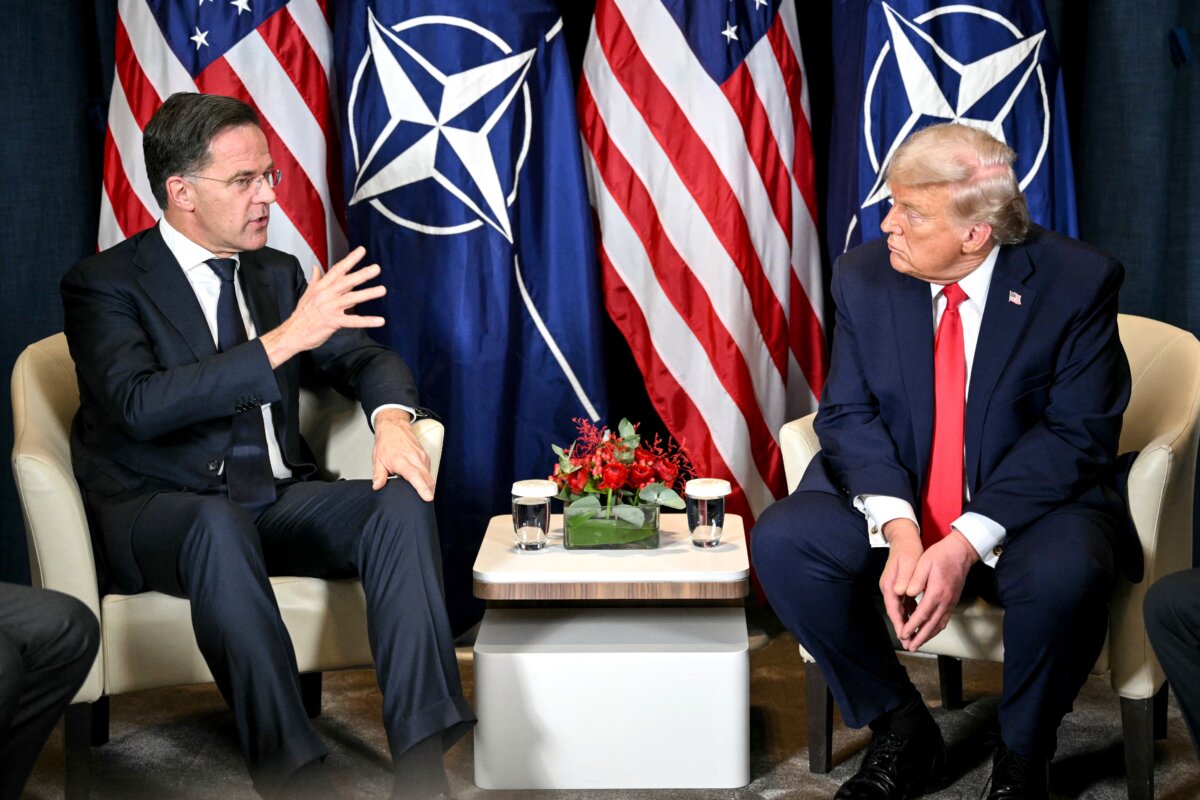
Trump considers NATO, as it has evolved, to be obsolete. When he first entered office in 2017, only the United Kingdom, Poland, and Estonia were, apart from the United States, paying the 2 percent of GDP that all NATO members had pledged to do but almost all had failed to achieve. In the last year, all of the slackers, including Canada, pledged to move their defense budgets to 5 percent of GDP over a short period (though defense spending will include an expanded range of items that might not obviously have much to do with defense). This is dramatic and welcome progress, and it is a level of spending that certainly Russia and probably China will be unable to equal.
Trump has also stated that in light of China’s military build-up, he considers the budget of what is now the War Department to be inadequate and that he intends to double it from its present 3 percent of GDP (a GDP of $31 trillion that appears now to be expanding at an annual rate of 6 percent). This will enable construction of the Golden Dome air defense project and will enable extensive tangible encouragement of a Far Pacific containment (of China) strategy including India, Japan, Australia, South Korea, Philippines, New Zealand, and perhaps Indonesia and even Vietnam, with Taiwan as a de facto beneficiary. Almost all of these countries have been substantially augmenting their own forces for some time.
Most of this is President Trump’s accomplishment, so whatever may be said of his methods, he has been instrumental in ensuring what is commonly called the democratic world will not be outgunned by its totalitarian rivals. What has essentially been happening since 1991, with the collapse of international communism and the disintegration of the USSR, is a natural and steady movement away from collective security directed at a single designated adversary, to a less-focused regional or national security. In the case of the majority of NATO countries, including Canada, there has been a minimalist definition of national defense since the whole of NATO was relying upon the security guarantee of the United States. This is changing.
The Western alliance will soon be so well-armed that it will not only be invulnerable to conventional attack, but also very heavily reinforced against the methods that the enemies of the West have resorted to since the terrible failure of their direct aggressive attacks against us by Nazi Germany and imperialist Japan in World War II. These enemies are sponsoring terrorist client organizations and trying to induce NATO, and the United States in particular, into endless and unpromising unconventional wars with no borders and no easy separation of friends from enemies, as happened in Vietnam, Afghanistan, and Iraq. Trump’s decisive blow against Iran’s nuclear program last summer and his recent removal of Nicolás Maduro and his wife, which appears to be effecting a gradual but profound shift in Venezuelan national policy, indicate that the United States has finally devised methods of avoiding the pitfalls of endless attrition.
In the Far East and South Asia, the steady self-strengthening of the Japanese and the Indians as the natural rivals of China and the group of Western-oriented countries enumerated above do make a very formidable ring of resistance to Chinese claims to exclusive authority over international waters and other annoying acts of muscle-flexing. It might well now be the appropriate time for NATO to change its name and expand into a worldwide league of adequately democratic states—with special arrangements with some undemocratic ones such as Saudi Arabia—as a collective bulwark on behalf of the existing frontiers and define legitimate interests of all of the member states, continuing with the implacable formula that an attack upon one is an attack upon all.
This would also fit with President Trump’s new focus on Latin America, where he appears to have accomplished a form of regime change in Venezuela without losing a single U.S. soldier or airman. According to some reports, he has effected a similar change in Colombia without taking any military action against that country. It also is difficult to see how the communist regime in Cuba, which has been almost a complete failure in everything except literacy and medical care, can long survive. The flamboyant conservative leader of Argentina, Javier Milei, is performing an economic miracle. Meanwhile, Chile, Peru, Ecuador, El Salvador, Honduras, and Paraguay have recently moved to the right in their elections.
The litmus test is coming for the 67-year-old communist regime in Cuba, which without Maduro has no visible means of support, and the gangster cartels in Northern Mexico. Trump has made no secret of the fact that he would not hesitate to use the U.S. Armed Forces against them.
Trump wants everyone in NATO to pull their weight and for the alliance to focus on real threats. Expanding and re-purposing the alliance as described would also alleviate the concerns of Europeans and Canadians about the dominance of the United States (which was not something they objected to when America was paying almost all the bills and doing almost all the work).
Clangorous and unorthodox though his methods are at times, Trump is making the democratic world steadily stronger, though some of the chips may fall in inconvenient places.
Views expressed in this article are the opinions of the author and do not necessarily reflect the views of The Epoch Times.
 Friends Read Free
Copy
Facebook
Tweet
Friends Read Free
Copy
Facebook
Tweet