
Commentary
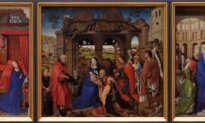
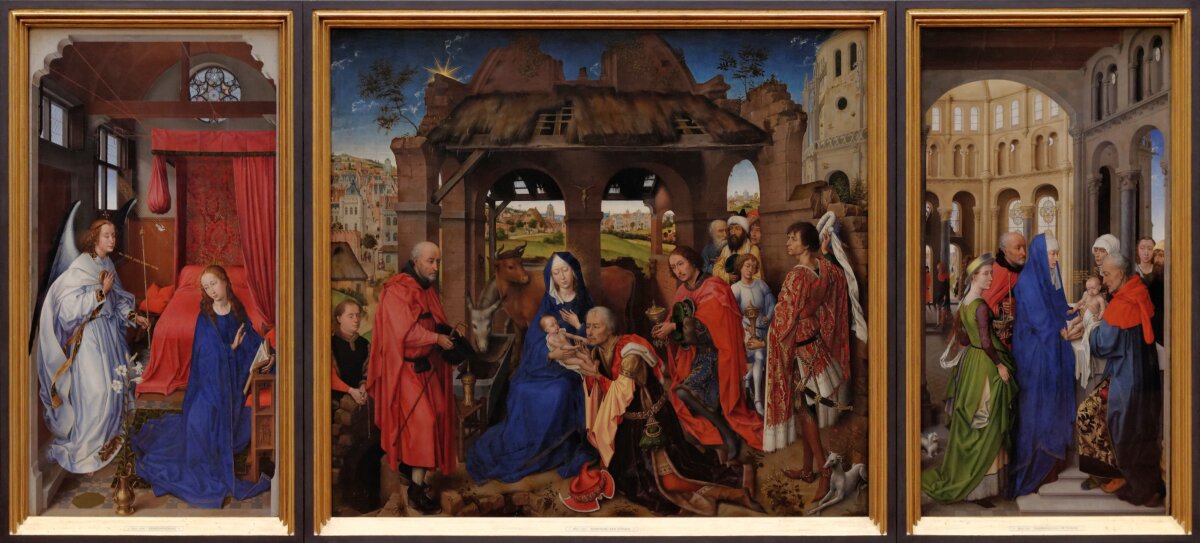
When the greatest poet of the modern world first laid his eyes on the St. Columba altarpiece, he fell into a deep silence. Later that day Goethe is reported to have said that he had now seen an image that was more valuable than any verse he himself had ever composed.
What was it about this now relatively obscure Netherlandish triptych that left such a powerful impression on a living, breathing Renaissance man?
Goethe was a poet with a titanic vision. He thought and wrote in cosmic terms. I do not think it is an exaggeration to say that this work of art, executed by Rogier Van Der Weyden (1399–1464), is as close as a painting can come to representing the cosmos in its entirety.
This is a big claim that requires more backup than even an authority as towering as Goethe can provide. I will attempt to make a beginning of justifying such a large claim here, but to be totally convinced I would encourage you to make a pilgrimage to see this masterpiece for yourself where it currently lives in Munich’s Alte Pinakothek.
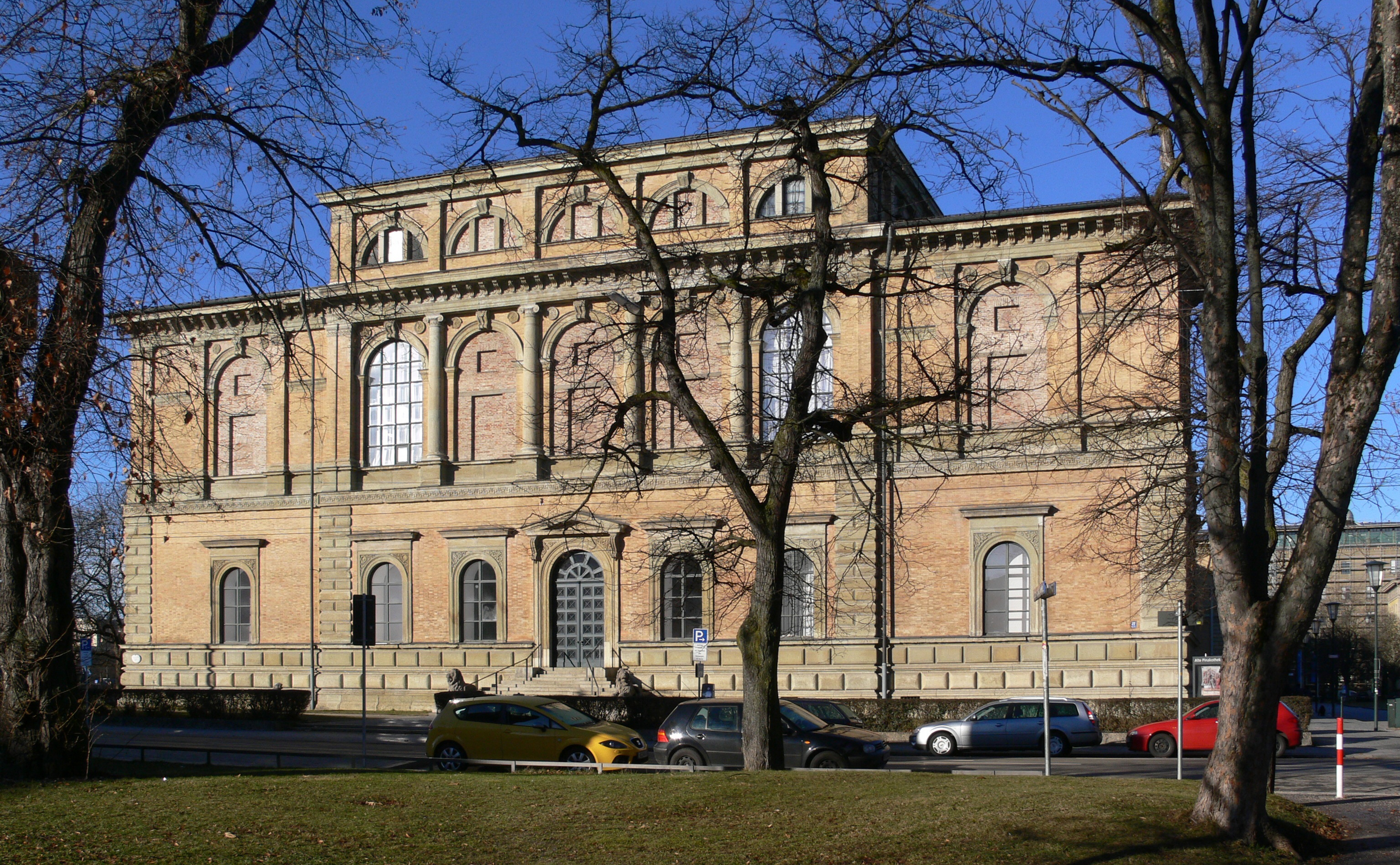 The Alte Pinakothek art museum located in the Kunstareal area in Munich, Germany, in a file photo. (Andreas Praefcke via Wikimedia Commons, CC 3.0)
But for all the greatness in this collection, no work insisted on more of my attention than the St. Columba Altarpiece. This was not part of the plan. I am a Raphael and Van Dyck guy by nature. The triptych was positively distracting; yet I did not regret for a moment any time I lost contemplating other great works that I gave to her instead.
I saw this ensemble for the first time in the flesh over 25 years ago and have returned to visit several times since then. For one stretch, I had the privilege of visiting the altarpiece about once a week for over three years and have since returned twice. I would conservatively estimate I have spent the equivalent of two full days studying this sacred work of art.
So much for personal testimony. Let’s see what the images have to say for themselves.
First, consider the subject matter of the work. The most natural way to begin thinking about the altarpiece is as a depiction of the life of Mary. Through her, we are told a story about the salvation of mankind. We begin with the annunciation, followed by the visitation of the three kings, and finish with the presentation of the Christ child in the temple. In all three pictures, Mary is clothed in a dark blue robe, a symbol of the depth, power, and beauty of her faith.
Blue traditionally symbolizes faith as a symbol of purity, the same purity we associate with creation itself, a purity that was then lost after the fall of man. God creates a new world in Mary’s woman, bringing the blue sky of heaven down into a dark and fallen world. Lest there be any doubt, an image of the fall appears as a work of art inside the larger work of art—an image of an image, if you will—carved into the wooden prie-dieu at which Mary kneels. This detail by itself is worthy of careful study and prepares the viewer for what he should expect from the work as a whole: it is not only meant to evoke some well known biblical scenes, but acts as an interpretation of how these stories relate to one another, what other stories they refer to, and ultimately what they symbolize.
In a single static image, our artist has managed to tell us that Mary is a pious woman, who studies scripture on her knees. She is the new Eve, worthy of being “hailed” by a divine messenger, preparing her mind for what has already been accomplished in her flesh by the Holy Spirit, whose golden rays float into her room with a dove through a closed window, passing through a physical barrier and leaving it unbroken in a way only light—only a god—can do.
By studying this image carefully, we are taught about the nature of divine movement that enters without breaking and arrives without traveling. It is also teaches us something about what we are and may yet become. We are taught how to look first at the image and then at ourselves. Van der Weyden places before us a symbolic narrative that rewards both the careful study of detail and stepping back to take stock of the whole.
We are in a world that is coming to master the possibilities and implications of perspective painting. The vanishing point that governs the discovery of perspective was thought to imply a kind of infinity on which all lines converge, a center around which the circumference of the world turns, making possible the appearance of proportion and harmony in the visible world that tells us about the invisible patterns lying behind it.
The rise and expansion of perspective painting also encouraged a new kind of ‘realism’ when rendering the human face. Renaissance painting represented both break and continuity with medieval iconography, a tradition in which the face was carved as a kind of ideal that showed the meeting of divine and human nature.
We could call medieval images divine portraits; like the Mona Lisa, an image of God would seem to see you and only you when you look at it, while, at the same time, you would know that the image would also appear to be looking at everyone else in the same way. This is what the theologians of the period called “divine omnivoyance,” a way of experiencing a paradoxical property of God that sees at once everything and everyone, remaining fixed even as we shuffle along this mortal coil.
Mary’s face, like every other we encounter in the altarpiece, grants us a glimpse of her interior life at a given moment in her personal and our own salvation history, while, at the same time, symbolizing the larger cosmic story in which she is both central and only a part, again, as we ourselves are. By turns, we can see a hopeful countenance, a visage of melancholic gravity, and the very image of stoic determination. Her threefold aspect mirrors the ages of man portrayed in the three wise men: one in his prime, the second middle-aged, and the third an old man.
This is a symbolic story told in threes. In the first image set in Mary’s bedroom, we are presented with a threefold cosmic truth about what is required of our human nature at its best. This most highly favored lady embodies faith, hope, and love, symbolized by the blue of her dress (perhaps the white of the angel, too), the green of her prayer mat, and the fiery red of bedstead, canopy, and clothes. These colors serve the purpose of drawing the three paintings together into a single narrative, teaching our senses—our bodies—before our minds, the harmony that the divinely ordered cosmos requires of its handmaiden, and by extension, what it requires of us.
As you probably have guessed by now, I could go on. I hope in what little I was able to say here about a work that deserves far more of a tribute than I could ever pay in writing, I have given you some sense of how much there is to be won by spending time with a beautiful work of art with a message of cosmic proportions.
Views expressed in this article are the opinions of the author and do not necessarily reflect the views of The Epoch Times.
 Friends Read Free
Copy
Facebook
Tweet
Friends Read Free
Copy
Facebook
Tweet