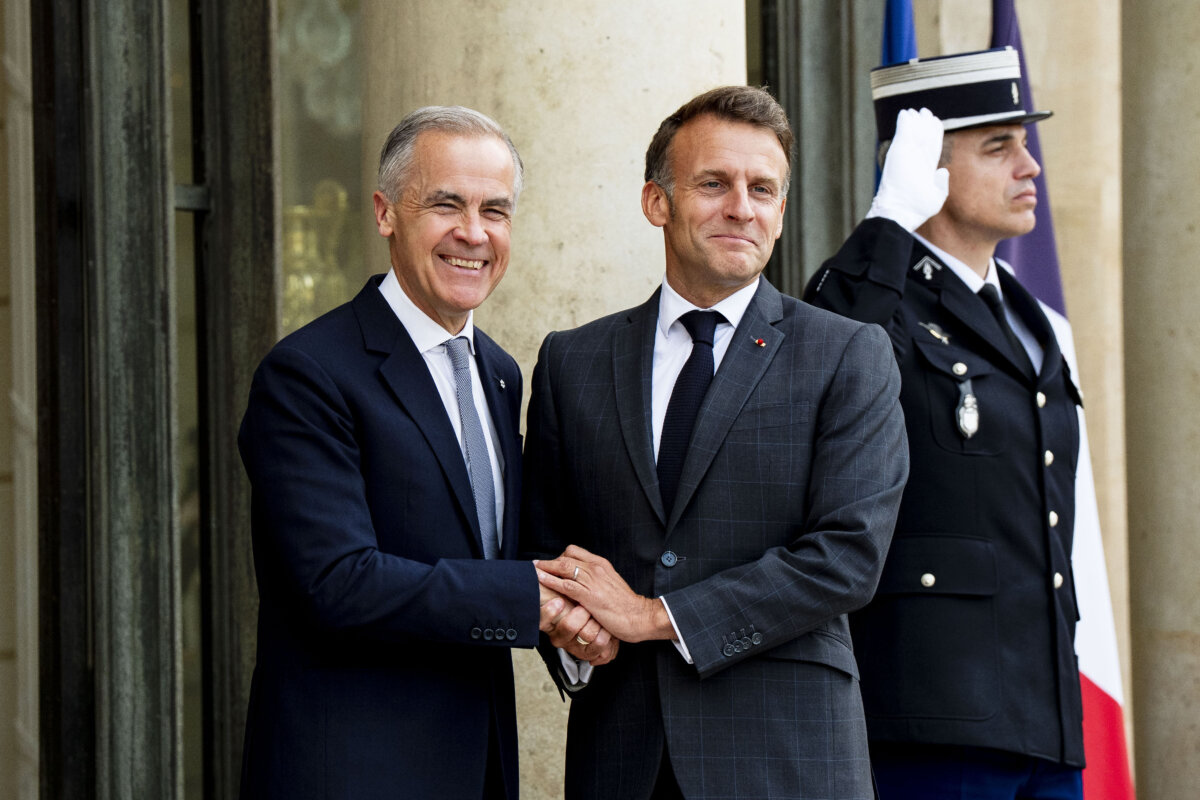

Prime Minister Mark Carney will meet French President Emmanuel Macron Sept. 20 on the French territory of Saint-Pierre-et-Miquelon off the coast of Newfoundland to discuss energy, defence, and technology partnerships, the Prime Minister’s Office (PMO) says.
“As Canada builds a dense web of new and strengthened connections, France is a natural partner in this mission,” a Sept. 13 news release from the office says.
The leaders will discuss aerospace, energy and critical minerals, and advanced technologies such as quantum, satellites, and supercomputing, the PMO says.
France traded $15.2 billion in goods with Canada in 2025. Canadian exports to France were valued at $5 billion, and imports at $10.2 billion, for the year.
The two countries have a long-standing defence and security partnership, including as NATO allies and partners in the European Union’s Security Action for Europe (SAFE) defence procurement initiative. They also cooperate on the promotion of the French language and culture through the Organisation internationale de la Francophonie, the release says.
“Canada and France share more than a border. We share a history, common values, and a resolute commitment to building a more secure and prosperous world,” Carney said. “In an uncertain world, President Macron and I understand the importance of this relationship.”
Carney is also expected to visit Strasbourg, France, and Liverpool, UK, from Sept. 15 to 17, during which he will address the European Parliament.
Saint-Pierre-et-Miquelon, an archipelago of eight islands about 25 kilometres off the southern coast of the island of Newfoundland, is France’s only remaining territory in North America proper. It is also the last surviving vestige of New France outside its Caribbean holdings.
Following the signing of the first Treaty of Paris in 1763, France transferred control of all French lands in North America to Britain except for the islands of Saint-Pierre-et-Miquelon, which provided a base for the French fishery.
In the nearly two centuries that followed, up to 1948, the French Consulate in St. John’s, Newfoundland, maintained extensive correspondence with the French administration of Saint-Pierre-et-Miquelon. The consulate served as a channel for information relay between the French-speaking authorities of Saint-Pierre and the English-speaking colonial authorities of Newfoundland, which included organizing official visits between the governors of both jurisdictions.
About 6,000 visa-exempt foreign nationals travel between Saint-Pierre-et-Miquelon and Fortune, Newfoundland and Labrador, by ferry every year.
The Canadian government updated entry rules in June for those arriving by boat to Canada from Saint-Pierre-et-Miquelon. Effective June 5, most visa-exempt foreign nationals travelling to Canada by boat from Saint-Pierre-et-Miquelon needed an electronic travel authorization (eTA), whether by ferry, privates boats, or commercial vessels.
The update was made due to Canada finding that some people were trying to bypass Canada’s pre-arrival screening requirements by travelling by boat between Saint-Pierre-et-Miquelon and Fortune.
“This change will not apply to passengers arriving by cruise ship, French citizens who are residents of Saint-Pierre-et-Miquelon and who are travelling directly to Canada, or seafarers working on commercial vessels, such as fishing boats, when travelling by boat from Saint-Pierre-et-Miquelon,” Immigration, Refugees and Citizenship Canada said.
“US nationals and lawful permanent residents do not need an eTA [electronic travel authorization], either.” When entering Canada from Saint-Pierre-et-Miquelon, they only need to provide a valid permanent resident card, also called the “green card,” or an equivalent valid proof of status in the United States.
 Friends Read Free
Copy
Facebook
Tweet
Friends Read Free
Copy
Facebook
Tweet