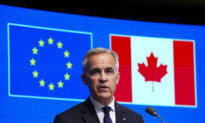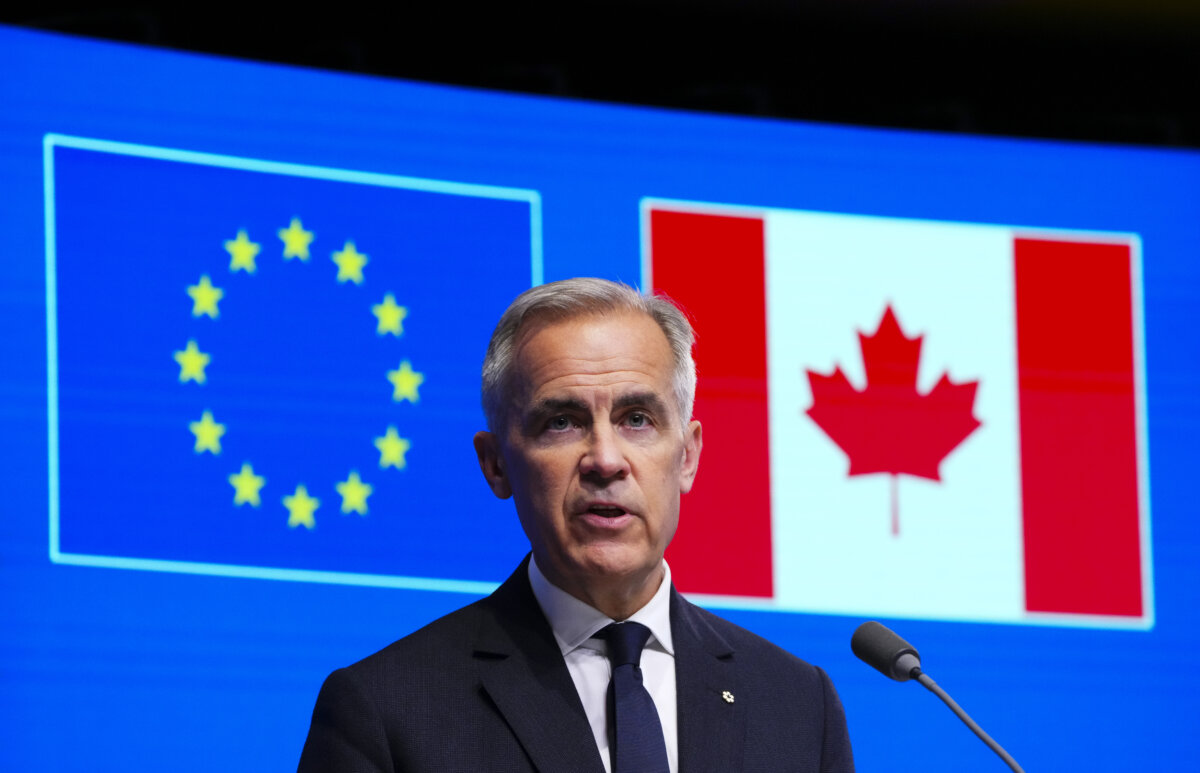


Prime Minister Mark Carney says his government isn’t looking to become a “member” of the European Union, as a report by the Wall Street Journal (WSJ) said that Canada is considering to become an “associate member” of the bloc. He said Canada is discussing a “unique alliance” with the bloc.
The Sept. 13 WSJ report based on unnamed officials from both sides said that EU members would be open to the idea of an associate membership for Canada but would need to create that category of membership, which does not currently exist. The report added that Ottawa has spoken with EU leaders about issues such as visa-free work and residency for Canadians.
The Epoch Times contacted the Prime Minister’s Office for comment but didn’t immediately hear back.
Carney was asked to respond to the report on Sept. 13 and confirm whether Canada is pondering an “associate member” in the bloc while attending the Toronto International Film Festival (TIFF) red carpet event. He responded that his government isn’t looking for Canada to become a “member,” without commenting on the concept of an “associate member.”
“We’re not looking to become a member of the European Union. What we are looking and … will begin discussions for a unique alliance with the European Union,” he said.
“We share the same values. We have the same priorities, and we have very complementary strengths. We’re stronger together, and this is at a time when the world’s more dangerous and divided, and friends need to stick together at these times.”
At another press conference last week, Carney was asked whether Canada will be seeking full EU membership. He initially provided a response that didn’t address the question. When pressed again by reporters, he said, “That was the non-answer to the EU membership.” He also highlighted Canada-Europe cooperation on defence during the press conference, held jointly with Ukrainian President Volodymyr Zelenskyy, who visited Canada last week, with Carney citing “Canada’s deepening relationship with European partners.”
Under Article 49 of the Treaty on European Union a country must be a European state and must first be granted candidate country status by the European Council following an opinion from the European Commission.
Canada has been seeking closer ties with the EU to diversify its international partnerships amid trade tensions with the United States. In an Aug. 22 address, Carney spoke of Canada “building at home and diversifying trade abroad” and announced plans for discussions with the EU on a “much stronger and deeper security and economic partnership.”
Carney has several planned meetings with EU leaders, including a trip from Sept. 15 to 17 that will take him to Strasbourg, France, and Liverpool, United Kingdom. The trip is intended to “strengthen Canada’s ties with the EU in trade, investment, and security,” according to a Sept. 12 news release.
In Strasbourg, he is to address the European Parliament, at the invitation of President Roberta Metsola, and will attend European Commission President Ursula von der Leyen’s State of the EU address.
In Liverpool, Carney is to meet with UK Prime Minister Andy Burnham, for the first time, with whom he will “discuss priorities for the Canada-UK relationship, specifically related to defence and security, energy, artificial intelligence, and critical minerals.”
Carney will also meet with French President Emmanuel Macron in Saint-Pierre-et-Miquelon, France, located off the coast of Newfoundland and Labrador, on Sept. 20 to “discuss deepening the Canada-France partnership in strategic sectors, including aerospace, energy and critical minerals, and advanced technologies such as quantum, satellites, and supercomputing.”
From Oct. 29 to 30, Canada will host the Canada-EU Summit.
“In a more dangerous and divided world, Canada and our European partners are moving ever closer,” Carney said. “Together, Canada and our European partners have the ambition and strength to create a more just, stable, and universally prosperous world.”
Conservative Leader Pierre Poilievre criticized the suggestion that Canada could join the EU in some capacity.
“Will European border policies apply in Canada, further overwhelming our immigration system while our youth can’t find homes?” he wrote in a Sept. 13 post on social media.
Poilievre also expressed concerns about whether taxes would be collected from Canadian businesses under such an arrangement and how small businesses would be able to navigate the “bloated EU bureaucracy.”
“And one more: who decides for Canada? The Welland welder did not elect a Eurocrat to regulate our steel. The Saskatchewan farmer and the Atlantic fisherman did not choose a Brussels agrifood regulator that has never even seen our prairies or coasts.”
 Friends Read Free
Copy
Facebook
Tweet
Friends Read Free
Copy
Facebook
Tweet