
Commentary
Reading the news from whatever source is often frustrating (quite apart from the fact that it is usually bad and depressing). Either the information is insufficient for one to come to a reasonable view of what is reported or a story that occupies all the headlines for several days disappears with equal suddenness so that you never get to hear the end of the story—that is, if any story can be said to have an end.
Artificial intelligence (AI) is no assistance in this situation, for if the story is dropped everywhere at the same time, as if by orchestration, there is nothing for its algorithms to work on. Occasionally, AI appears not to want to admit its ignorance and therefore makes up an obviously absurd answer, which the naive may take at face value; usually, though, it says that there is no publicly available information for it to relay.
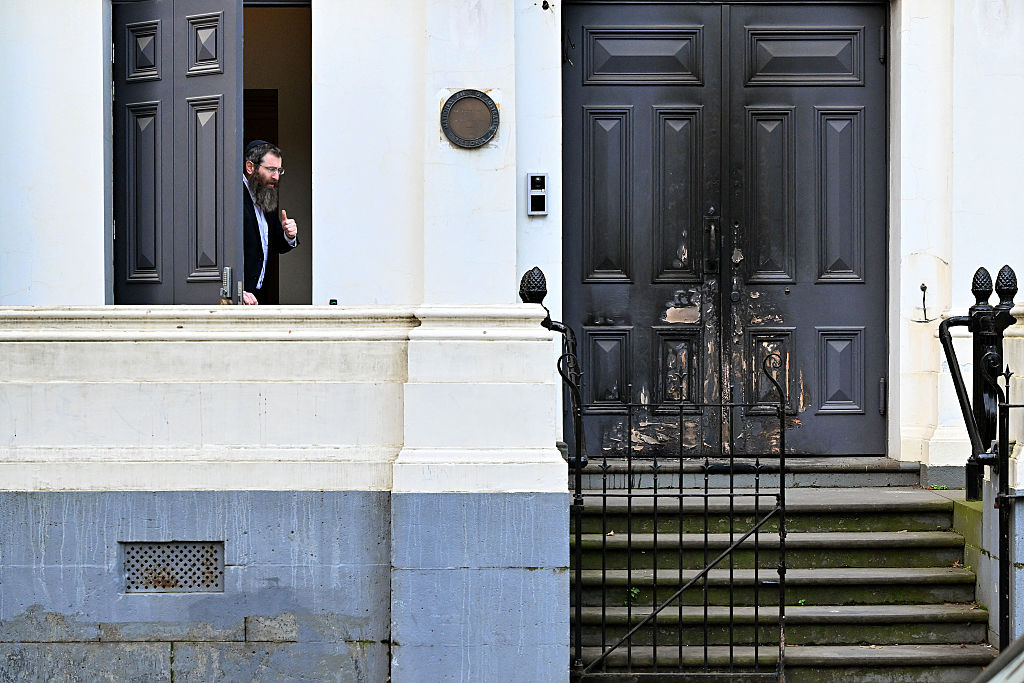
Recently, I was interested to read of the case in Australia in which a magistrate ruled that a man who had attempted to set fire to a synagogue in Melbourne had been motivated by madness rather than by anti-Semitism. The man, called Angelo Loras, aged 35, was said to have been suffering from “terrifying delusions” that explained his actions, largely because he had stopped taking the medication for schizophrenia that he had been prescribed for some time. The story was reported in journals around the world, almost in precisely the same words.
But what was unsaid was almost as important as what was said.
Loras was described as Iranian, but Angelo Loras is not a typically Iranian name, and so I consulted AI to find out in what sense he was Iranian. Had he changed his name? AI told me that he had been born in Iran, and self-identified as Iranian: nothing else, not even when he had settled in Australia. Such photographs of him as I found show a man of counter-cultural appearance, wearing (for example) long sword-like earrings and a fishnet vest.
On seeing this picture, I immediately thought, “Aha, drugs!” That might well account for his psychotic state, for his delusions and hallucinations. There was, however, no information one way or another on this important aspect of the case. Some might think my suspicions prejudiced, and so they might have been had Loras lived in a society where such drugs were unknown or very rarely used, and unknown to produce psychotic states; in the circumstances, however, my suspicions were merely prudent.
Then there was the question of the content of Loras’s delusions that induced him to act in the way he did. It is, after all, stretching credulity to believe that he chose to try to burn down a synagogue with 20 people in it purely at random, that it might as well have been an insurance office or a medical center. The latter is not totally impossible, but it is highly unlikely. I could find no report of the content of his delusions, and neither could AI.
Although delusions or hallucinations indicate madness, their content derives from the ideas and circumstances that are known to the mad person. This was recognized a long time ago. Thomas De Quincey, in his “Confessions of an English Opium-Eater,” wrote of dreams induced by the consumption of opium, “If a man whose talk is of oxen should become an opium-eater, the probability is that … he will dream about oxen.”
The machines that madmen come to believe are influencing or persecuting them always derive imaginatively from the technology of the age in which they live. It is the same with persecutory delusions: Madmen believe that they are being persecuted by organizations that exist in their own time. A madman adopts and exaggerates the bugbears that are familiar to him from his surroundings.
Thus, if a man grows up in a society in which anti-Semitism is prevalent, when he becomes mad, his delusions are quite likely to be anti-Semitic in content. The dichotomy between being mad and being anti-Semitic is a false one, which the magistrate in Australia seems not to have understood—and as none of the reports of the case seems to have understood either.
I once had a patient, a young Muslim of Pakistani descent, who very nearly killed his father, accusing him of being a very bad, non-observant Muslim. The attack on his father came out of the blue, but it was quite clear that the son had for some time been mad. He was a heavy consumer of cannabis, but whether he was mad because of the cannabis or whether his madness preexisted his consumption of cannabis was not certain. The relationship between drug-taking and madness is often dialectical.
I read the writings of the young man, and it was obvious that they were mad. They were incoherent (as was his speech), and the writing varied from huge lettering to micrographic, with peculiar and undecipherable little pictures interspersed in it. But it was also clear that his writings had an Islamist or jihadist flavor to them, demanding death to infidels, among whom he considered his father to be one. He was mad; his ideas were mad. Nevertheless, his ideas reflected and derived from those of many people around him, from the circles in which he moved.
His father was a public-spirited man; he wanted his son prosecuted, not out of revenge for his personal attack on him, but to protect the public. And indeed, the young man was sent under order to a secure psychiatric hospital.
The relation among madness, drug-taking, and anti-Semitism (or other extremist political ideas) is complex and sometimes difficult to disentangle. In Paris in 2017, a man called Kabili Traoré broke into the flat of a neighbor, a retired Jewish paediatrician, Sarah Halimi; beat her severely, shouting anti-Semitic slogans, accusing her of being Satan, and intoning that Allah was great; and threw her over the balcony, killing her.
Traoré was mad at the time, but he was intoxicated with cannabis. He had had a disturbed childhood; he had many convictions for violent crime and drug dealing. The court found him not guilty of the murder of Halimi because he was mad at the time of his act. However, he had been heard to pass anti-Semitic comments about his neighbor well before he killed her; besides, his intoxication with cannabis was voluntary. The fact that he was not punished for his crime caused an outcry.
He was sent to a psychiatric facility instead. There was the possibility that, separated from cannabis and treated appropriately with medication, he would become normal. If he did, there would be pressure to release him, for there can be no legal justification for keeping a perfectly sane and unconvicted man indefinitely in a psychiatric hospital against his will.
But is there anyone who thinks that this man should ever be at liberty again? I suspect, but cannot prove it because my information is insufficient, that the Australian case of Angelo Loras is similar or analogous, namely a case in which the law is acting against the interests of society and endangering its safety. If this happens too often, there will one day be an explosion of outrage, not pleasant to see.
Views expressed in this article are the opinions of the author and do not necessarily reflect the views of The Epoch Times.
 Friends Read Free
Copy
Facebook
Tweet
Friends Read Free
Copy
Facebook
Tweet