
Commentary
As U.S. President Donald Trump meets with Chinese leader Xi Jinping over the next few days in South Korea, will their conversations extend beyond tariffs and trade restrictions? Perhaps they will include the inherent risks of nuclear saber-rattling.
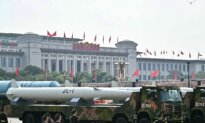
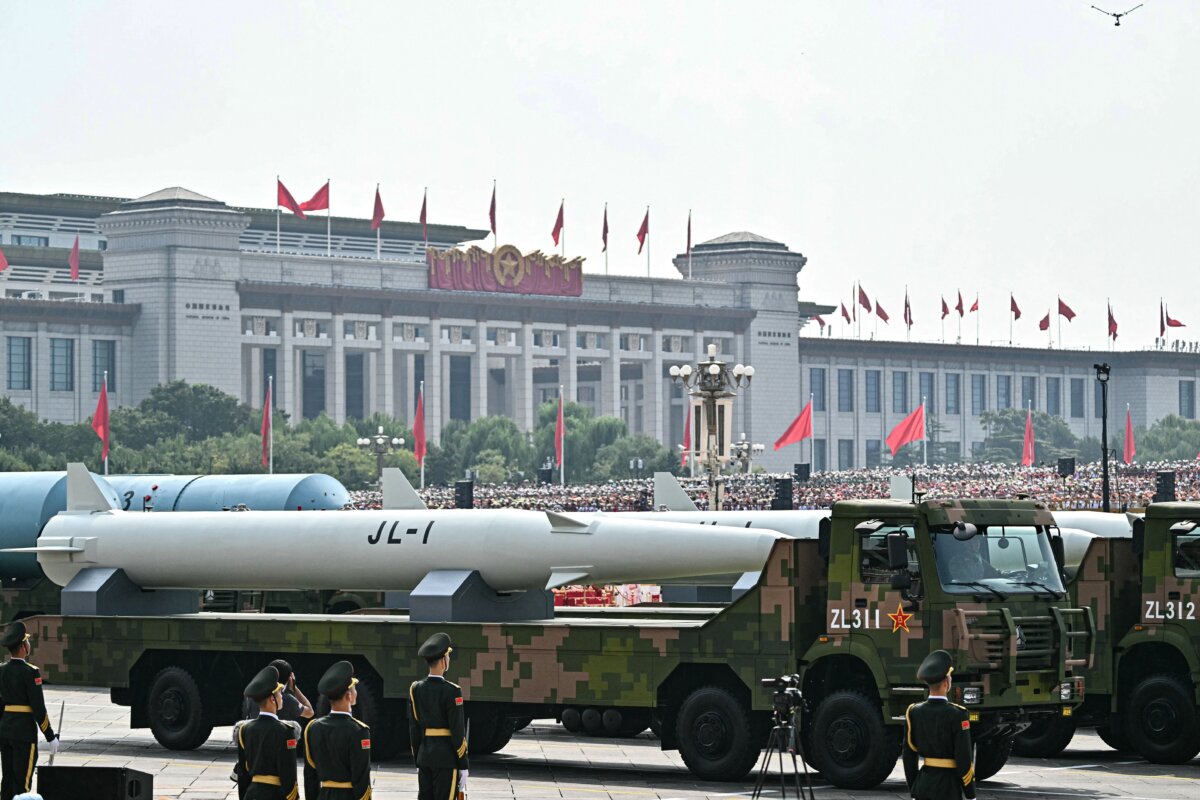
Case in point: In last month’s grand celebration marking the 80th anniversary of the end of World War II, Victor Gao, vice president of the Beijing-based Center for China and Globalization, issued a warning that should not be ignored. When translated, the former official stated that, “any attack, conventional or nuclear, will have devastating consequences.” Gao then referenced China’s nuclear arsenal that had been in the aforementioned parade, which can supposedly strike any target globally in under 20 minutes.
It’s clear that this threat was directed at the United States and Japan for their declared support for and defense of Taiwan, and could represent a serious rhetorical shift by Beijing.
Why Such an Aggressive Statement?
The nuclear retaliation threat reflects the Chinese communist regime’s growing aggressiveness in the region and in other parts of the world, and at a celebration of the end of World War II. In the past several months, trade policies, geopolitics, and official rhetoric have become more adversarial than just competitive between Washington and Beijing, and everyone knows it.
The intention of issuing the threat may have been to link the end of one world war with the potential start of another, in reference to a shift in U.S. policy in the Asia-Pacific region. Some argue that the Trump administration has begun backing away from the “One China” policy and “strategic ambiguity” regarding Taiwan, which has been a part of American-Chinese relations since the Nixon era.
Is US Shifting Away From the ‘One China’ Policy?
By making the defense of Taiwan a top priority, the administration appears to be moving toward a policy of “strategic clarity,” where Trump is arguably tilting toward Taiwan and against China geopolitically and economically. That is a provocative move, and in the administration’s view, a necessary one, to deter the regional and global ambitions of the Chinese Communist Party (CCP).
As noted above, the United States isn’t the only country pledging to defend the island nation against a Chinese invasion. Japan has explicitly tied its national security to Taiwan’s. Going forward, Japan will play a more active and strategic role in regional security arrangements, as it has with the United States since the end of World War II. Japan’s newly elected president has declared that increasing defense spending is a top priority.
Beijing’s Response: Limit Access to Critical Elements
No doubt Beijing can see the writing on the wall, so to speak, and may partially explain China’s decision to limit U.S. access to strategic rare earth elements, of which China controls about 60 percent of global supply and 92 percent of global processing. The impact of Beijing’s new restrictions has been felt in the European Union, China’s largest trading partner, as well as in Japan. Both have been collaborating to find ways to persuade China to reduce, if not eliminate, the rare-earth restrictions.
Limiting American access to highly coveted rare earth elements, which are used extensively in military guidance, communication systems, and other economically and militarily strategic areas, directly affects American military preparedness, a fact that Beijing keenly understands. If doing so was meant to garner the Trump administration’s attention, it appears to have been successful.
Is Escalation Inevitable?
But as their meetings unfold, will Trump and Xi find a way to de-escalate the rhetoric and reverse their highly consequential trade policies?
That’s difficult to know.
On the one hand, the United States has no desire, need, or intention of a military strike against mainland China. Yet it continues to arm Taiwan while levying high tariffs on China.
On the other hand, the Chinese economy is suffering under the tariffs, and Beijing considers Taiwan as part of China. Therefore, any military defense of the “renegade province” of Taiwan by the United States and Japan against the Chinese army or naval forces would be regarded as an attack on China. Defending Taiwan against the CCP’s military would almost certainly involve the United States and Japan engaging Chinese forces at some level.
Is that the “conventional” attack that Victor Gao was referring to that would be the potentially triggering event for a nuclear response from Beijing against the United States and/or Japan?
It would seem likely, given that the Chinese military exercises have increased markedly this year.
Is Xi Looking at a Taiwan Invasion to Stay in Power?
Further complicating the equation is Xi Jinping’s flagging political support at home, particularly with the People’s Liberation Army (PLA). Just last week, nine of Xi’s top generals were removed from their posts. Purges are common in China and other dictatorial regimes, but in this case, all the generals had been appointed by Xi himself.
The official reason for the purge was corruption, but that’s unlikely. Members of the CCP are notorious for their graft and accumulation of great wealth through various means, including state-owned enterprises, illicit bank loans, and other malfeasance.
A more probable cause is disloyalty to Xi Jinping or to his policies, which are, of course, the same thing. Could one of Xi’s policies that the generals disagreed with be a planned attack on Taiwan?
It’s certainly not out of the question. “Reunification” has long been one of Xi’s top priorities, and he has asked his military to be ready to make that happen by 2027. But with the Chinese economy decelerating, high unemployment, and falling real estate prices, attacking Taiwan ahead of schedule may look like a very good idea to Xi, if not to his generals.
Speculation of Xi’s political demise has circulated for years, often with good reason. But even if his support is slipping in some quarters of the Party, like all leaders, he will play the cards he holds. One of those could be a hypersonic nuclear missile delivery system, for which the United States may have no credible defense at this time.
Hopefully, convincing Xi to change his mind about a nuclear response is on the agenda in South Korea.
Views expressed in this article are the opinions of the author and do not necessarily reflect the views of The Epoch Times.
 Friends Read Free
Copy
Facebook
Tweet
Friends Read Free
Copy
Facebook
Tweet