
Commentary
If one only looked at the headlines, the Gaza war might seem like a straightforward military campaign. But in reality, it’s also a mirror—a mirror of Israel’s deepest domestic divides, its coalition politics, and its unresolved questions about identity and strategy.
A Fragile Political Backdrop
The war did not erupt in a political vacuum. Between 2019 and 2022, Israel held five elections in less than four years—a record that revealed ongoing instability. In three of those elections, Benjamin Netanyahu won the largest bloc but failed to form a government. In one, rivals Naftali Bennett and Yair Lapid stitched together an ideologically diverse coalition that briefly ousted him. Only in November 2022 did Netanyahu return with a coalition that still governs today.
This turbulence is in part due to structural factors. Israel’s system is nationwide proportional representation: 120 seats in the Knesset (parliament) are allocated based on vote share, with a low threshold of 3.25 percent. That means small parties with narrow agendas regularly enter parliament. Since no party has ever had an outright majority, coalitions are necessary. A party with just five or six seats can tip the balance, granting it outsized leverage in negotiations.
The Judicial Reform Storm
By 2023, the coalition rested on right-wing nationalist factions and ultra-Orthodox religious parties. The government advanced sweeping judicial reforms. Supporters argued that Israel’s supreme court and attorney general (and more broadly, the civil service) had become too activist, blocking legitimate decisions by elected governments. Critics countered that the reforms went too far, as they would gut the last meaningful check on executive power in a parliamentary system where the government already controls the legislature.
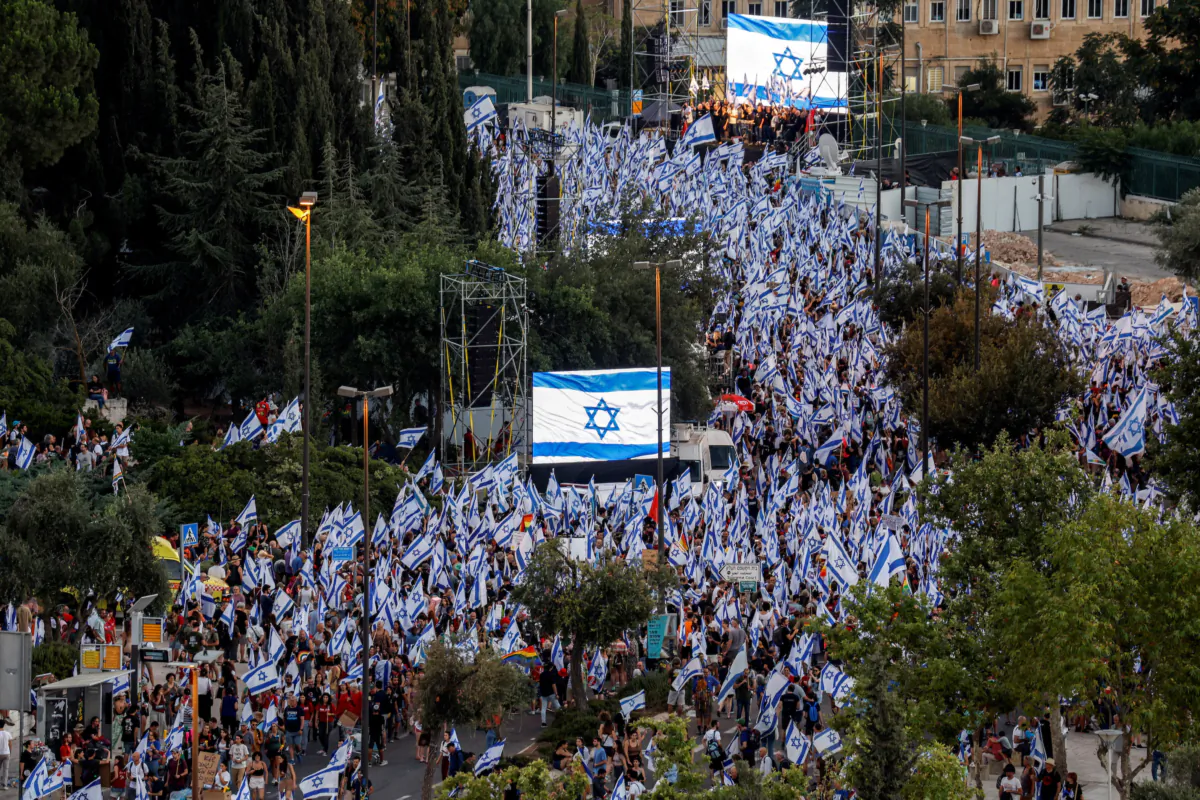
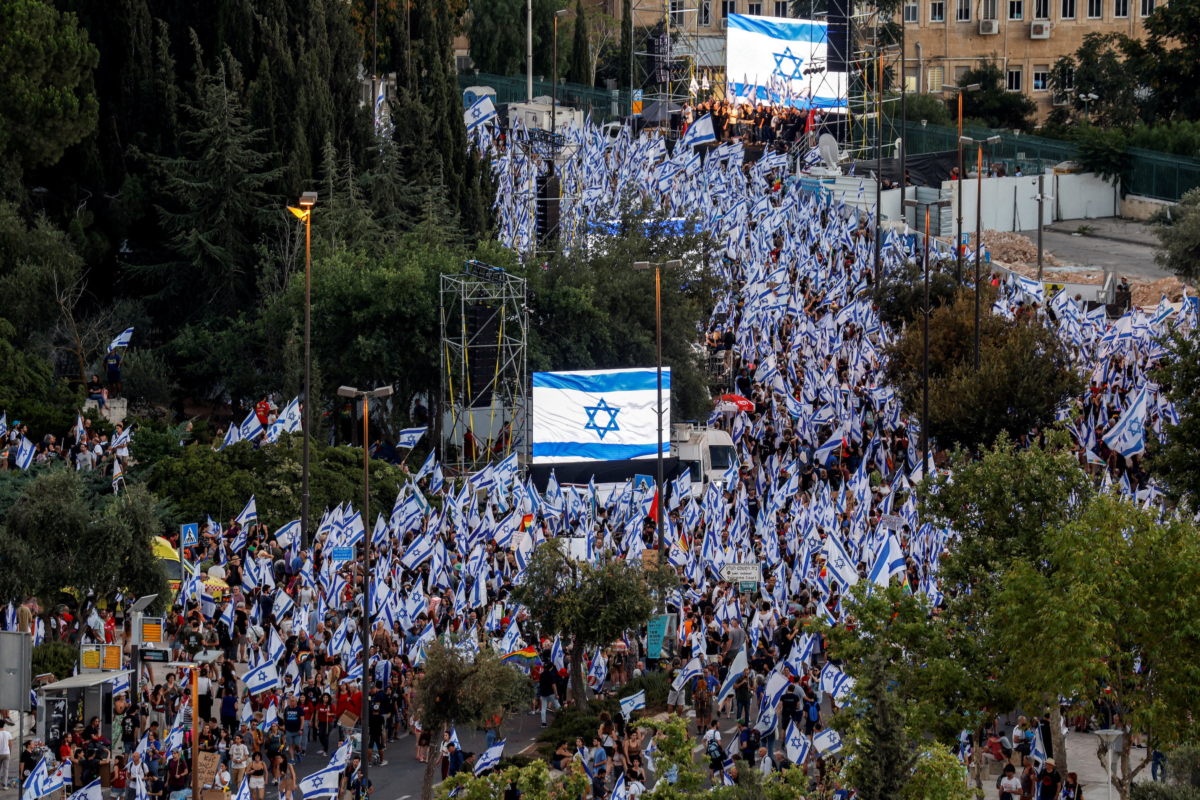
The clash sparked the largest protests in Israel’s history, with hundreds of thousands in the streets. Former military and intelligence chiefs publicly warned that national cohesion was fracturing, and reservists threatened to refuse duty. Adversaries, from Hamas to Hezbollah, were undoubtedly watching. Some Israeli commentators—across the spectrum—later speculated that Hamas timed its Oct. 7 attack partly in light of these divisions.
Shock, Unity, and Politics
The Oct. 7 attacks were a trauma without precedent. More than a thousand Israelis were killed, hundreds kidnapped. I have written before about some failures that may have led to this disaster. In any case, Israelis of all camps rallied in a show of unity presumably unexpected by Hamas. One opposition leader, Benny Gantz, joined with his party to form a temporary war cabinet for several months. But unity was brittle. Critics demanded Netanyahu’s resignation even in wartime. In the eyes of many observers, each military decision carried an implicit second layer: Would it preserve or collapse the coalition?
The Ultra-Orthodox Exemption Dilemma
The war also laid bare one of Israel’s most bitter internal rifts: the status of the ultra-Orthodox (Haredim). Since 1948, their yeshiva students have been exempt from military service, a compromise Ben-Gurion once wrought as temporary and small-scale. Today, entire communities expect lifelong exemptions, backed by stipends for full-time religious study. Perhaps emboldened by the coalition’s dependence on these parties, they have demanded that these exceptions be codified into law, once and for all.
Meanwhile, many secular and traditional Israelis have shouldered 100–200 days of reserve duty during the Gaza war, risking life and livelihood. The imbalance has grown intolerable for a multitude. In a war requiring national sacrifice, many, including on the right-traditional side of the political map, ask why some should fight and die while others stay outside the system.
Total Victory
Inside the coalition, far-right partners insist on “total victory”: the complete dismantling of Hamas. For them, compromise equals betrayal. Ending the war without full victory could topple Netanyahu’s coalition. But prolonging it erodes international patience, strains Israel’s economy, and drains public morale.
Additionally, it is hard to define total victory besides unconditional surrender, which doesn’t seem to be on the table, when your enemy is embedded in society. Further, an “order of magnitude” move, in line with the dropping of atom bombs on Japan that had prompted it to surrender, if even possible and morally acceptable, might still prove ineffective against an adversary such as Hamas.
It’s crucial to pause for a moment, at this point, and consider the nature of terrorist organizations, and how it has manifested in this conflict. This encompasses the horrendous torture, killing, and abductions—to use as bargaining chips—of men, women, and children, including infants on Oct. 7, 2023. Moreover, it encompasses the intentional embedding of military assets within their own indigenous population to maximize their civilian deaths as a tool of pressure on Israel. (Equate that with CCP leaders and generals who have stated they are willing to lose 50 percent of China’s population in a war with the United States).
In the old days, warriors who attacked women and children, or hid behind them as “human shields,” were considered cowards. Unfortunately, to all sides, now some are indoctrinated to view them as heroes.
All of the above mean that there is a probability it would not have mattered much what the Israeli government would have done; we’d still be in the same quagmire today. To make a deal, one needs two willing parties. Hamas, meanwhile, has repeatedly reneged on potential deals. The result is paralysis: a war that drags on because stopping too soon or too late both carry political costs.
Fiction and Reality
Tom Clancy’s “The Sum of All Fears” posed a moral dilemma. After a nuclear attack on Denver, the U.S. president considers destroying an Iranian city in retaliation. Protagonist Jack Ryan refuses: Vengeance for humiliation is no reason to kill hundreds of thousands of civilians, saying there are other ways for responsible leaders with less collateral damage.
Within and without Israel, a similar question casts a growing shadow: “How many Gazan deaths are acceptable in pursuit of victory?”
Israel’s traditional military doctrine emphasized swift, decisive wars, from the aptly named Six Day War in 1967 to, more recently, Hezbollah being decimated by Israel in September 2024, with the “beeper operation” and other attacks. That cascaded to the fall of the Assad regime in Syria. Iran’s nuclear program was struck by Israel and the United States in June 2025 for 12 days. In both recent cases, adversaries survived but were strategically weakened—and the operations ended swiftly.
By contrast, Gaza has become a prolonged campaign, with rhetoric even drifting into talk of expelling populations. This break from past doctrine underscores the war’s growing entanglement.
In Conclusion
Israel faces relentless pressure from Washington and Europe to secure cease-fires and hostage deals. But concessions risk splitting the government. Refusals risk alienating allies. The outcome is a stop-start war of truces, breakdowns, and shifting goals.
The Gaza war is not just about Hamas or Israel. It’s a vivid case study in how domestic agenda drives foreign policy. That in itself is not unusual—international relations, in the end, are often downstream of domestic politics. As every country’s foreign policy reflects its internal debates, its divisions, its survival instincts. The deeper test is what those pressures yield. Do they produce policies and actions that, in the long run, safeguard society and allow it to endure, or spawn cycles of division and decay?
Views expressed in this article are the opinions of the author and do not necessarily reflect the views of The Epoch Times.
 Friends Read Free
Copy
Facebook
Tweet
Friends Read Free
Copy
Facebook
Tweet