
Commentary
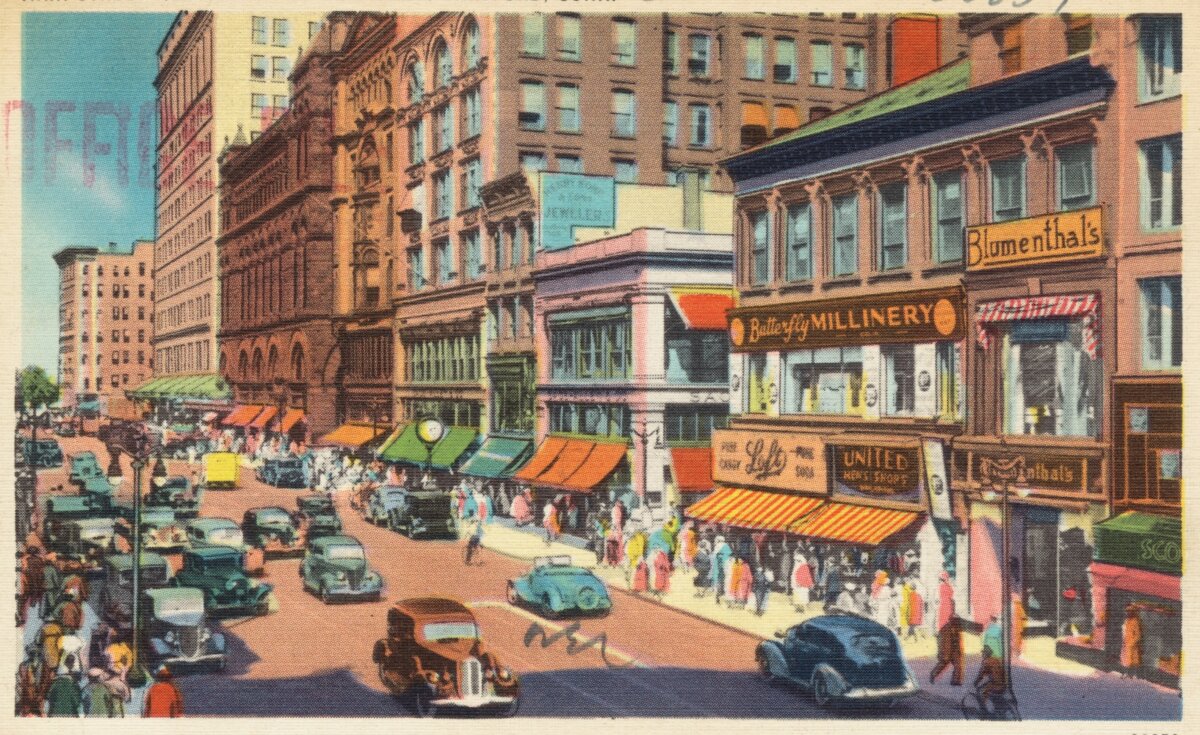
Hartford, Connecticut, was once one of the world’s great cities, a place where the best artists and most successful industrialists wanted to live, with walkable streets, a gorgeous river, and the most modern of everything—a place of high civilization and beauty. In the 1880s, it was the grandest and greatest city in the country, before being surpassed by New York City, thanks mostly to the commercialization of steel.
Hartford was the last and greatest American city in the pre-steel age. The move to second and, then, third place did not destroy the city, which was the storied home of Mark Twain and Harriet Beecher Stowe, the home of the oldest continuously operating public art museum in the United States (Wadsworth Atheneum), the insurance capital of the world, and the country’s oldest continuously published newspaper (Hartford Courant). For much of the first half of the 20th century, it was still lovely and enviable.
Then came the interstate highway system following World War II. The 1956 Federal-Aid Highway Act funded it. In Hartford, they coincided with urban renewal efforts that demolished older buildings and neighborhoods in the name of “progress” and automobile-centric planning. The result was a city—once known for its wealth and vibrancy—with population loss, severed neighborhoods, and a lasting legacy of blight and crime.
I seriously doubt that the city can ever come back. Even now, the infrastructure is still there, including the concert halls and museums, plus a beautiful downtown park and many older buildings. But the life is gone. It’s hard to put one’s finger on the precise problem. The crime and loitering are obvious, as is the sense of vulnerability just walking around. Every business still there struggles and people are worried even to own a home.
I first thought that the problem was city finances alone. It is caught in the terrible trap concerning schooling. Property taxes are sky-high to fund them, but no one wants to use the schools. Cut the taxes to draw residents, and the schools get worse. Raise the taxes to improve the schools, and you drive even more people away. There is no solution to this problem. In addition, the city has a massive public pension debt that no mayor can solve. The entire thing is a quagmire without a solution.
The bailouts from the capital never last. They patch the problem. The wound reopens when the money runs out.
In talking with residents, there is really one huge standout problem in the history of decline. There are two interstate highways that wrecked the place, forming a literal X over the city. The malefactors who did this surely had to notice the shape they were creating. A once-great city was literally crossed out of existence.
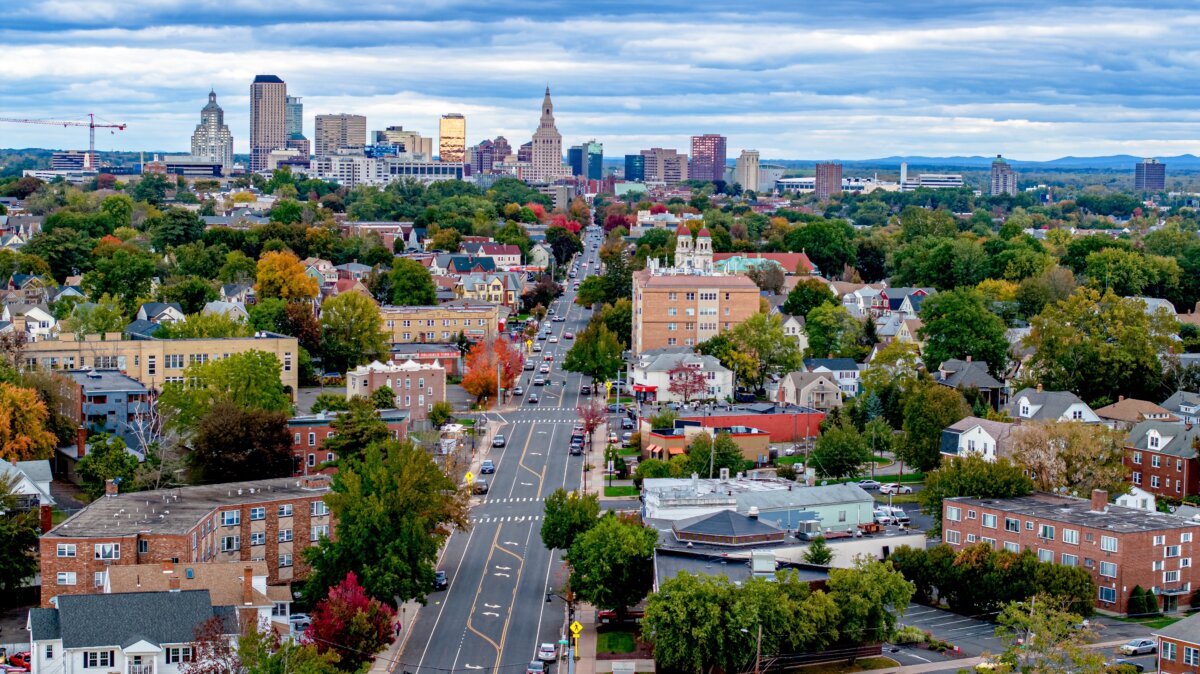
It began with Highway 84 that cut straight through the heart of town, destroying vast swaths of historic homes and businesses, ruining traditional life for everyone, and sending the place into huge upheaval from the late 1950s through the 1960s.
Next came Highway 91, which was built, astoundingly, to cut off the Connecticut River from the rest of the town, wrecking the most valuable real estate and destroying a core feature of the city’s beauty. Looking at it today, you have to think: An enemy hath done this.
Again, this didn’t happen to just any city. It was America’s great city of the Gilded Age, a center of industry, culture, and art. One might have thought that there would be massive opposition, not just to these projects or other cases in which the interstates wrecked cities and diverted flows of wealth, but also the entire “urban renewal” scam that was really just an industrial racket for developers and builders.
But as we look back, there was surprisingly little controversy, as if the entire tired and exhausted population was depleted of energy.
I can understand why. World War I was a trauma that wrecked so many lives, and it was followed by Prohibition and then the Great Depression, which turned out to have only set the stage for World War II, and human slaughter without precedent.
Desperate for a return to normal life, such as was possible, the Cold War began immediately in the new nuclear age when our former allies in war became the new dreaded foe. Yes, another war—but this one with even higher stakes.
Looking at it this way, I can see how this huge infrastructure project elicited little in the way of protest. Plus, they said the purpose was to boost the automobile of the future at the expense of the passenger train of the past. There was another reason given at the time. The idea is that we needed interstate highways for defense purposes. We needed quick ways to evacuate cities. Plus, trucks with big bombs would travel around the country in ways that would foil Soviet radar.
Who possibly could argue with such a far-reaching, far-flung litany of excuses? Plus, again, the population was obviously in deep trauma, with many living people having suffered two world wars and a depression. Exhaustion set in and people were prepared to accept whatever was coming, even the utter destruction of their own beautiful cities and towns at taxpayer expense.
Finally, a sensible voice showed up in 1961 to explain everything that was going wrong. It was Jane Jacobs, who wrote “The Death and Life of Great American Cities.” She explained how all of these highway projects were wrecking life in cities and ruining the organic flow of people and commerce to replace them with a central plan. It would not work and would only feed poverty and crime. She was in many ways a genius and said what needed to be said, all of which is obvious to us today but not to the elites at the time.
The damage was already done. Hartford was the headline victim, but every other city suffered, too, including New York City; Chicago; Detroit; New Orleans; San Francisco; Boston; St. Paul, Minn.; Washington; Atlanta; Cincinnati; Rochester, N.Y.; Syracuse, N.Y.; Miami; Dallas; and Houston. They all suffered in horrible ways, the story of which is still not told fully today. It’s actually flabbergasting once you think about it, that we let all of this happen.
One might suppose that the lesson would be learned. There would be regrets and apologies. Politicians would pledge never to allow something like this to happen again. We would have learned and improved. Maybe there has been some pullback in fascist-style schemes on this level, if only because the money ran out, but there were never apologies, much less justice.
Many cities have attempted to revert and repair, but Hartford cannot do that. It is all too far gone, too structural, too deep, too painful. The city has moved on to suffer forever as commuters come and go as necessary and the few storefronts in the city struggle to survive another day.
Sometimes we wonder what happened to this great country of ours and why we are having such a hard time recapturing the glory days. People blame the race riots, the inflation, the debt, the cultural collapse, the learning loss, the loss of faith, the corruption of the political class, and much more.
Maybe the real explanation has to start with Dwight Eisenhower, of all people, who allowed himself to be manipulated into endorsing history’s largest infrastructure program that laid waste to all that was civilized and organic to our lives. The decline might be said to have originated way back then. He even left a last message that seemed to repudiate his actions. Beware the military-industrial complex, he said.
Hartford today stands as a survivor of this tumultuous period. I sometimes fantasize what I would do if I became Hartford’s mayor for four years with a free hand to fix things. I’ve thought about this over and over and still cannot come up with any viable solution that would really restore this lost gem. Better policing costs money, and that requires higher taxes, and so does better schools, but that would only cause more to flee. This trap is a wicked one and illustrates the fundamental lesson.
The Green New Deal and the schemes now being promoted by the International Energy Agency to reach net zero are more of the same kind of thinking—grand plans that will end in disaster, just as the same kind of schemes have in the past. Never wreck what is organic to a city and never replace what works with some crazy theory of what you think constitutes progress. This was the mistake of the last century. We dare never repeat that.
Views expressed in this article are the opinions of the author and do not necessarily reflect the views of The Epoch Times.
 Friends Read Free
Copy
Facebook
Tweet
Friends Read Free
Copy
Facebook
Tweet