
Commentary
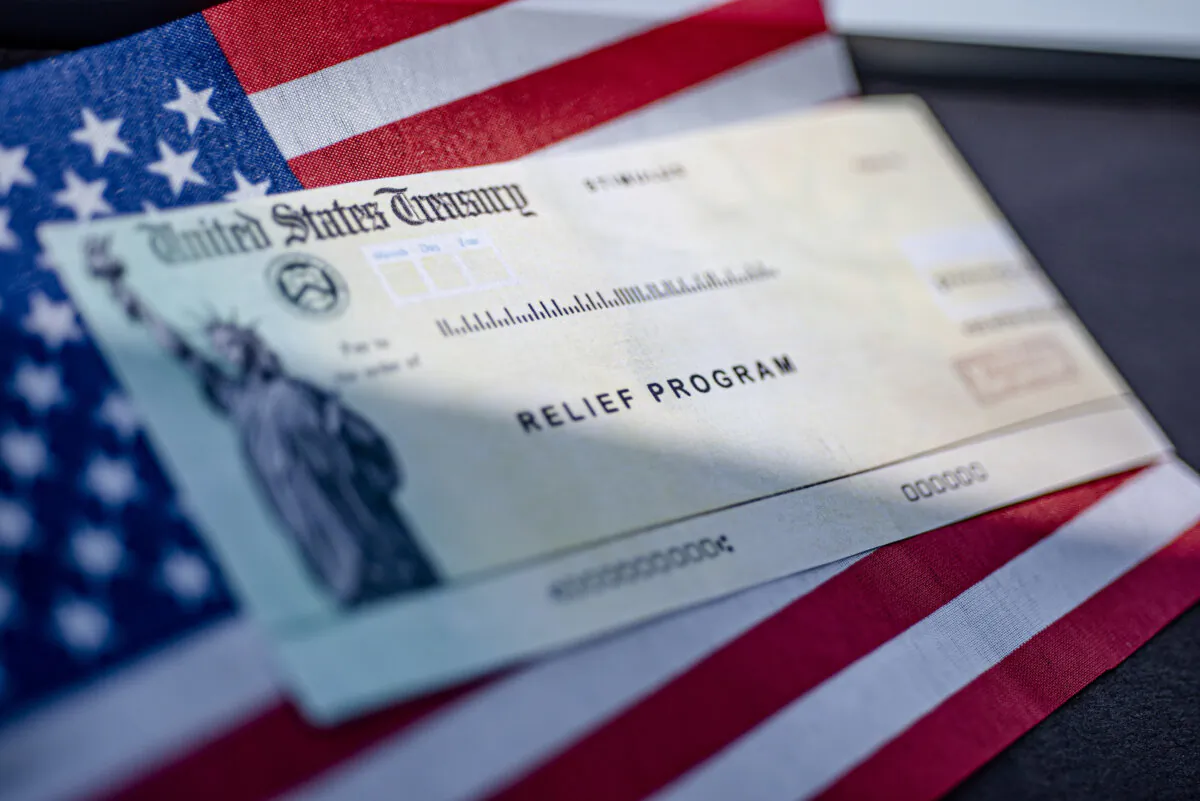
We are still working through the whole of the effects of the COVID-19 pandemic stimulus payments. By now, it is widely understood that the unprecedented infusion of cash, directly into bank accounts, that lasted from 2020 to 2022 fueled a raging inflation.
It was a classic case in which what seemed to be riches turned to dust once the purchasing power of the dollar began to tank. Watching this unfold in real time, with full knowledge of the implication, was one of the most riveting experiences of my life.
That said, there are many other effects of this wild experiment. A new article in the International Journal of Drug Policy argues that the stimulus payments were responsible in part for the rise of illegal drug use and overdoses during the period. The article in question is “Dynamics of drug overdose deaths in the United States during COVID-19” by Hawre Jalal and Donald S. Burke of the University of Ottawa and University of Pittsburgh, respectively.
The conclusion of this paper is stark: “Pandemic era overdose deaths comprise continuing exponential growth, a COVID-19 related sustained rise tied to social disruption, and Economic Impact Payment [EIP] linked spikes. Future relief payments should consider staggered disbursement and concurrent harm reduction measures to mitigate overdose risk.”
How do they reach this incredible conclusion?
“A log linear model projected the 40-year exponential trend and seasonality to establish a no-COVID baseline,” the article reads. “Pandemic era deviations were modeled with Poisson state fixed effects regressions. Five-week moving window t-tests flagged synchronous mortality spikes across states, and a two-way fixed effects event study estimated the elasticity of OD deaths to EIP-related income shocks. JP Morgan Chase checking balance data validated the income–mortality link.”
What we have here is a correlation and not proof of causation. That’s inevitable in such studies. Nonetheless, the relationship seems intuitively plausible. Many thousands of dollars appeared like magic into bank accounts. These infusions were discretionary income in a time of great boredom because stores, entertainment, and travel were off-limits, while opportunities for spending were otherwise throttled.
The intention was that this money would be used for rent and groceries or perhaps savings. The notion was that this money would take the sting out of the lockdowns, effectively buying off a population of people who otherwise would have protested the fundamental attack on freedom. But this discretionary income also permitted a fiduciary adaptation to a new way of living. Apparently, many people turned to illicit drug use.
The speculation here is not implausible. If you use a long baseline and draw a curve, there is a large spike in overdose deaths during the exact period when the stimulus payments arrived. Combine forced idleness with discretionary income, and you have the making of a drug epidemic.
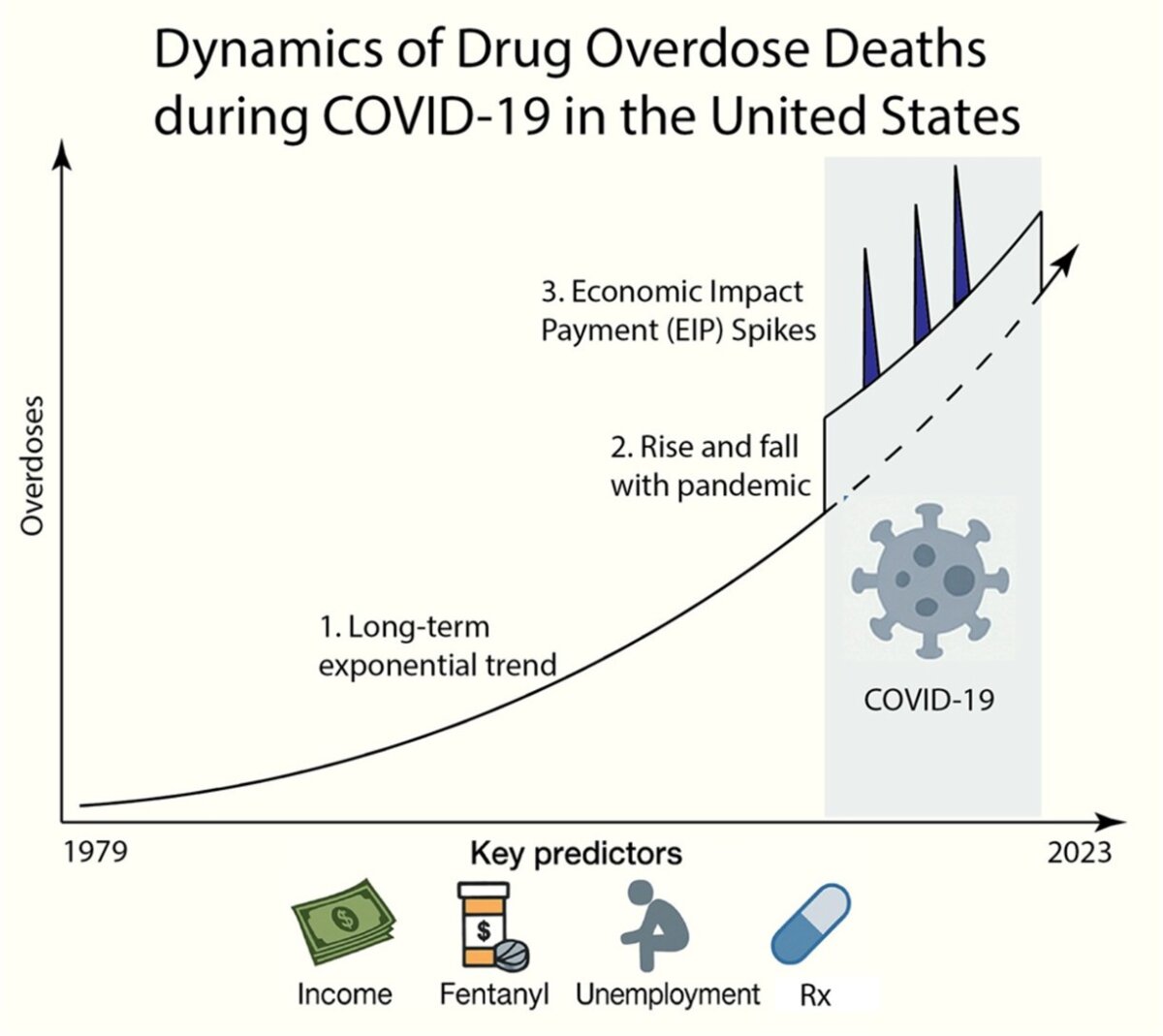
Usually, drug overdoses have followed a steadily increasing trajectory over four decades. There are intermittent periods of acceleration and regression. But generally the pattern has remained. Surges have come thanks to the arrival of easily available prescription opioids, heroin, and fentanyl, plus various street mixes that have proven deadly. All of this is well-documented.
During the COVID-19 pandemic period, overdose deaths climbed sharply. These and not the virus account for a substantial portion of the overall decline in U.S. life expectancy. This problem was likely intensified by social isolation, job loss, restricted access to medical care, and new availability of drugs. The poor in particular were affected by these changes, the very populations most sensitive to sudden shifts that would intensify attraction to drugs and substance abuse.
There were fully three rounds of stimulus payments: April 2020 to May 2020, December 2020, and March 2021. These payments were unlike any other welfare benefits distributed in U.S. history. Instead of being targeted to solve particularly unique situations, these payments were distributed to a broad swath of the population regardless of financial need or employment status. It was a time of free money for all.
The authors wrote: “At the start of the COVID-19 shutdown, the baseline weekly overdose (OD) mortality rate was 0.45 per 100,000. Early in the pandemic, OD mortality increased gradually by approximately 1 [percent] or 0.005 per 100,000 per week. During EIP disbursement periods, three distinct spikes in OD mortality were observed.
“The first spike (EIP 1, April-May 2020) reached an additional 0.020 per 100,000, while the second (EIP 2, January 2021) and third (EIP 3, March 2021) spikes reached 0.012 and 0.014 per 100,000, respectively. These represent weekly increases of approximately 4.4 [percent], 2.7 [percent], and 3.1 [percent] relative to the baseline weekly mortality rate.”
They compared with the baseline to find that “death rates across states did not exhibit significant synchronous increases from 2018 to 2021, increasing the likelihood of a causal relation between the EIPs and OD deaths across states.”
This is a good way to put the insight: It is not proof of a direct cause between stimulus payments and drug overdoses but it does make a causal relationship likely.
That said, the authors did attempt to account for confounding factors: “The rushed rollout of EIP 2—due to the impending expiration of certain [Coronavirus Aid, Relief, and Economic Security Act] provisions—offers a quasi-experimental context wherein the timing was driven by external legislative deadlines rather than overdose trends.”
In other words, when unique changes in behavior resulting in death perfectly correlate with changes in the means by which the instruments of death are acquired, it does not seem to be a stretch to observe a causal connection, especially in absence of other plausible confounders.
The implications of this paper are beyond anything I had ever considered. Note that the reduction in lifespan by death is substantially attributable to drug overdoses. Those in turn are linked with huge cash infusions from the federal government at a time when people were bored, unemployed, and depressed with shattered communities and family life. This is a spellbinding modern example of “good intentions gone wrong.”
The paper is understated in a way consistent with the venue, but it is impossible to avoid the strange implications. The government flooded the economy with money in order to protect the health of the population. That money ended up funding a huge wave of drug deaths. Once you think about the meaning of this, you have to wonder how it is that anyone could defend these policies.
I had personal friends who were in recovery from alcohol and drug addiction who relied on meetings in a community. Those meetings were all canceled. Zoom was fine but not enough: They reverted. Some of them died as a result. Who gets the blame for this?
The authors politely suggested that the next time, the payments could be dispersed with more focus on financial need and not deposited in huge lump sums. Yes, this seems right. But when you also observe the revelations of the amount of fraud and waste associated with stimulus payments, the actual conclusion is that nothing like this should ever be attempted again.
Enough experimentation on the population. We’ve seen enough.
Views expressed in this article are the opinions of the author and do not necessarily reflect the views of The Epoch Times.
 Friends Read Free
Copy
Facebook
Tweet
Friends Read Free
Copy
Facebook
Tweet