
Commentary
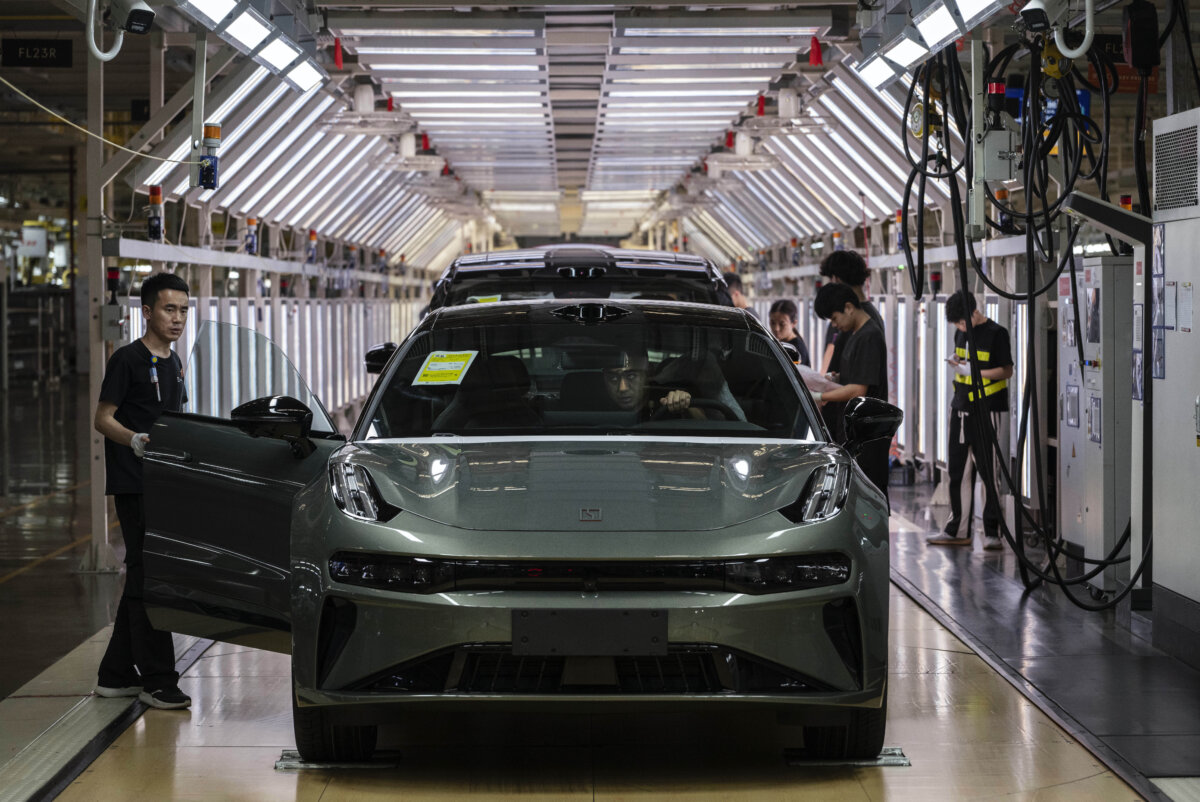
In yet another sign of how reluctant Chinese consumers are to spend, sales of electric vehicles (EVs) crashed in February.
Month-to-month moves of any statistical series should always be taken with more than a grain of salt. This drop is especially suspect, coming off a period when Beijing heavily subsidized sales leading up to the Lunar New Year celebrations.
Nonetheless, the fact that those earlier subsidies, rather than boosting sales, simply stole from the future announces how reluctant Chinese consumers are and, consequently, how fundamentally troubled China’s economy is.
Even considering all the applicable statistical caveats, February’s release is striking. According to the China Passenger Car Association, sales of what Beijing calls “new-energy vehicles”—EVs and hybrids—fell by 32 percent from the month before and some 25 percent below year-ago figures. Led by the EV decline, overall retail auto sales fell by 34 percent from January levels.
In the face of such weakness and what it says about China’s economy more generally, the recent “Two Sessions” meeting of the rubber-stamp National People’s Congress has offered little more to encourage the Chinese consumer and spur him or her to spend more freely. Trade-in subsidies for cars and household appliances have done more to create monthly fluctuations in sales than drive up overall economic activity, much less take up some of the overcapacity in certain industries that is itself a product of Beijing’s poor planning.
Beijing’s less-than-powerful policy initiatives on consumer spending are especially disturbing, given the huge weight placed on the household sector by China’s ongoing and long-standing property crisis. Since that crisis began in 2021, homebuilding activity has dropped by some 70 percent through January 2025, the most recent period for which complete data are available. Since residential construction in China once accounted for more than 30 percent of the economy, that falloff alone continues to have a powerfully adverse economic effect.
Perhaps still more significant, the collapse of the property development sector has caused a huge slide in the value of existing homes in China. According to data firm Trading Economics, home prices fell by an average of 3.1 percent in January, an acceleration from the 2.7 percent decline in the previous month and the 31st straight month of price declines. This turn has cut deeply into household net worth, leaving Chinese to cut back and save in what is something of a desperate effort to fill this financial hole.
Beijing would need to take dramatic steps to put household finances right and encourage spending, but, as the latest Two Sessions meetings show, the Chinese Communist Party has no intention of doing so.
Vehicle exports have continued to help manufacturers facing this huge drop in domestic demand. Exports of all Chinese passenger cars rose by some 56 percent in February, with more than half of the so-called new energy vehicles. Some 40 percent of Tesla China’s production went out of the country.
Producers no doubt welcome this source of demand, but it is at best unreliable. The European Union has moved to restrict sales of Chinese vehicles, as has India and other Chinese trading partners. Even the pricing edge that has helped Chinese EV exports in the past is no longer reliable, as copper and lithium prices have risen dramatically from year-ago levels.
Given the monthly volatility in these and other sales measures, March might very well show something of a rebound in vehicle sales, including EVs. But against the background of China’s fundamental economic problems, such a jump—if in fact it emerges—would hardly signal an end to the nation’s pattern of slowing growth.
Views expressed in this article are the opinions of the author and do not necessarily reflect the views of The Epoch Times.
 Friends Read Free
Copy
Facebook
Tweet
Friends Read Free
Copy
Facebook
Tweet