Commentary
Japanese Prime Minister Sanae Takaichi and her 18 cabinet members earlier this month publicly disclosed their personal assets, as well as those of their immediate family members.
Takaichi reported total assets of 32.06 million yen, roughly $206,553, well below those of several key ministers.
Topping the list was Defense Minister Shinjiro Koizumi, with 272.48 million yen (about $1.75 million), which was all held by his wife, Christel Takigawa. Second was Foreign Minister Toshimitsu Motegi at 193.97 million yen (about $1.24 million). Third came Internal Affairs Minister Yoshimasa Hayashi with 150.88 million yen (about $972,055).
In contrast, would Chinese leader Xi Jinping and the other six top members of the CCP Politburo Standing Committee dare to disclose their own assets and those of their families?
The answer is no.
Not only do they refuse to make their wealth public, but under Xi, the Chinese Communist Party (CCP) has not even dared to reveal how much money senior military officials convicted of serious corruption actually embezzled.
During Xi’s first two terms, he purged more than 170 generals under his anti-graft campaigns, including former Politburo members and Central Military Commission (CMC) Vice-Chairmen Xu Caihou and Guo Boxiong, former CMC member and Political Work Department Director Zhang Yang, and former CMC member and Joint Staff Department chief Fang Fenghui.
How much did they each embezzle? The CCP’s official line for Xu, Guo, and Fang was that it was “an especially enormous amount.” For Zhang, the CCP’s state-run media outlet Xinhua News Agency reported that it was “a huge sum of assets from unexplained sources.”
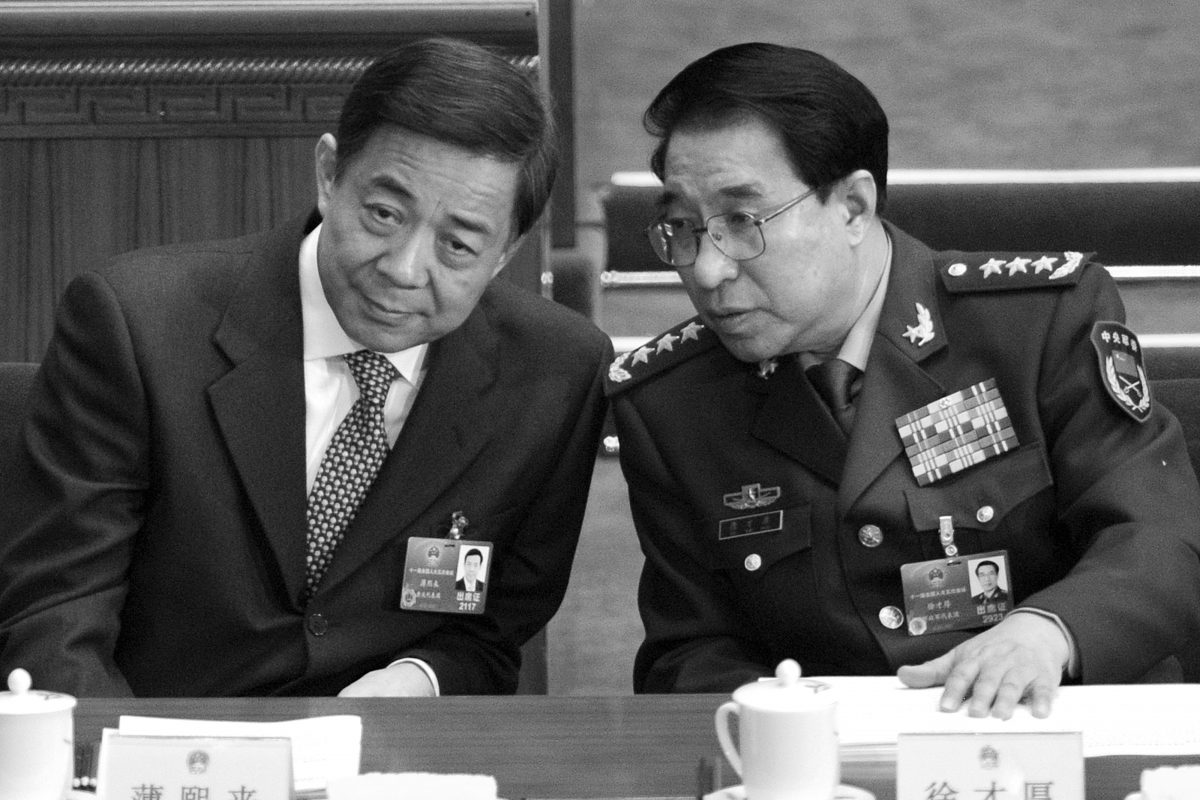
After Xi secured his unprecedented third term at the 20th National Congress in 2022, the Rocket Force scandal sparked successive purges within the military. More senior generals were removed from their posts, including former Politburo member and CMC Vice-Chairman He Weidong, former CMC member and Political Work Department Director Miao Hua, former State Councilor and Defense Minister Li Shangfu, and Li’s successor, Wei Fenghe.
How much did they each embezzle? For He and Miao, the CCP’s official rhetoric was that it was “an especially enormous amount.” For Li and Wei, it was that the amount was “huge sums of money.”
However, not a single Chinese media outlet has ever demanded that the CCP release specific figures.
For ordinary Chinese people, these sums are probably astronomical. I would like to quote from Chinese reports to show just how “huge” or “enormous” they could be.
Phoenix Weekly, in 2014, reported that the cash alone—in dollars, euros, and renminbi or yuan—authorities seized from the basement of Xu Caihou’s luxury residence in Beijing weighed more than a ton. Many bundles of banknotes hadn’t even been opened. And that was before counting the countless gold, silver, jewelry, ancient artifacts, calligraphy, and paintings from the Tang, Song, Yuan, and Ming dynasties, plus raw chunks of jade.
Guo and Zhang were allegedly more corrupt than Xu, according to various Chinese media reports.
So why won’t the CCP reveal the exact corruption figures of military officials it’s already prosecuted?
The answer is simple: The CCP isn’t a legitimate political party “serving the people wholeheartedly.” Instead, it’s a party that mainly works for the renminbi, which translates to “the people’s money.” The CCP is scared to death that the Chinese people will come to see the truth—that the CCP is built on deceit, malice, and struggle and that it commits wrongdoing without restraint.
In contrast, according to a World Bank report, by 2016, more than 150 countries and regions worldwide had established systems for public officials to disclose their personal and family assets.
The CCP has been aware of asset disclosure systems for decades. As early as the 1988 “Two Sessions,” Chinese lawmakers proposed legislation on it. In 1994, the Eighth Standing Committee of the CCP’s rubber-stamp legislature officially included an “Asset Declaration Law” in its legislative plan. But more than 30 years later, no such law exists.
In December 2019, Peking University professor Zheng Yefu published an article titled “Asset Disclosure Should Begin With the [Politburo] Standing Committee,” arguing that official asset declaration is “fair, peaceful, low-cost, and ideologically neutral, and has been adopted by countries outside the Western tradition, thus spreading globally.”
Zheng said: “Let the seven [Politburo] Standing Committee members take the lead in disclosing their assets. … Their taking the lead in asset disclosure is the best way to prove their innocence and set an example for officialdom. If that is done, there is no need to worry about its implementation.”
Six years later, Xi and his six Politburo Standing Committee members have ignored Zheng’s proposal.
The reason is that the CCP is the most corrupt party in the world, and nearly all CCP officials are corrupt.
After 10 years of anti-graft campaigns, Xi personally promoted and fast-tracked He to the Politburo and vice chairmanship of the CMC. Barely two years into the job, authorities said He was accused of committing “serious crimes involving a massive amount of money.” And that’s just one example.
On Dec. 6, two Chinese J-15 fighter jets targeted Japanese F-15s with radar, putting Tokyo in its crosshairs, which is little more than political theater. Its real purpose is to divert attention from the severe economic, social, and political crises the CCP is facing.
I recently read an article titled “This Is Not a Crisis, This Is Death,” written by Wu Hongsen, a current affairs commentator based in Shanghai. The article was published on Dec. 12 by Vision China, a U.S.-based independent Chinese media company.
The author noted that Japan mostly recovered from 30 years of prolonged economic stagnation that began in the 1990s, following the bursting of a massive real estate bubble. Wu wrote that China is now experiencing a situation similar to Japan’s: a real estate collapse, soaring unemployment, shrinking consumption, falling corporate profits, and massive factory and shop closures.
“But China’s situation is different: it’s a total systemic collapse, not just an economic crisis or a great depression; it will be the end of the entire society,” he wrote.
The CCP is now facing an existential crisis. This is the harshest reality it faces, and it is one of the reasons the CCP wouldn’t disclose officials’ assets.
If the exact amounts embezzled by corrupt military figures were made public, what if the rank-and-file soldiers rose in revolt?
If Xi and his Politburo Standing Committee members were to disclose their assets, wouldn’t that spell the end for them?
Views expressed in this article are the opinions of the author and do not necessarily reflect the views of The Epoch Times.
 Friends Read Free
Copy
Facebook
Tweet
Friends Read Free
Copy
Facebook
Tweet