

Commentary
The latest results from the National Assessment of Educational Progress (NAEP) are nothing short of catastrophic. They are an indictment of an education system that has been subject to decades of top-down “accountability” and has consumed trillions of dollars—more and more each year—only to deliver worse results.
On Sept. 9, the Department of Education released the 2024 NAEP scores for 12th-grade math and reading and eighth-grade science. The results are ugly. They show that U.S. schools are failing in their most basic mission: ensuring that students actually learn.
Just 35 percent of 12th graders are proficient in reading—the lowest score since the NAEP began in 1992. Stunningly, the math scores were even worse, with only 22 percent proficient—the lowest score since the current test began in 2005. In science, barely 31 percent of eighth graders met the proficiency bar for their grade.
To put this in perspective, researchers commonly equate 10 points on NAEP math and reading assessments to about one year of learning. Since the early 1990s, 12th-grade reading scores have dropped by 10 points. That means that today’s graduates, on average, leave high school reading a full year behind their peers from three decades ago. In math, 12th-grade students are about half a year behind their counterparts in 2015.
Failed Promises of Spending and Regulation
For decades, technocratic reformers and policymakers have promised that a combination of higher spending and top-down regulatory “accountability” would reverse educational stagnation. Instead, scores cratered.
Some may point to COVID-19 as the culprit. But the truth is that the downward trend began long before the pandemic. Math achievement for 17-year-olds peaked in the late 2000s and has been sliding ever since. Reading, too, was declining well before 2020. The pandemic merely accelerated a collapse already in motion.
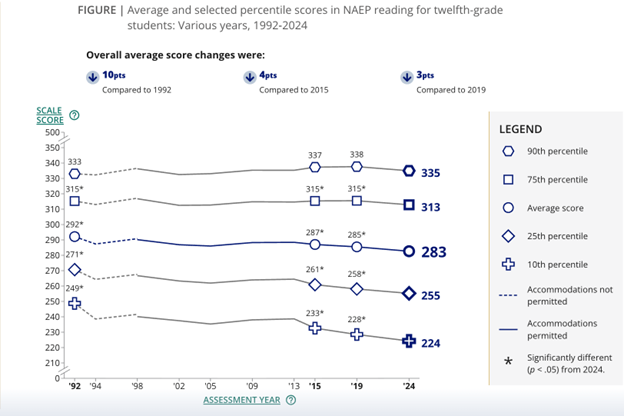
Achievement gaps are also widening, calling into question diversity, equity, and inclusion (DEI) practices that were supposed to close gaps by helping the most disadvantaged students. The new NAEP results show that the gap between the highest- and lowest-performing quintiles has widened to 111 points today from 84 points in 1992.
Throwing money at the problem hasn’t helped, either. Inflation-adjusted spending per pupil has more than doubled over the past 40 years as performance has declined.
The reality is that it’s not how much money we spend that matters.
Secretary of Education Linda McMahon said, “Success isn’t about how much money we spend, but who controls the money and where that money is invested.”
In other words, it’s about incentives—and the incentives embedded in our current education system are perverse. Bureaucracies face no serious consequences for failure, while parents have little recourse when schools don’t deliver.
By contrast, Catholic schools aren’t subject to the same top-down regulations as district schools. Instead, like other private schools, Catholic schools are held directly accountable to parents. The result? Catholic school students significantly outperform their district school peers.
On the 2024 NAEP assessments for fourth- and eighth-grade students released earlier this year, Catholic school students outperformed district school students by a grade level in fourth-grade math, a grade and a half in fourth-grade reading, and approximately two grade levels in both subjects in eighth grade.
Real Accountability Is Bottom-Up, Not Top-Down
We’ve tried “accountability” from the top down—federal mandates, state testing regimes, elaborate school grading systems—and it hasn’t worked. Regulations should not be mistaken for accountability.
Real accountability comes from the bottom up, through transparency and choice. It means giving families clear, transparent information about school performance. And it means giving them the power to act on that information through genuine school choice.
Money should follow students, not systems. When parents can take their children—and the funding attached to them—to schools that actually work, incentives shift. Schools that serve families well thrive. Schools that don’t are forced to change—or close. That is the clearest path to reversing decades of stagnation and decline.
America’s students have already lost too much time and too many opportunities. The latest NAEP scores are a national alarm bell. The only question is whether we will keep hitting the snooze button or finally wake up.
Reprinted by permission from The Daily Signal, a publication of The Heritage Foundation
Views expressed in this article are the opinions of the author and do not necessarily reflect the views of The Epoch Times.
 Friends Read Free
Copy
Facebook
Tweet
Friends Read Free
Copy
Facebook
Tweet