
Commentary
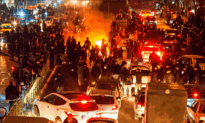
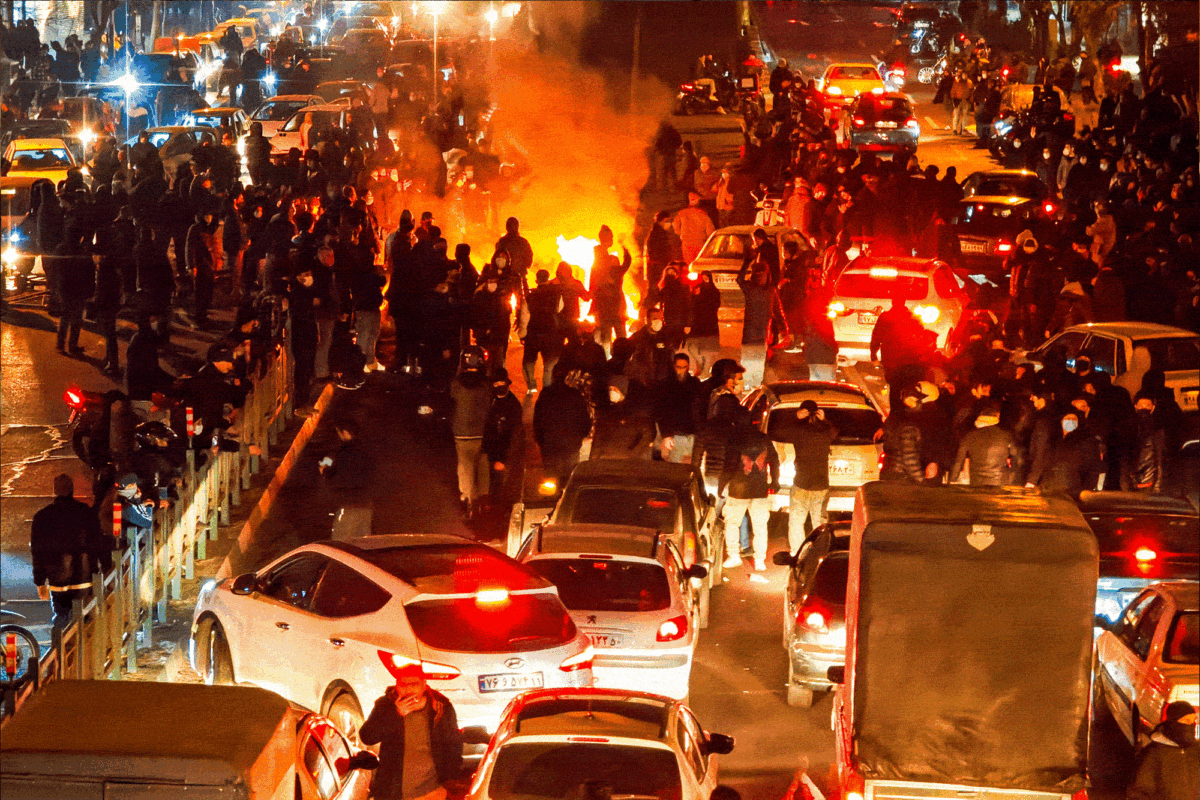
Grim reports are emerging from Iran of a high death toll following the regime’s violent clampdown on pro-freedom protests. Contrary to the regime’s narrative that these protests have been instigated from abroad, they appear to be grassroots in nature. They have been bubbling under the surface for many years, especially since the death of Mahsa Amini more than three years ago.
On the whole, Iranians are an educated and proud populace with a very long history. The Islamic Republic is basically a small blip (47 years) in a lengthy historical timeline. Growing numbers of Iranians are aware not only of the decimation of the regime’s proxies in the region and the neutralization of the mullahs’ nuclear ambitions, but also of freedom movements in Syria and Venezuela.
How do they gain different perspectives than those provided by Tehran?
Many Iranians have breached the communication firewalls that the regime implemented, and they learn about events outside of Iran from the media and Iranians living abroad. If the people of other nations can fight for freedom and opportunity, why not the Iranians?
Although brutal and lethal reprisals against the uprisings ramped up for several days, and pro-regime counter-protesters were ordered to march in the streets, the freedom fighters displayed courage. The rigid regime seems to be at war against its own citizens, with conflicting casualty figures tabulated by the clerical regime and the freedom fighters.
Since former Iranian leader Ruhollah Khomeini was installed in 1979, there have been several opposition activities carried out against the mullahs’ iron-fisted rule. They have all failed for a host of reasons and have illustrated how durable the regime is. However, that doesn’t make the regime palatable.
This time around, the protesters appeared to be better organized and relentless in their pursuit of regime change from within. Even if the protests have been tamped down in recent days, one wonders whether regime opponents are biding their time, waiting for another opportunity to take the movement further.
If the regime does fracture, what could happen?
Would elements of the armed forces come over to the side of the people?
Would there also be some clerical leaders from the Guardian Council who would call for certain reforms?
Would Crown Prince Reza Shah, the first in line to the late Pahlavi dynasty (1925–1979), return from exile and play a role in the formation of a new government? He is the son of Mohammad Reza Pahlavi, who was ousted prior to Khomeini’s return to Iran.
Although relations between Iran and the West were acceptable during the Pahlavi monarchy, life for Iranians wasn’t a paradise on earth. Certainly, women enjoyed greater rights and more opportunities, but if groups or individuals opposed the monarchy, they would have to deal with the dreaded secret police, the Bureau for Intelligence and Security of the State.
U.S. President Donald Trump has informed Iranians that help is on the way, but what does that mean? It could involve tougher financial sanctions on the regime’s oil sector, or it could mean surgical strikes against critical military targets without boots on the ground, in which Israel might play a role. What is likely is that the regime has started to rebuild Iran’s air defense and missile systems over the past six months.
The outcome of the current uprising is far from clear. Still, one can hope that greater freedom and opportunity can be achieved if courageous Iranians have the staying power to topple a regime that is a primary sponsor of terror in the world. If an overthrow is accomplished, one can only speculate about which political system would fill the void.
One area of concern for Iranians inside the country, as well as diaspora Iranians, is the possibility that China and Russia could supply the regime with advanced cyber capabilities and weapon systems to support regime survival. Or is it likely that China and Russia are enmeshed in their own domestic challenges and would remain at arm’s length from Iranian leader Ali Khamenei?
Those who support liberty hope and pray for the latter and not the former. We should also bear in mind that nothing is guaranteed. If the regime is ousted in the future, would the new governance system be better, the same, or worse than the current leadership? No one can predict what could unfold.
Views expressed in this article are the opinions of the author and do not necessarily reflect the views of The Epoch Times.
 Friends Read Free
Copy
Facebook
Tweet
Friends Read Free
Copy
Facebook
Tweet