Commentary
Mexican forces raided and arrested the cartel boss, Nemesio “El Mencho” Oseguera of the Jalisco New Generation Cartel (CJNG), on Feb. 22. He and his gang fled and shot back. “El Mencho” was shot during the operation. On his way to the hospital, he died.
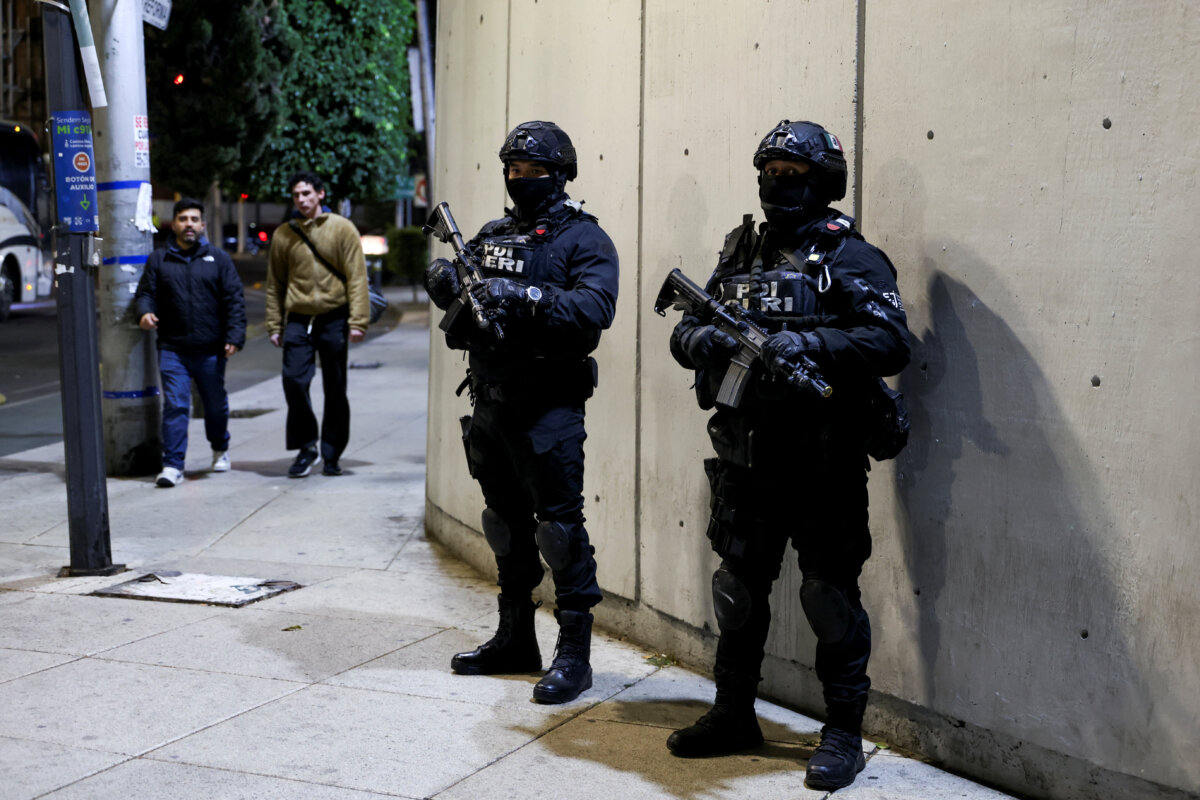
The same day, CJNG retaliated with arson, roadblocks, and killings. At least 50 branches of a bank and 200 convenience stores were damaged, and the entrances to cities were blockaded with burning buses. The cartel ambushed Mexican military installations, killing 25 of Mexico’s national guard.
The Mexican forces who fought against the CJNG are heroes. The ongoing operations against the CJNG will disorganize, deter, and decrease Mexico’s illicit drug exports to the United States, including cocaine, fentanyl, and heroin, and improve U.S.–Mexico relations. Following the capture and CJNG retaliation, Mexican forces continued to take action against the cartel, confiscating military-grade weaponry, including armored vehicles, rocket launchers, and high-powered rifles.
CJNG is also known to use mines, grenades, and armed drones. In most mid-sized cities under the cartel’s control, it can assemble a paramilitary group of about 50 men, sufficient to defeat the local police force. This gives the cartel extraordinary power over local governance.
In 2020, the cartel attempted to assassinate the chief of police in Mexico City. That chief survived and is now head of federal security. But other CJNG assassinations have been successful, including against a sitting judge, former state governor, and state security secretary. The group has massacred up to 35 citizens at a time. CJNG is rightly designated by the United States as a foreign terrorist organization.
The cartels have held territory in Mexico since the 1980s, when they started smuggling Colombian cocaine to the United States. CJNG is particularly strong in central Mexico, where it operates from coast to coast. It specializes in cocaine smuggling and controls ports on both sides of the country that give it easy access to precursor chemicals from China for illicit fentanyl and methamphetamine production. It can transport the precursors and cocaine across the country from port to port and beyond. Now that El Mencho is dead, his lieutenants will likely get into territorial fights with each other for these lucrative ports, smuggling routes, and production facilities.
The Mexican government has been soft on the cartels, so the Trump administration is publicly pressuring its leaders by suggesting that U.S. military operations could extend across the border to capture cartel bosses and terminate cartel labs. U.S. strikes could use armed drones as deployed against terrorists throughout the Middle East. The United States is already assisting Mexican authorities with intelligence, likely including through surveillance drones over Mexican airspace.
More help is needed. The cartel operates throughout Mexico and globally. It has corrupted and intimidated high government officials in Mexico. The intimidation likely goes all the way to the country’s president, who does not want the kind of disruption that followed the death of El Mencho.
According to President Donald Trump, President Claudia Sheinbaum of Mexico is not doing enough. “She’s not running Mexico. The cartels are running Mexico,” he said in early January. “She’s very frightened of the cartels … I’ve asked her numerous times, ‘Would you like us to take out the cartels?’” The answer has been a resounding no—at least in public.

Some Mexican citizens had sympathy for the cartel prior to its most recent violence. The cartel manufactured a cult of personality that raised El Mencho to almost godlike status. It handed out toys to children and boxes of food to citizens. It claimed to protect populations under its control from other cartel groups.
The question now that El Mencho is gone is whether the next level of commanders will fracture and create multiple CJNG splinters, leading to a civil war among them, or whether they will remain unified and choose one among them to lead the organization. Other cartels will likely attempt to use any confusion to launch further attacks against a weakened CJNG. A rise in fuel theft and extortion of lime and avocado plantations by small gangs is also likely.
Sheinbaum deserves credit for greenlighting the operation against El Mencho. Perhaps this was a turning point for her and Mexico. But Mexico does not have the sophisticated signals intelligence and long-range armed drone resources that are so effective against these kinds of asymmetric terrorist threats. The government has been infiltrated by cartel operatives at lower levels and intimidated at the highest levels, which makes it difficult for it to carry out operations.
So the United States could and should do far more in the fight against cartels in Mexico. This includes defeating El Mencho’s top lieutenants, who are already engaged in new cycles of violence. Lower-level gang members should also be arrested by the Mexican government. Illicit weapons exports from the United States to Mexico should be stopped.
The rest of the cartels, along with their international financial networks, should be dismantled, including the Chinese money laundering network used by CJNG. The supply chains that bring chemical precursors from China to Mexico for manufacture into illicit fentanyl should be interdicted at sea.
These requirements of U.S. national security are not easy, but they have been neglected for far too long. The United States will likely have to do much of this, as Mexican authorities will probably not take such a comprehensive approach. Nevertheless, to get Mexico as active as possible against the cartels, the United States should continue to use tariffs as a lever. Congress should ensure that this remains possible on national security grounds after the U.S. Supreme Court ruling against tariffs.
Without systemic action against the cartels in Mexico, along with their international operations, the Mexican government will remain under cartel influence, the illicit drug flow will continue largely unabated into the United States, and the flow could rise in the future. U.S. deaths from overdose in 2025 will likely come in at about 72,000. That number is down from the 110,000 who died in 2023, but cartels that were beaten in the past have revived when not completely eradicated. The best approach to cartel violence is a campaign of complete eradication from the lowest to the highest levels of the organization, using all means available by both the U.S. and Mexican governments.
The above is admittedly only a supply-side solution. The United States must also address the demand side of the problem. Addicts in the United States should be forced into drug treatment programs when they are found to violate the law. But this can be done simultaneously with a full-court press in Mexico. The more expensive illicit drugs are made by reducing the supply from cartels, the more successful the demand-side solutions will be. The full court press will likely need to include U.S. forces, whether or not the Mexican government agrees. As much of this should be done in coordination with Mexico, and with plausible deniability, so the Mexican government appears to be at the helm. But one way or the other, it must be done and soon.
Views expressed in this article are the opinions of the author and do not necessarily reflect the views of The Epoch Times.
 Friends Read Free
Copy
Facebook
Tweet
Friends Read Free
Copy
Facebook
Tweet