
Commentary
“America will never again give up the moon.”
This bold declaration was made by Jared Isaacman, administrator of NASA, during the agency’s March 24 “Ignition” series of phenomenal briefings that detailed plans for a moon base, a nuclear-powered spacecraft program, a transition to commercial space stations, and many science programs.
Isaacman was correct that America had given up on the moon.
Of course, NASA’s Apollo program “won” the moon in 1969 and sent 12 astronauts there by 1972, when Apollo was curtailed prematurely and Washington proceeded to flounder and waste this victory.
In April 2010, then-President Barack Obama famously canceled his predecessor President George W. Bush’s “Constellation” manned moon program revival, replacing it with an empty diversion to Mars and a hubris of denial that America faced any geostrategic competition in space.
Between Obama’s cancellation and the slow-walking of the Biden administration, the United States lost a nearly 10-year head start over China, which is now making rapid progress toward its goal of sending Chinese citizens to the moon by 2030 as part of a greater Chinese Communist Party objective to dominate the Earth-moon-Mars system and thence the solar system.
To be sure, NASA’s “Ignition” back to the moon is happening because of the insight and leadership of President Donald Trump, who revived the U.S. lunar program in December 2017 (Space Policy Directive 1), established the groundbreaking Artemis Accords for peaceful conduct on the moon in 2020, and earlier this year ordered NASA to return Americans to the moon before 2029.
Follow-up briefings made clear that NASA is already working to achieve Trump’s goal of a lunar return before 2029, while also advancing moon base planning with a speed and breadth critical to winning the strategically crucial race for the moon—building a presence that better deters Chinese aggression and ensures lunar access for the now 61 Artemis Accords partner nations.
Lori Glaze, acting associate administrator for NASA’s Exploration Systems Development Mission Directorate, and Carlos Garcia-Galan, program executive for the moon base, offered great detail regarding NASA’s moon base plans.
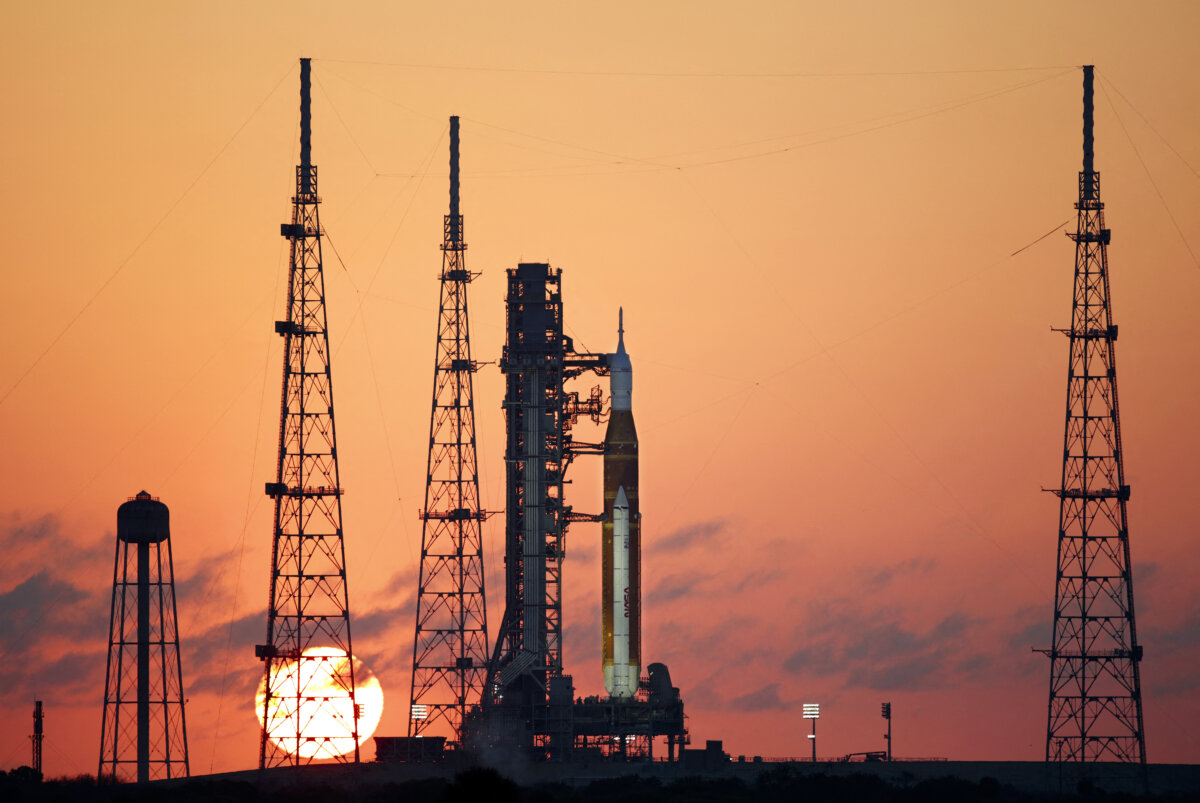
Glaze explained that the next three Artemis spacecraft missions to the moon are already underway: In early April, three U.S. astronauts and one Canadian astronaut launched the Artemis II circumlunar mission.
By 2027, a redesigned Artemis III could test “one or both” Human Landing System lunar landers in low Earth orbit, the development of which is now being accelerated by Elon Musk’s SpaceX and Jeff Bezos’s Blue Origin.
Initial mission elements are already being assembled for the planned 2028 Artemis IV mission, which will return two astronauts to the moon for five to seven days.
Isaacman and Glaze also stressed that there will be a second planned 2028 manned lunar mission, Artemis V, and that NASA will eventually work toward a lunar launch “cadence” of at least two lunar missions per year.
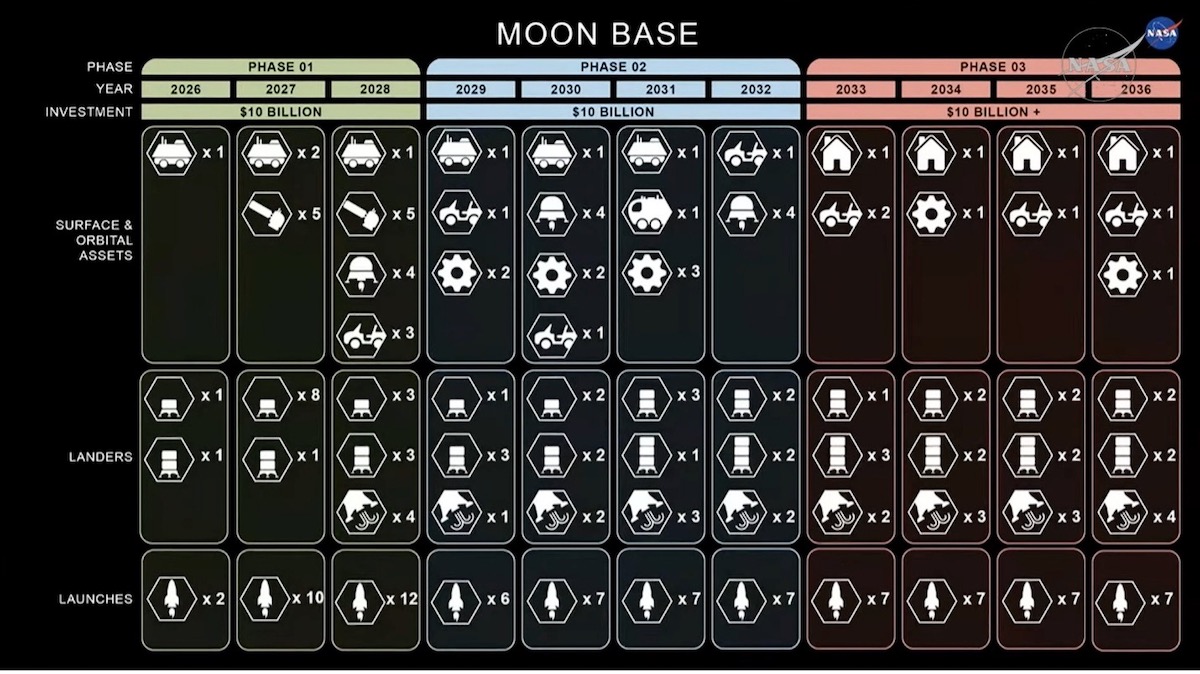
Garcia-Galan then proceeded to explain in further detail what NASA plans to do on the moon: a 10-year (2026–2036) $30 billion program that includes 79 lunar launches; 72 lunar landings, 24 of which could include manned crews; the transport of 11 small Lunar Terrain Vehicles (rovers) with one large pressurized crew rover; four large moon habitats; and two five-satellite lunar communication, navigation, and observation satellite constellations.
Isaacman made clear that NASA’s moon program will not require a “plus-up” in funding from Congress; he will be diverting funding and technology from other programs, such as the Gateway small lunar space station, to help build structures on the moon.
Garcia-Galan also made clear that most payloads sent to the moon will be equipped with cameras, so that anyone with access to the NASA website will be able to follow in great detail U.S. and partner activities on the moon.
The “Ignition” briefing revealed America’s plan not just to win the race with China to return to the moon, but also to win the more important race to populate the moon.
Even if China sticks to its oft-mentioned schedule to send its first astronauts to the moon in 2030, the United States will have achieved 37 lunar launches and 29 lunar landings for both unmanned and manned payloads by 2030.
So when Trump has his mid-May summit with Chinese leader Xi Jinping, he will arrive in Beijing as militarily ascendant on Earth, and with clear momentum to become the ascendant power on the moon—the current strategic high ground for Earth-space geostrategy.
Trump will have proved that he can not only lay low China’s terror-proxies on Earth, but also that he is capable of making sure that China’s capacity for inciting wars on Earth is not going to divert America’s drive for the moon.
At the conclusion of his opening for the March 24 “Ignition” introduction brief, Isaacman stated: “This is the moment where we should all start believing again. When ideas become missions, and when hard work delivers world-changing accomplishments, NASA once changed everything, and we’re going to do it again. The greatest days of science and discovery are ahead of us.”
Winning the race for the moon is now a strategic imperative for the United States and all other democracies; it deserves consistent American funding and political commitment, as well as the support of allies and Artemis partners.
Views expressed in this article are the opinions of the author and do not necessarily reflect the views of The Epoch Times.
 Friends Read Free
Copy
Facebook
Tweet
Friends Read Free
Copy
Facebook
Tweet