
Commentary
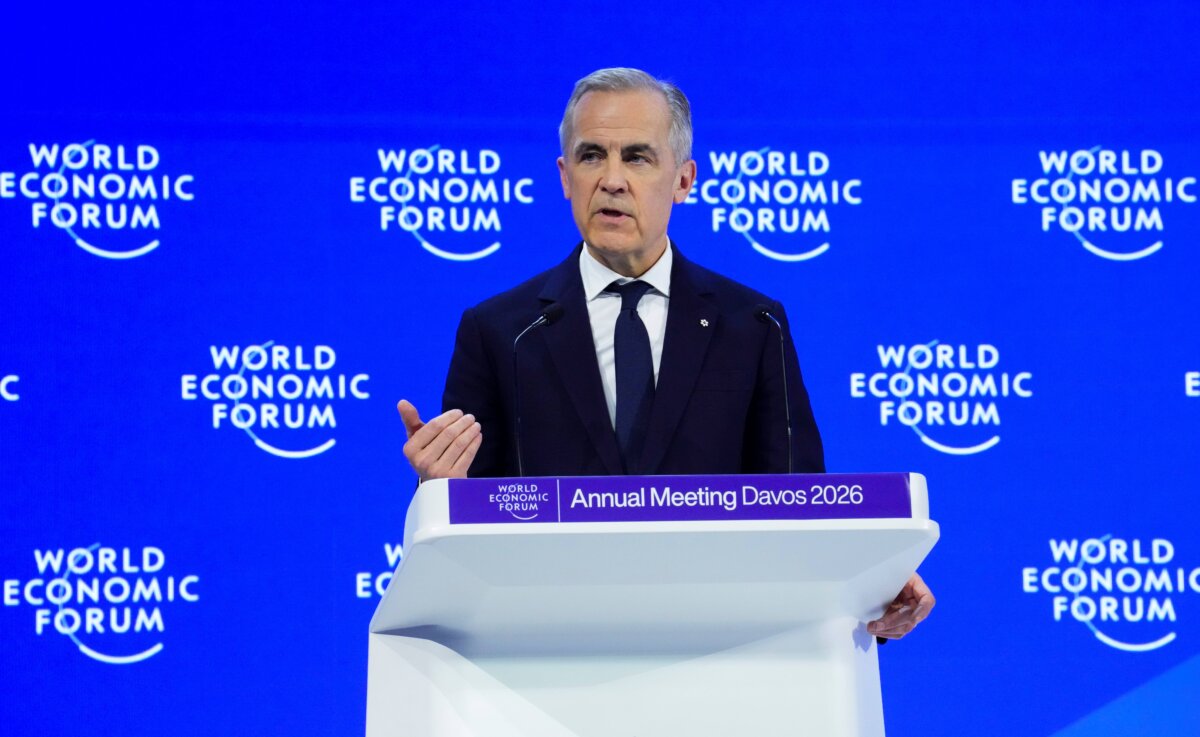
Although Prime Minister Mark Carney’s address in Davos was polished, ambitious, and fluent, it cannot be read in isolation from his remarks in China last week, where he spoke approvingly of a coming “new world order.” Those words are not neutral. They carry a long and troubling history, particularly when invoked in Beijing, where the phrase is often used to justify the erosion of liberal norms in favour of hierarchy, managed markets, and political control.
When a Canadian prime minister echoes that language, even indirectly, it risks lending legitimacy to systems that reject the very principles Canada claims to defend. Seen in that light, the Davos speech reads less as sober realism and more as an attempt to reconcile democratic values with an emerging order that is neither benign nor aligned with Canadian interests.
Carney is right about the diagnosis. The post-Cold War illusion of frictionless globalization has ended. Power matters again. Geography matters again. Energy, food, critical minerals, defence capacity, and industrial depth have returned as the foundations of sovereignty. On that point, there is broad agreement. The divergence begins with the prescription.
The speech frames Canada as a middle power whose future depends on coalition-building, variable geometry, and values-based realism. In theory, this sounds pragmatic. In practice, it risks becoming values-based abstraction, a framework that gestures toward realism while avoiding its hardest implications.
Canada does not need to reinvent itself as a country cautiously navigating between giants. We are a G7 economy, an Arctic nation, an energy superpower, a founding NATO ally, and the United States’ most integrated economic and security partner. Any serious strategic doctrine must begin from that reality rather than dilute it.
The speech repeatedly urges countries to name reality and stop living within a lie. Yet it hesitates to do so fully. It speaks of great power coercion in general terms, while avoiding clear distinctions between adversaries, competitors, and allies. More notably, it carries an undercurrent that portrays American power as something to hedge against rather than anchor with. This surfaces through repeated references to hegemons, transactionalism, and the need to build alternatives to existing centres of power.
That framing deserves scrutiny, particularly considering recent provocative and at times disturbing pronouncements by Donald Trump. Those remarks have understandably unsettled allies and markets alike. But it is a mistake to confuse episodic rhetoric with structural reality. The Canada-United States relationship is not a tactical arrangement calibrated to the mood of any single administration. It is a multi-generational partnership rooted in geography, integrated defence, continental supply chains, and shared strategic interests that will long outlast any one presidency.
Canada’s prosperity and security are not historical accidents. They are the product of proximity, defence integration, energy trade, and decades of alignment with the world’s leading liberal democracy. Diversification is sensible. Strategic distancing is not. Middle powers do not gain leverage by signalling ambivalence toward their principal ally. They gain it by being reliable, capable, and indispensable over time.
The speech also blurs a critical distinction between alliances and coalitions. Alliances are built on trust, shared risk, and long-term commitment. Coalitions are transactional and issue-specific. Both have their place, but they are not interchangeable. Treating them as such risks replacing durable security arrangements with flexible but fragile groupings.
There is also a gap between ambition and execution. The address cites sweeping domestic achievements and commitments: the removal of interprovincial trade barriers, rapid approval of major investments, doubled defence spending, and industrial renewal at scale. These are worthy objectives, but they remain largely aspirational. Canada continues to struggle with regulatory delays, infrastructure bottlenecks, procurement failures, and an inability to translate capital into production at speed. Declaring strength does not make it real.
One of the most telling lines in the speech is the claim that Canada will rely not only on the strength of its values, but on the value of its strength. That instinct is correct, but strength is not asserted abroad. It is built at home through disciplined public finances, credible defence procurement, reliable energy development, faster project approvals, and sustained support for productive industry.
Carney closes by urging Canada to abandon comforting fictions. That instinct is sound, but the fiction Canada must discard is not belief in alliances or shared norms. It is the belief that eloquence can substitute for leverage, that process can replace power, and that strategic distance from allies somehow enhances sovereignty.
Canada does not need to invent a third path between great powers. It needs to walk its own path with confidence, anchored in alliances that matter and the hard work of building strength at home.
In a harsher world, clarity matters more than choreography.
Views expressed in this article are the opinions of the author and do not necessarily reflect the views of The Epoch Times.
 Friends Read Free
Copy
Facebook
Tweet
Friends Read Free
Copy
Facebook
Tweet