Commentary
To make America healthy again, we must first shake up the one-size-fits-all factory model that dominates K–12 education. These years shape children during the most formative period of their lives, laying the groundwork for physical health, mental resilience, and lifelong success. Without a strong foundation built on movement, play, and individual attention, we cannot expect the next generation to thrive.
The roots of today’s system reach back to the Prussian model of compulsory schooling that the United States imported in the early 1800s. After suffering military defeats, Prussian leaders created the structure to ensure that they would never lose another war.
Schools were engineered to produce obedient soldiers and compliant factory workers, not curious thinkers or healthy citizens. That same rigid structure, devoid of any humanist ideals, still defines American public education two centuries later.
The Fall of Recess and the Rise of Obesity
Nearly 50 million children, as a rolling average, spend 13 years inside this government-run system. Each day, they sit for seven hours with almost no chance to move or play. Research has demonstrated that some attention-deficit/hyperactivity disorder (ADHD) diagnoses could be caused by adult expectations for children to engage in sedentary activity for long periods.
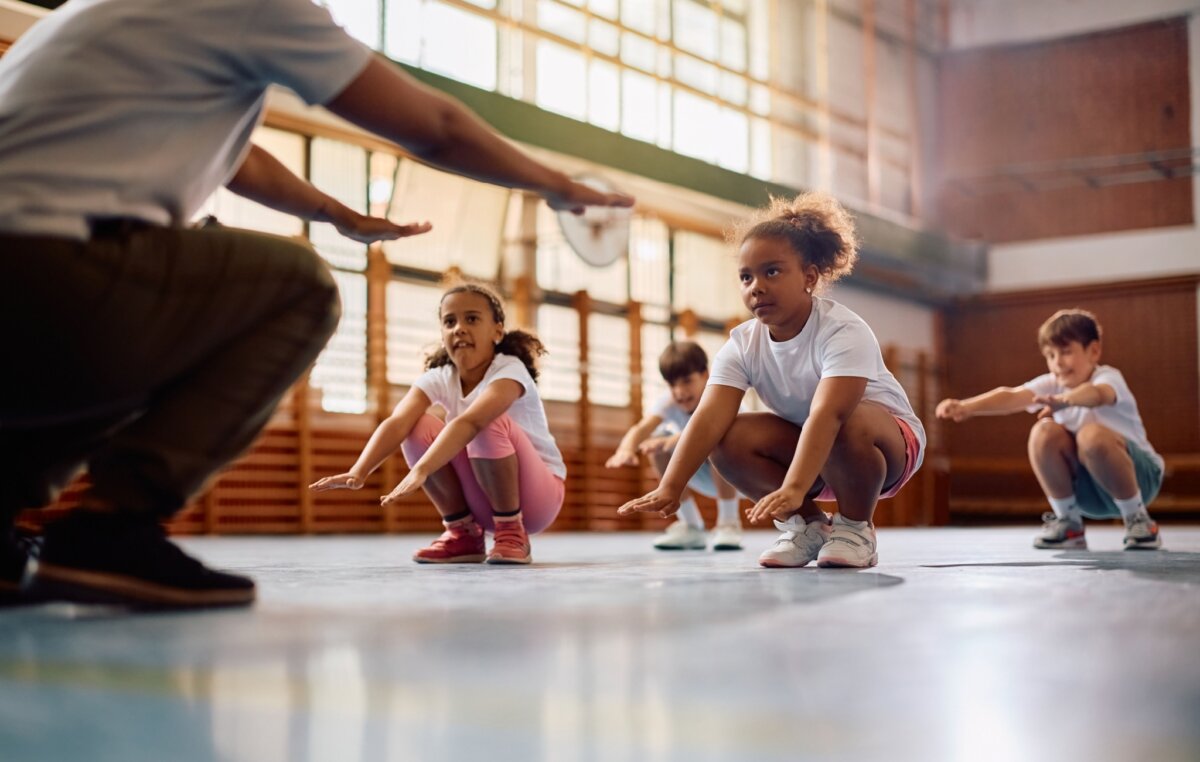
Nowhere is the mismatch more obvious than in the dramatic decline of recess. Since the mid-2000s, up to 40 percent of school districts nationwide have dramatically reduced or entirely eliminated recess. Recess time has fallen by 60 minutes since 2001, on average. The driving force behind these cuts was an intense focus on standardized test scores. But science demonstrates that obsession is likely to be counterproductive.
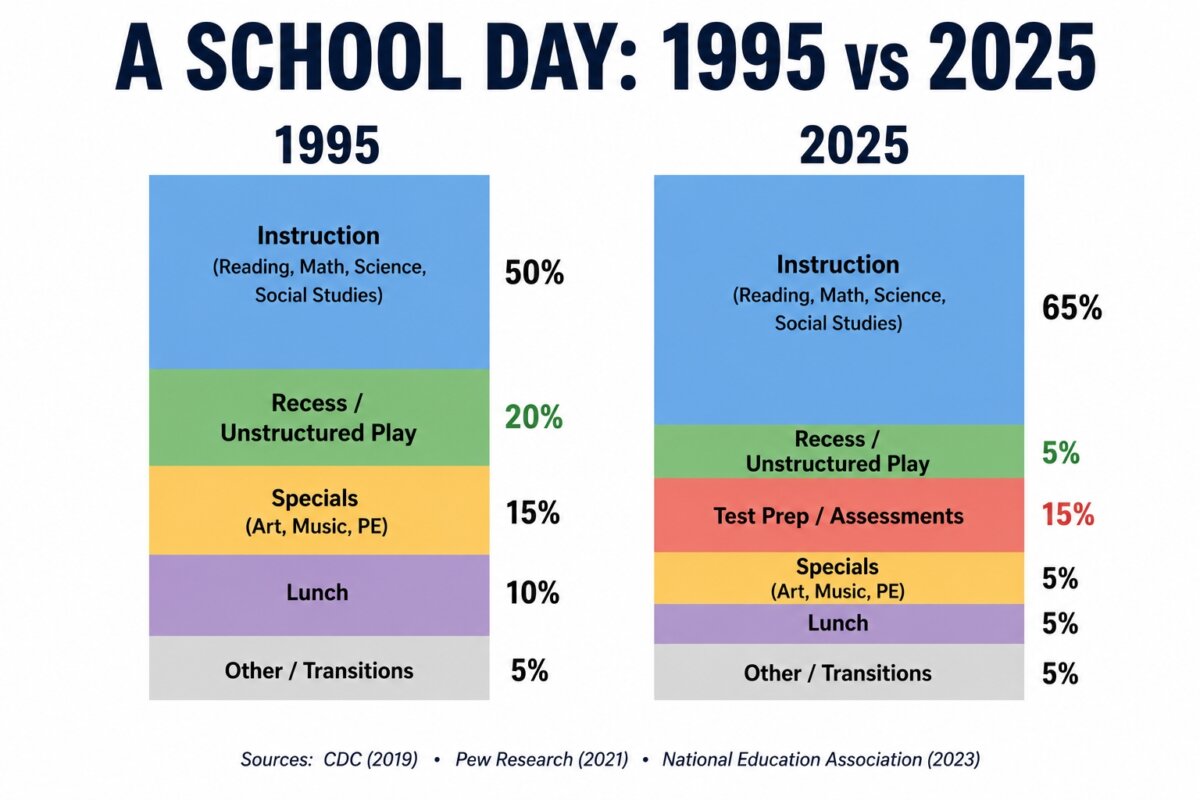
Research, including the federal government’s own, consistently shows that recess improves attention spans, reduces disruptive behavior, and boosts academic performance. Far from a distraction, unstructured play actually helps children absorb and retain what they learn.
Students in countries such as Denmark, Finland, Japan, and the UK regularly get breaks after every 45 or 50 minutes of instruction.
The death of recess has become such a serious concern that the American Academy of Pediatrics released updated guidance on the subject on May 11—the first revision in 13 years. The new recommendations call for at least 20 minutes of recess and multiple daily breaks, scientifically proven to support both learning and development.
One in five American children is now obese. This reality makes President Donald Trump’s push to revive the Presidential Physical Fitness Test especially timely. The program encourages schools to treat physical fitness as a core part of education rather than an afterthought.
I saw this approach in action during a visit to The Academy at the Parc, a microschool nestled in nature in Sebring, Florida. The campus follows a Waldorf-inspired curriculum that emphasizes hands-on projects, regular movement, and fresh meals prepared daily on-site. Many families there rely on Florida’s school-choice scholarships to make attendance possible. The difference in energy and focus among the students is unmistakable.
A similar model thrives at Alpha School in Austin, Texas. Students receive targeted instruction for only a couple hours each day and devote the rest of their time to hands-on projects and collaborative activities. The results speak for themselves: These children score in the top 1 percent nationally on academic assessments while staying active and engaged.
For traditional schools, the problems run deeper than structure and schedule. Public schools are not just failing to educate the minds of children, they’re also having negative impacts on their bodies. The meals served in those same schools often also undermine both physical health and academic achievement.
Medical Overreach in Public Schools
Authoritarians have long viewed compulsory schooling as the ideal vehicle for imposing medical decisions on families without genuine consent. Compulsory vaccination schedules for school attendance, even with limited exemptions for religious and medical reasons, are an especially controversial experiment in school-based social engineering. Those requirements are under review in states that prioritize parental authority and school choice.
During the COVID-19 pandemic, officials in Washington attempted to require the experimental 2022 vaccine as a condition of enrollment, from Head Start to high school. The data proving that students were not at risk from COVID-19 didn’t sway officials. They backed down only when the policy was found to disproportionately exclude minority students, who were less likely to have been vaccinated. Teachers unions also prioritized political goals over the well-being of students in engineering school closures.
Beyond the sticky questions of vaccinations, an arguably more insidious overprescription crisis in schools has escalated since the advent of No Child Left Behind. Unable to change the educational environment, teachers and school counselors have medicalized childhood impulsivity and increasingly used powerful psychostimulant drugs to alter children until they can conform. Classroom teachers, not pediatricians or even school nurses, are the most likely to suggest an ADHD diagnosis. A growing body of anecdotal evidence suggests that children diagnosed with ADHD frequently discontinue medication when they leave traditional schooling and enroll in microschools.
School Versus the Brain
The one-size-fits-none school calendar virtually guarantees that kids will lose much-needed sleep. Early-morning starts are dangerously disconnected from teenage circadian rhythms and are a primary cause of chronic sleep deprivation. Research links sleep disruption generally, and early school start times in particular, to poorer concentration, elevated anxiety and depression, and greater risk of obesity. Nearly all of those are also associated with energy drinks, which many students now rely on.
Schools that push their start times later report better attendance, superior academic performance, better physical health, and even fewer car crashes. But 90 percent of public high schools still start before 8:30 a.m., contrary to the recommendations of the Centers for Disease Control and Prevention and the American Academy of Pediatrics.
When discussing the mental burden of public school adolescents, we shouldn’t neglect the ideological and political pressures of the modern classroom. Students report that distress about climate change, national immigration raids, and other distant issues create anxiety and distraction. The school social environment itself can be a source of mental health or behavioral challenges: Teen suicides tend to mirror the school calendar, pointing to stress, bullying, and other pressures inside conventional schools. At the other end of that spectrum, assigning administrators to mediate student problems may also reduce opportunities to build psychological resilience.
The factory school system no longer fits the needs of American families or the health of American children. We must expand school choice, prioritize learning, restore recess, improve nutrition, strengthen physical education, reduce overmedication, build resilience, and protect sleep and play.
School choice provides the most direct path forward. When families can select microschools or homeschooling programs, children gain far more time for hands-on learning and genuine physical activity. With education freedom, every child has the chance to succeed. No child has to be stuck in a school that’s ignoring best practices. Only by breaking free from the outdated Prussian model can we raise a generation that is both well-educated and truly healthy.
Reprinted from The Daily Economy, a publication of the American Institute for Economic Research
Views expressed in this article are the opinions of the author and do not necessarily reflect the views of The Epoch Times.
 Friends Read Free
Copy
Facebook
Tweet
Friends Read Free
Copy
Facebook
Tweet