
Commentary
Madrid’s alignment with Beijing during the Iran war, including blocking U.S. military access and echoing Chinese Communist Party (CCP) narratives, signals a strategic shift that risks undermining NATO unity and deepening Europe’s dependence on China.
When the United States and Israel launched strikes against Iran on Feb. 28, Spain’s socialist prime minister, Pedro Sánchez, moved quickly to block it. Madrid refused to allow U.S. forces to use two jointly operated military bases on Spanish territory—Naval Station Rota and Morón Air Base—for operations related to the Iran war and later closed its airspace entirely to U.S. aircraft involved in the conflict.
Spanish Defense Minister Margarita Robles told the press that “neither the bases are authorized, nor, of course, is the use of Spanish airspace authorized for any actions related to the war in Iran.”
Sánchez framed the conflict as “an unjustified and dangerous military intervention.” He has since repeatedly described the U.S.–Israeli campaign as an “illegal, reckless, and unjust war.” That framing, invoking international law to oppose U.S. military action, was echoed in the Great Hall of the People in Beijing.
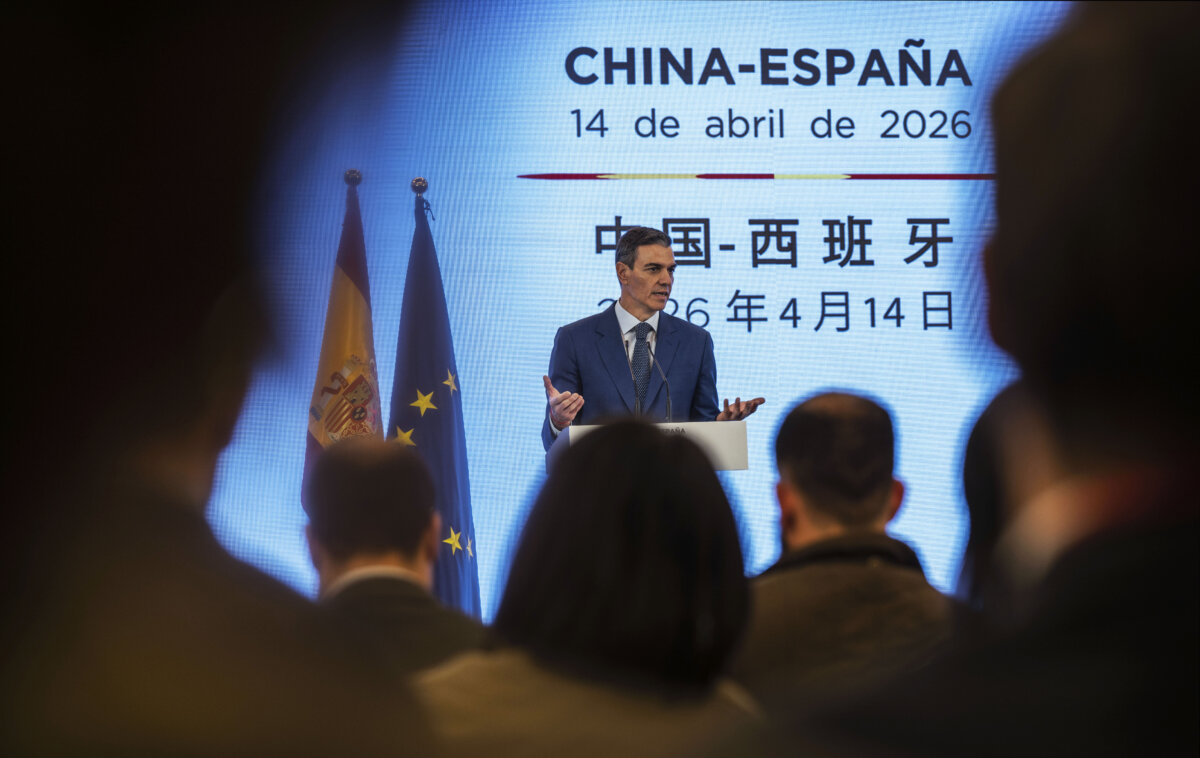
On April 14, just six weeks after blocking the U.S. bases, Sánchez arrived in Beijing for a meeting with Chinese leader Xi Jinping, his fourth visit to China in four years. Standing alongside Xi at a press conference, Sánchez made a statement that no other NATO leader has come close to making: “It seems very difficult to me to find other interlocutors who can untangle this situation caused in Iran and in the Strait of Hormuz beyond China.”
It was unprecedented that a head of government of a NATO member state was standing in Beijing and designating the CCP—not the United States, not the United Nations, not the European Union—as the indispensable power for resolving both the Iran conflict and the Ukraine war.
Sánchez blames the United States for the war, but the CCP has been supporting the Iranian regime for years, as part of its axis along with Russia, North Korea, and Afghanistan. Beijing purchases a large percentage of its energy from Iran and, in return, provides Tehran with money and technology, supporting the very missile, drone, and nuclear programs that are at the core of this current conflict.
In recent years, when the Iran-sponsored Houthis blocked trade in the Red Sea, Chinese ships were given a pass, while Spanish ships were not. The same is true of the current closure of the Strait of Hormuz, where Iran’s Islamic Revolutionary Guard Corps has stated at times that it would grant safe passage to Chinese vessels but has made no similar offer to Spain or to Madrid’s EU or NATO partners.
The visit to Beijing brought Spain even deeper into the CCP’s orbit. Sánchez announced 19 bilateral agreements with China, dominated by economic and trade cooperation, and confirmed the establishment of a new Permanent Strategic Dialogue with Beijing, a high-level bilateral dialogue mechanism China reserves for its closest partners.
However, the official name of the relationship is the Spain–China Strategic Diplomatic Dialogue Mechanism. Sánchez seems to have added the word “permanent,” suggesting his desire to portray the relationship as being closer than it may actually be. Even this slight change in phrasing should be a concern to EU and NATO partners, particularly the United States, as it signals a Spanish shift away from its Western partners.
According to Chinese state media outlet Xinhua, Sánchez told Xi that Spain “actively supports the four major global initiatives proposed” by Xi. These include the Global Development Initiative (2021), the Global Security Initiative (2022), the Global Civilization Initiative (2023), and the Global Governance Initiative (2025).
Xinhua reported that Sánchez stated that he “opposes a new cold war and the attempt to decouple and sever supply chains.” This language, referencing the need to avoid a new Cold War, is consistent with the CCP’s messaging, which Beijing pushes when any nation defies its demands or opposes its policy objectives. One example from this Sánchez visit is Beijing’s claim that Sánchez opposes redirecting supply chains away from China.
There are numerous legitimate reasons why Europe would benefit from directing its supply chains away from China that do not equate to a new Cold War. A country can choose to be less dependent on China without establishing an iron curtain and living under constant threat of war, as during the Cold War. However, “friendship” with Beijing is very much a zero-sum game, in which the CCP’s friends are those who go along with all policy objectives, and “reckless destabilizers” are those who oppose them.
Spain’s warming toward Beijing predates the Iran war. King Felipe VI paid a state visit to China in November 2025, the first by a Spanish monarch in 18 years, deepening a relationship Sánchez has been cultivating at the highest institutional level since taking office.
In response to Spain’s refusal to grant access to its base, U.S. President Donald Trump called Spain “terrible” and ordered U.S. Treasury Secretary Scott Bessent to “cut off all dealings” with Madrid.
“We’re going to cut off all trade with Spain. We don’t want anything to do with Spain,” Trump told reporters on March 3.
An internal Pentagon email obtained by Reuters later outlined options, including suspending Spain from NATO.
The dispute is compounded by a second grievance. Spain is the only NATO member that refused to commit to the alliance’s 5 percent gross domestic product defense spending target agreed to at The Hague summit last year, insisting that it can meet its capability goals at 2 percent.
Whether wittingly or unwittingly, Spain is serving the CCP’s dual objectives of weakening NATO and maintaining Europe’s dependence on Chinese supply chains.
Beijing has recently issued threats against the EU over its proposed “Made in Europe” program. China’s trade surplus with Europe already reached $83 billion in the first quarter of 2026. Meanwhile, oil and energy prices are rising in Europe by as much as 60 percent for some classes of energy because of the Iranian regime’s closure of the Strait of Hormuz.
The hope is that when the pain of enabling China becomes sufficient, Europe will join the United States in pushing back.
Views expressed in this article are the opinions of the author and do not necessarily reflect the views of The Epoch Times.
 Friends Read Free
Copy
Facebook
Tweet
Friends Read Free
Copy
Facebook
Tweet