
Commentary
Economists get fired up once a year over the Nobel Prize. It’s the only time of the year in which their science is taken truly seriously by a scientific body. Whomever gets the prize is then celebrated for the rest of his life. He is the toast of the town and his work cited with great authority. Following that person’s ideas then sets a career path for young professors and graduate students.
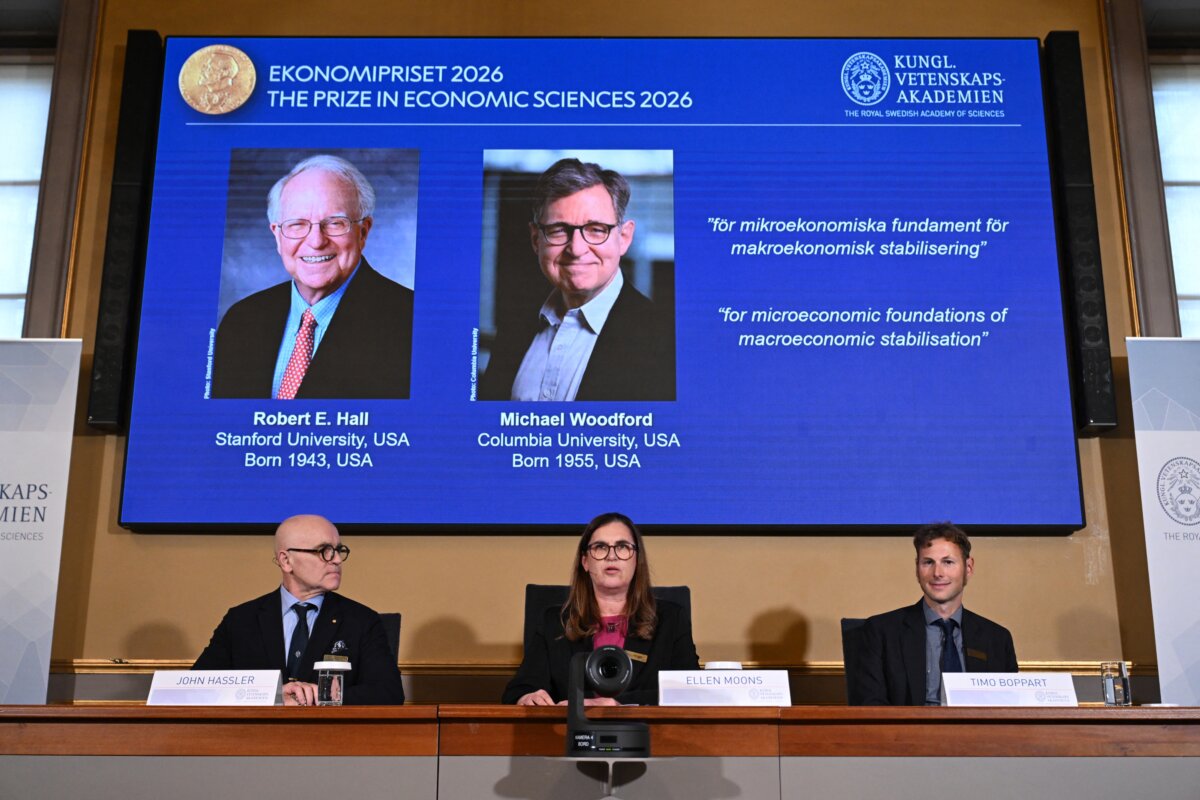
This year the prize goes to Robert Hall and Michael Woodford for their work on business cycles. The headline contribution is that they approached a macroeconomic problem—large-scale swings in economic activity—from a microeconomic perspective; that is, looking at individual decision-making and how it responds to policy changes.
The upshot of their work is supposedly to improve the operations of what is called stabilization policy. The idea is that planners need to anticipate the impact of microeconomic adaption to new policies. Yeah, I know what you are thinking: yawn. I share that sense.
They are part of a school of thought called the New Keynesians, given that moniker because they supposedly improve on the thoughts of the grandmaster of countercyclical policy John Maynard Keynes.
Their work and all in this field suffer from the same problem. They neglect the work done in the 1930s by F.A. Hayek and Ludwig von Mises that examines the underlying cause of business cycles in the first place.
Rather than map out better and more effective ways of leaning against cyclical activity, the Austrians sought to explain why the problem exists in the first place. Without a focus on that, all plans for stabilization will end up producing the opposite. No one has ever refuted the Austrians on this point. In fact, the Austrian theory of the business cycle is taught in all financial courses and is baked into all professional credentialing for financial advisers.
The theory is not neglected at all, except by economists themselves.
The Austrian story begins with a clear description of capital structures and the coordinating role of the interest rate in pricing out investment decisions over a range of time schedules. The mapping of these investment schedules is revealed in the yield curve that typically slopes upwards such that borrowers will pay a higher rate for longer-term projects than overnight lending.
When central banks play with the interest rate—typically to lower it to boost political and financial conditions—it sends signals to financial markets that are not consistent with underlying market conditions. They end up subsidizing longer-term capital projects in a way that is not sustainable over the longer term. Pressure builds as expected consumption fails to match investment patterns, thus producing clusters of errors. This is revealed in recessionary conditions.
The Great Depression (a response to previous boom) is still the clearest example but there have been many in the postwar period too, rounds and rounds of cyclical booms and busts that follow a predictable pattern, all kicked off by misbegotten monetary policy.
The beauty of thinking of business cycles this way is that it shows the real function of a pullback in output. Its purpose is to cleanse the market of poor decision-making, which is precisely why attempts to stabilize the markets through ever more intervention is such a bad idea. The recession is the needed corrective to an unsustainable boom, not a problem to solve but a solution to the distortion.
The last time a recession in the United States was allowed to take its course was 1980–82. The messaging at the time was to allow the pullback in output to prepare the ground for a more sustainable prosperity. That is exactly what happened as economic conditions boomed for the remainder of the decade.
That was also the last time that policy makers in the United States were completely honest with the American people: the recession is a price that must be paid in the same way that a hangover is the consequence of a boozy night of partying.
Since those days, the path of countering cycles with more credit manipulation has become the norm. It’s nowadays completely unthinkable that the Fed and the government generally would simply allow a downturn to take its course. And this is a massive problem; our capital structures have not been permitted to heal in 40 years.
We need only consider the most famous attempt at stabilization that we’ve seen in our lifetimes, the central bank’s response to the housing and financial crisis of 2008. It was Ben Bernanke’s idea to slam interest rates to zero with a wild bout of money printing to paper over the losses to the banking sector.
The inflationary consequences of this policy were avoided through a financial trick: the Fed started paying a higher-than-market rate for deposits, thus keeping the hot money off the streets. People waited for an inflation that never came.
What happened instead was the biggest distortion in production structures in the history of capitalism. With a zero interest rate policy, it was always advantageous to choose leverage over savings and capital accumulation. Indeed, those eschewing leverage were punished as thrifty chumps who don’t know what’s good for them. The resulting financialization of everything produced a boom with no foundation in savings and real production.
The Fed chair got the Nobel Prize himself and walked away from the mess he created. Even now, we have not shaken off the effects as markets worldwide have developed an intractable addiction to debt and an endless tsunami of paper. Finally the inflation arrived but the Fed finds itself out of tools. It cannot raise rates dramatically as it should because that would blow up borrowing costs by the federal government, loan service that would inevitably be paid by more money printing.
So this is where we are, stuck in a zero-interest rate world. Once you adjust current rates—even if they seem high by comparison—by the inflation rate, you get right back where we were back in 2008. Bernanke created a policy mess without a solution.
In a wide-ranging interview in Time Magazine, President Donald Trump was asked about the explosive debt and the concern over default. He pushed back and said there was no way that the government would ever default because we can always just print the money. He added that the debt might ultimately be paid off through inflation.
It’s a shocking comment but he was only saying what everyone else knows by now. The only 2 percent target for inflation is no more. The Fed has already given up on it. By now, it is a settled truth that inflation for the duration is going to run between 3 and 4 percent. That’s the new reality of our lives. It’s brutal and leads to continued decay in living standards but that’s where stabilization policy has gotten us.
This is a policy that cries out for repudiation on both theoretical and empirical grounds. Instead, the architects are being given a Nobel Prize. This is sheer folly but consistent with so much else in public life today: we choose the path of error over the path of truth. The young professors and graduate students will go now and do likewise.
Views expressed in this article are the opinions of the author and do not necessarily reflect the views of The Epoch Times.
 Friends Read Free
Copy
Facebook
Tweet
Friends Read Free
Copy
Facebook
Tweet