
Commentary
When people today speak of “old movies,” they mostly mean the 1980s or 1990s. Not I. Most of my favorite films date from the early 1930s through the 1950s. The dramas and musicals have the most appeal, especially the Busby Berkeley extravaganzas (astonishing spectacles) and anything with Fred Astaire.
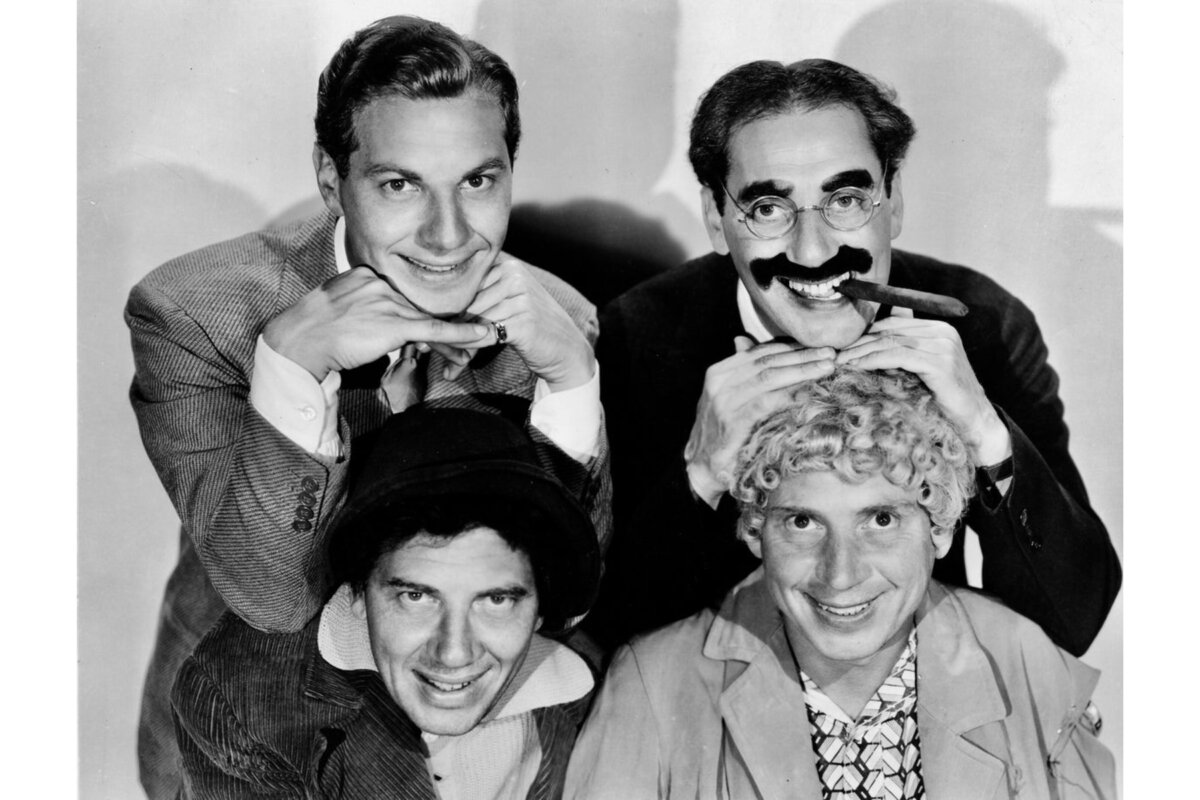
And yet there are the pure comedies, especially the Marx Brothers. They are funnier now than ever.
During the Great Depression, the point of the cinema (probably true today too) was to provide a delightful escape from the sadness and toil of extremely hard times. It was 90 minutes in which one could see and experience something wholly different.
It’s hard to imagine what a movie, especially one that talked, would have meant in those days. It was a technological miracle, a sign that life can get better and that not all is loss. That was a rather important reminder in those days.
Plus, these films make for revealing cultural history. They often show fantasy worlds; that’s the idea. But they reveal what that generation regarded as opulence, deviance, humor, and seriousness. In some ways it all looks familiar but strangely foreign, from the way people dressed to their use of language, especially literary references and slang that have since fallen out of use.
Watching nearly any Marx Brothers film is still a delight after nearly a century. I think often about the generation that saw these movies for the first time, with amazement and endless hilarity, not to mention the constant stream of intelligent puns and predictably absurd twists. If you had told people back then that they would still be watching them in the 21st century, they surely would have been stunned.
The short list: “Animal Crackers” (1930), “Monkey Business” (1931), “Horse Feathers” (1932), “Duck Soup” (1933), “A Night at the Opera” (1935), “A Day at the Races” (1937), “Room Service” (1938), “At the Circus” (1939), “Go West” (1940), “The Big Store” (1941), and “A Night in Casablanca” (1946). They are all delights.
A note, however: People unfamiliar with this genre can confuse The Marx Brothers with The Three Stooges. They are in fact worlds apart. Stooges is straight slapstick, mostly ridiculous with a working-class appeal, but offering very little in terms of intellectual stimulation with a low level of erudition. Obviously. That’s the whole point. Personally, I’m not a fan.
The Marx Brothers are completely different. They were five brothers from a working class family of Jewish immigrants in the early 20th century. Yes, Marx was their real-life name from their father Samuel “Frenchie” Marx, who was a tailor. The kids were educated in a conventional way but excelled at the arts and music. They began to perform on the Vaudeville circuit and gradually made their way to Broadway and then to Hollywood as technology improved. By then, they had perfected their various personas and their act, as only brothers can.
It was pure magic, every bit of it, with Groucho taking the lead but the others just as distinctly hilarious. Often the early films emphasized their performance arts: Harpo as an incredibly talented harpist, Chico as a fantastic trick pianist and singer with a fake Italian accent, and Groucho as a wonderful dancer and silly vocalist. My goodness, they were funny.
I just watched “Horse Feathers” (1932) with family friends with some kids around. The film was racier than I remembered, to be sure, but the double entendres were lost on them. Mostly they found the action hilarious.
It tells the story of a new college president—Professor Quincy Adams Wagstaff—of a prestigious but failing New England institution, one of hundreds left from the old world. It was named Huxley College—yes, after Thomas Huxley, the 19th-century biologist. The rival school: Darwin College. That gives you a sense of the tone: very high and very low at once.
The gag here is the same with most of the Marx Brothers. Groucho, Harpo, and Chico swirl around a world of normal, settled, stodgy people and introduce chaos and indignities with intelligence and wit, while everyone else keeps hoping that normalcy will soon return. It never does. The contrast between the anarchic players and the fixed and settled world around them is the running plot in every film.
The Marx Brothers repeat this theme in many settings: the department store, politics, the Old West, the opera, the races, and so on. Groucho shows up as the manager, the prime minister, the gunslinger, the producer, the gambler, always the head of something, and makes successive levels of messes while everyone else is shocked but trying to keep it all together.
It’s always the same and always funny. As to the titles of the films, your guess is as good as mine. The early ones seem to have no point at all. “Duck Soup,” for example, is the greatest sendup of statecraft and war ever put to film, hands down, no question. Why the name? Don’t know.
In “Horse Feathers,” the college is failing financially and turns to the new president to find the answer. President Wagstaff makes his position clear in the beginning with a wonderful song:
“I don’t know what they have to say, It makes no difference anyway, Whatever it is, I’m against it. No matter what it is or who commenced it, I’m against it. Your proposition may be good, But let’s have one thing understood, Whatever it is, I’m against it. And even when you’ve changed it or condensed it, I’m against it. I’m opposed to it. On general principles I’m opposed to it.”
And so on. We all know people like that. Often this song comes to mind when I follow the actions of Congress and the government generally.
He discerns that the real problem is that the football team keeps losing games. He decides to recruit players from the local speakeasy.
The point is not the plot but the jokes. Among my favorite concerns is the password to get into the speakeasy. The answer is the word “swordfish.” Chico is charged with guarding the door while Groucho wants in. The following exchange happens.
Baravelli (Chico): (guarding the door) Hey, I tell you what I do… I give you three guesses. It’s the name of a fish.
Professor Wagstaff (Groucho): Is it Mary?
Baravelli: Ha ha! Atsa no fish!
Wagstaff: She isn’t? Well, she drinks like one. Let me see… Is it sturgeon?
Baravelli: Hey, you’re crazy! A sturgeon, he’s a doctor cuts you open whena you sick. Now I give you one more chance.
Wagstaff: I got it! Haddock!
Baravelli: Atsa funny, I gotta haddock too.
Wagstaff: What do you take for a haddock?
Baravelli: Well, sometimes I take an aspirin, sometimes I take a calomel.
Wagstaff: Say, I’d walk a mile for a calomel.
Baravelli: You mean chocolate calomel? I like-a that too…
Very funny, but watching it today, you discover some of the jokes are lost on us. Calomel was mercurous chloride, essentially a mercury poison mistaken for medicine. It was in common use, a shocking fact to discover. Groucho flips it by invoking the slogan for Camel cigarettes: “I’d walk a mile for a camel.” Yes, cigarettes were not only advertised on radio but also recommended by doctors.
Chico flips it again by confusing the word with caramel, as in the candy.
Imagine that flying by very fast and you get a sense of the type of humor here. See what we can learn about the past from this?
One encounters other peculiar cultural archetypes that have vanished in name. Wagstaff’s son attends the college and has for 12 years. He never graduates because he spends all his time with the “college widow,” a glamorous 20-something woman who lives well and is forever dressed in what looks like a silky cocktail dress (played by the talented Thelma Todd).
The term “college widow” referred to a townie woman who dates the seniors: a widow because the boys are always graduating and moving on. It is in this context that we are given the song “Everyone Says I Love You.” This was later resurrected by Woody Allen in a movie by that name.
See what you can learn from our cultural history?
The film also fully anticipates the central problems of modern college education: the tension between sports and academics, the struggle between high standards and continued revenue streams, and the impossible tedium of faculty meetings, not to mention corruption at the highest levels. It was all there and perfectly foreseen in this film from 1932!
There are ways in which I could critique the Marx Brothers genre of films. The stodgy old world they are forever trolling had a lot to say for it actually and was not nearly as ridiculous as the films make it to be. That said, sometimes it is enough just to enjoy something and laugh, which is precisely what these movies make possible.
Views expressed in this article are the opinions of the author and do not necessarily reflect the views of The Epoch Times.
 Friends Read Free
Copy
Facebook
Tweet
Friends Read Free
Copy
Facebook
Tweet