
Commentary
I asked a woman who lived past her 100th year what the best innovation was in her lifetime. Was it radio or TV? The internet? Flight? The washing machine?
Her answer shocked me. It was the radiator that provided indoor heat. That’s what changed her life completely. Nothing else touched her so deeply, rearranging life priorities.
Before that, she remembers, most of her time was spent tending the fireplace to keep the homestead warm during cold Northwest seasons. When she was sick or had to be elsewhere, she had to arrange a replacement from among siblings.
It was not just an annoyance. It was a full-time job, and a dirty and arduous one at that.
I found that remarkable but did not really understand until this past weekend. I experienced just one element of what it is like to keep a fire going in a fireplace for days and evenings over several days.
Mind you, I did not have to fell the trees, chop the wood, and stack the wood. That was already done, resulting in a huge area toward the side of the house with beautifully stacked wood. It’s been there from three years ago and will likely last another season.
My first task was to gather the wood and bring it indoors. This has to be done several times per day or in three or four trips once per day.
It would amaze you how much wood a fireplace consumes.
It’s not that fireplaces are unknown today, but they have been replaced by ceramic logs and gas lines. The romantic in me has always regretted that a bit, on grounds that it is too much an acquiescence to convenience over the rudimentary experience of burning logs, complete with the great smell and sound that no amount of electronic or petroleum products can replace.
Can we get back some authenticity here, and stop replacing the physical world with fakes and trompe l’oeil? At least we should surely seek every opportunity to return to basics.
Romance is one thing, and reality is another.
Building the architecture of the wood for the fire is a learned skill, involving spacing it properly to keep the air flowing and choosing the right logs that will settle in a gentle downward motion once burned rather than spill everywhere and create a mess.
Then the first challenge presents itself: how to go from a cold fireplace to one that is roaring high enough to provide heat to the room. No fair using petroleum starters and other tricks. Embracing the real involves small pieces of wood and paper, lighting with a match and blowing enough air to keep the fire from burning itself out. This can take as much as 10 to 15 minutes, but when it works, it is truly satisfying. It feels like a great achievement.
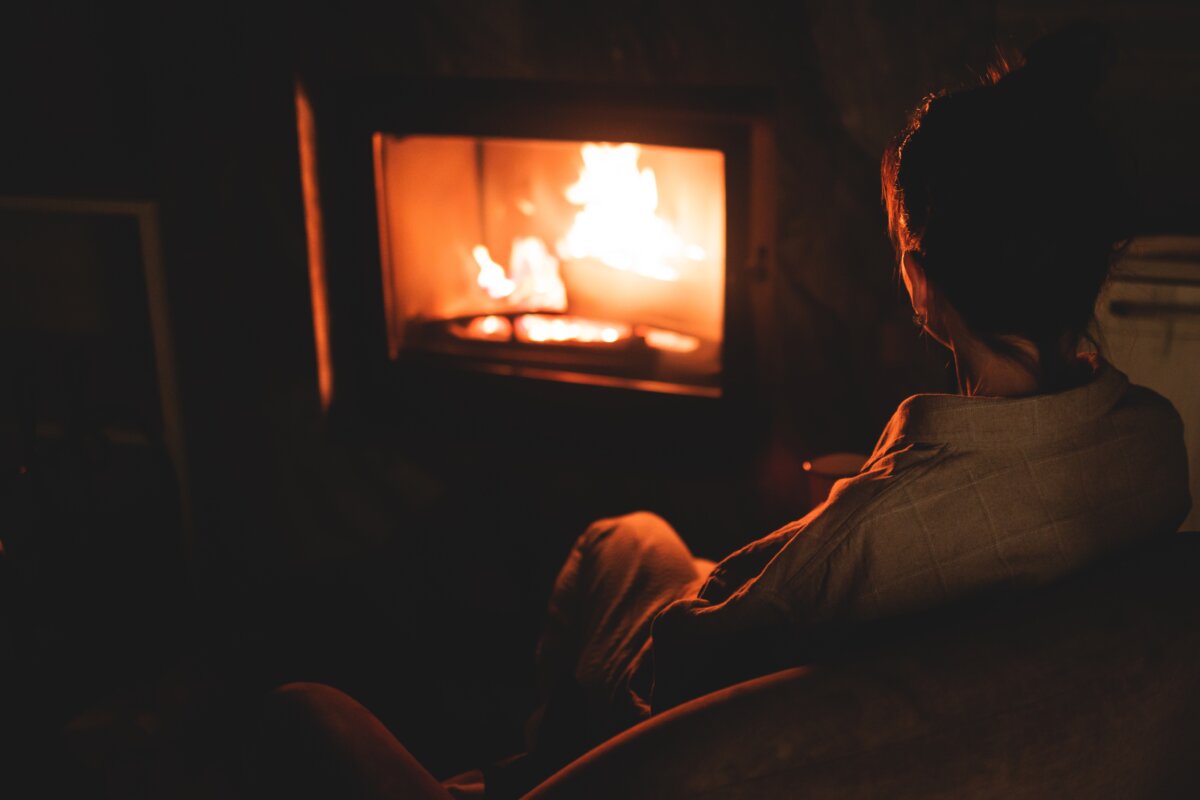
Once that part is done, you can sit back and relax, but not for very long. Depending on how wet or dry the wood is, you are likely going to be back at the fire every 45 minutes to an hour, adjusting logs or putting new ones in, sometimes picking them up with your hands, making sure to only touch the parts that are not hot coal, or otherwise manipulating them this way or that with a tool.
Time to relax again, but you will be back up before you know it. If you get lost in reading or talking or otherwise get too distracted, the fire will start to burn out, which is a bit of a humiliation if your goal is to have a fire all day. When you see this happening, you feel an implicit rebuke of your negligence.
Plus, restarting a fire that has died down requires huffing and puffing and not just a bit of it. You can find yourself kneeling down in front of the fire for 10 to 15 minutes, grateful for every pack of cigarettes you did not smoke.
However, it’s quite the exciting task, because as the logs heat up again, they begin to smoke and smoke more. You sense the moment coming but cannot anticipate it exactly. At some unpredictable moment, there is a flash boom. The fire appears, almost like magic, as if it had been hiding there the whole time and only revealed itself once compelled.
This moment, of course, elicits a great smile and internal joy.
The process starts over again, up and down, tending the logs, moving burn pieces this way and that. Halfway through the day, the available wood begins to diminish, sending you out into the cold again to gather more and get it inside. You build the fire to stay warm, but several times in the day, you are suiting up again to face the elements outdoors.
In times when genuine heroism is not exactly a daily experience for most of the professional class, this process can feel like quite the achievement. It also feels uniquely gendered toward men, which provides a satisfaction of its own. Indeed, the gradual coming to an end of the authentic household fireplace has meant the elimination of one of the last tasks in the home that call forth uniquely masculine skill sets.
Another point to notice is that the person who is tasked with this responsibility unavoidably absorbs the smell of smoke: on hands, in hair, and all over one’s clothing. Go to sleep like that and you transfer the smell to the bed. In fact, the entire house has that smell, in any case, as does everyone in it.
There is simply no way to keep the smoke entirely out of the house. Ideally, the heat moves in and the smoke goes up the chimney, but it is a delicate balance that is never finally realized.
Doing this for a day might sound like fun, and it truly is. But one can easily imagine that if this routine occupied you for one-quarter or one-third of the year, every year for your youth and adulthood, it might be a bit much. You can see how a generation in the 1920s or so was thrilled beyond description to gain the magical benefit of radiators running on hot water. It must have seemed like the dawn of heaven on earth.
Today, we treat fireplaces as luxury goods and flatter ourselves into thinking that we are doing things the old-fashioned way by building a fire in them. It is truly a delight to do so, and also a great pleasure that we do not have to do this if we don’t feel like it.
The apartment building next door to me was built in the 1880s, such that every unit has a fireplace, even those on the fourth floor. I’m trying to imagine how this worked. The pile of wood next to the fireplace would have to be gigantic to last an entire season, and surely it would be crawling with bugs. There must have been services to deliver this wood because going up four flights of stairs with wood in tow (from where?) does not seem particularly viable.
Maybe they delivered wood weekly or monthly. Hard to know how it would otherwise work.
All these units eventually had radiators installed in them, so using the fireplaces or not became an option. I toured a top floor apartment with some friends who were considering taking the place, and they were giddy with the idea of having a real fireplace in their apartment. I, too, thrilled to the idea.
However, I’m guessing that it would turn out to be different in this setting than it was 100 years ago. The fireplace would be lit only on special occasions, only for the aesthetic value for cocktail parties and dinners, and not because one needed it to stay warm.
Consider the word “fireplace” itself: It is intended to identify a function separate from what was once called the hearth. The hearth was the place in the home that provided warmth to endure the winter, plus other functions: baking bread, boiling stews, heating irons for clothing, boiling sheets.
The hearth was the center of the household and needed constant and unrelenting tending all year to keep the home life functioning. The hearth wasn’t just heat; it was the literal and symbolic center, including storytelling, cooking, and gathering.
Modern living rooms are just for sitting with TVs or devices instead. We’ve gained comfort and time but have traded it for detachment and atomization.
The hearth, meanwhile, is extinct, except perhaps in high-end homes that seek to recreate the past as a luxury good to consume for purely aesthetic reasons. Did we lose something with the advance of technology? Certainly we did.
The same is true of the fireplace itself. For my own part, I enjoyed my time struggling with the experience but feel gratitude that I need only pretend to do things the old way.
Views expressed in this article are the opinions of the author and do not necessarily reflect the views of The Epoch Times.
 Friends Read Free
Copy
Facebook
Tweet
Friends Read Free
Copy
Facebook
Tweet