
Commentary
I was late to the spirit of Liberty event honoring Rep. Chip Roy (R-Texas) and his office Saturday night. I had spent the afternoon at a meet-and-greet with readers of The Epoch Times in Houston, and Houston is nearly four hours from Kerrville. By the time I walked into the conference room at the Y.O. Ranch Hotel, the evening was already underway.
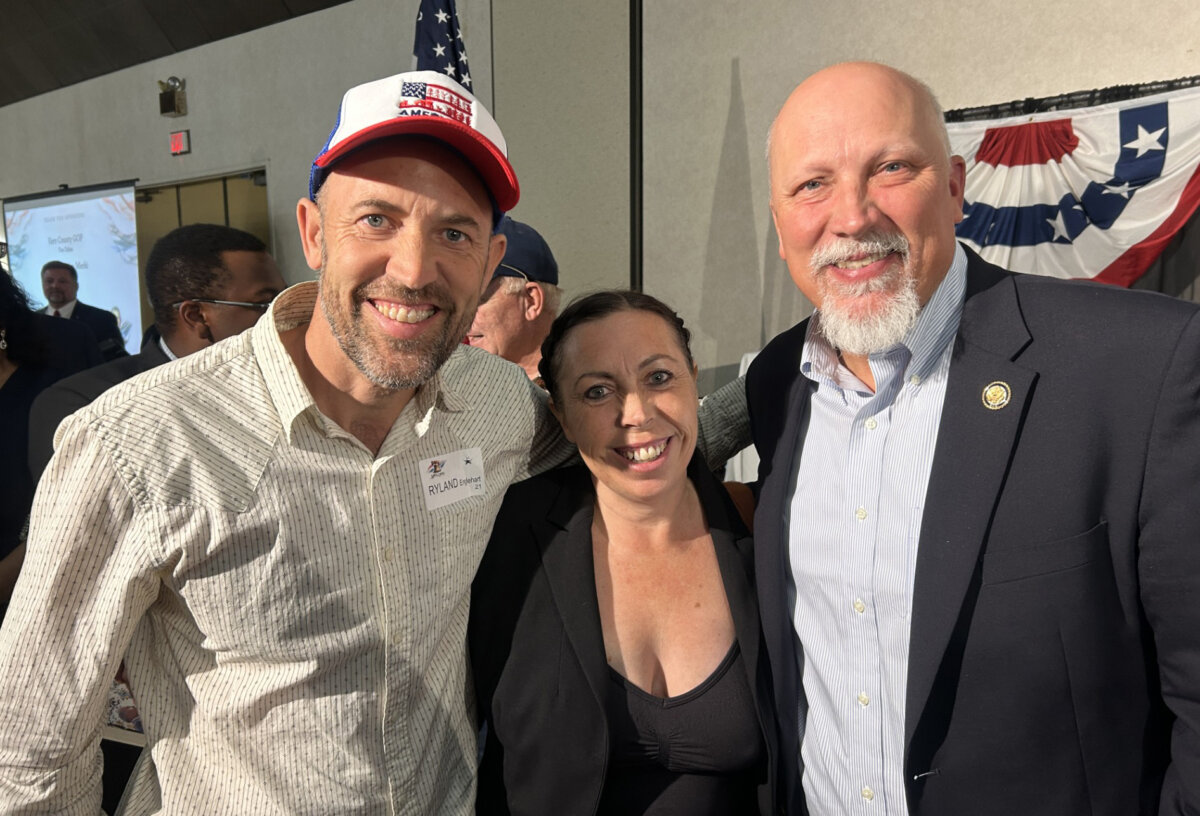
The room looked like someone had opened several chapters of American history at once. Some guests wore colonial clothing. There was a Benjamin Franklin, women in beautiful dresses with corsets laced up the front and back, American flag shawls, and baseball caps proclaiming the wearers’ commitment to one part or another of the conservative movement. And, of course, this was Texas, so there were hundreds of cowboy hats. The tables were decorated with American flags. The entire room felt patriotic, but not in the glossy, professionally staged way of a campaign event. It felt homemade, heartfelt and deeply personal.
The evening was hosted by Texans Uniting for Reform and Freedom, known as TURF, and We the People: Liberty in Action. Terri Hall did an extraordinary job curating it. But underneath the costumes, flags, and speeches was one simple message: gratitude.
Roy chose not to seek reelection to Congress when he decided to run for attorney general of Texas. The attorney general’s office would have allowed him to continue serving Texas while being more rooted in the state, closer to his wife and their two teenage children, and away from the constant pull of Washington. He did not win that race. Now, after years in Congress, he will no longer be our congressman or our attorney general.
What struck me was how genuinely sad people were to lose him.
I have always liked Roy. During the COVID era, I remember watching him speak passionately to an almost empty chamber, calling out failures on both sides of the aisle. He has always had an unusual ability to argue his case, a gift for words and a willingness to say what he believes even when it would be easier to remain quiet.
But Saturday night was not primarily about legislation, votes, or speeches on the House floor. It was about what happened when ordinary Texans called his office and needed help.
Person after person described how Roy and his staff had made a difference in their lives. Some said he renewed their faith that there might still be good people in government. Others spoke about feeling seen and heard, and knowing that his office would be there when they needed it. Again and again, people stood to offer their gratitude. Many of them cried.
When Roy finally took the stage, he was clearly moved. He looked around the room and said it was a little like getting to attend his own funeral. Everyone laughed, but it was funny because it was true. People were saying the things we too often wait until someone is gone to say.
He told the room that his North Star would remain God and family. He also seemed almost uncomfortable with the praise. From his perspective, he said, he had simply done his job. Why shouldn’t lawmakers go to Washington and do what is best for their people? Why should that be considered extraordinary? The mandate is actually quite simple.
Maybe it should be simple. The reaction in that room showed how rare it has become.
Rafael Cruz, the father of Sen. Ted Cruz (R-Texas), also stood to speak. He offered an impassioned expression of gratitude, not only for what Roy had done for Texas, but for the role he said Roy had played in helping shape his son into the man he is today. When Rafael finished, he asked everyone in the room to pray over Roy and his wife.
He ended with a message that surfaced more than once throughout the evening: “God is not done with you.” No one in the room knew what would come next, but people clearly believed Roy’s work was not over simply because he had lost an election.
Roy did not pretend that losing the attorney general’s race meant nothing. He acknowledged his frustrations and factors he believed had influenced the campaign, but he did not dwell on them. Neither “attorney general” nor “congressman” was the title he used to define himself. The identities he emphasized were child of God, husband, and father.
That distinction provided another theme for the evening. Political titles are temporary. Elections are lost and terms end. Chip described a hierarchy in which government service came after God and family, not before them.
He also articulated an idea that is close to my heart through my work in the food sovereignty movement. He argued that government should not make people dependent upon it, but should create and protect the conditions in which independence is possible.
As someone who has owned businesses in multiple states, I have repeatedly experienced projects losing momentum when a new mandate, permit, or compliance requirement intervened. Those experiences are why his comments connected so directly to my work in food sovereignty and local agriculture.
His remarks distinguished independence from isolation. The room itself was filled with examples of people helping, supporting, and recognizing one another. The argument he presented was that public institutions should leave room for families, farms, businesses, and communities to act for themselves rather than making government their only possible source of support.
Angela Smith, founder and president of the Fredericksburg Tea Party, told a story that captured this better than any list of congressional accomplishments could. She had endorsed a candidate who ran against Roy. He would have had every political reason to write her off afterward. Instead, he met with her, gave her his cell phone number, and drove around San Antonio with her until they found a restaurant where they could sit down and talk. He wanted to know where they went from there and how he could help the Fredericksburg Tea Party accomplish what its members were trying to do.
That story stayed with me. Politics trains people to punish disloyalty. Roy chose relationship.
When I went to shake his hand, he knew who I was. He thanked me for the help our ranch provided during the Kerrville floods. He told me he had wanted to come to Sovereignty Ranch when Robert F. Kennedy Jr. visited, but they could not make the schedules work.
This was not the first time his office had made me feel seen. After I fed more than 4,800 people during the floods, Chip sent me a certificate honoring what I had done. But he did not put it in the mail with a stamped signature and three generic words of thanks. He sent a member of his staff, Terri Hall’s daughter, to hand-deliver it to me at a book signing at Schreiner University.
It arrived in a beautiful little blue binder embossed with the words “Congress of the United States of America.” Inside was a certificate of gratitude, but the words mattered more than the presentation. Chip acknowledged that I was new to the community. He understood that I was still getting settled and bringing my family here, and that no one could have expected me to jump into a disaster response. But I did jump in. He wrote that he could see feeding people was my ministry, that the community was grateful, and that all glory should go to God.
That is what so many people in the room were trying to describe. They had not simply received help from a government office. They had felt seen by a human being.
Representative government cannot survive as nothing more than a transaction between voters and officeholders. We are not just names in a database, constituent case numbers, demographic categories, or votes to be collected every two years. The promise of representative government is that someone goes to Washington carrying the interests and stories of actual people with him. Representation requires more than voting the preferred way. It requires remembering whom you represent.
The certificate did not change the number of people we fed or make the work more valuable. It told me that someone had noticed. The care with which it was written and delivered communicated something a form letter never could: You are part of this community. Your work mattered. We saw you.
That was also what I heard in Smith’s story and in testimony after testimony throughout the night. People were not praising a political brand. They were describing encounters in which power had not made a person too important to listen, remember, or return a phone call.
My exchange with Roy that night was small, but it reflected what so many others had described throughout the evening. He remembered people. He remembered what they had done. He knew his district as a community, not merely as a voting bloc.
That should not feel radical, but it does.
Most of us know the opposite story. We believe in a politician. We volunteer, donate, vote, and defend him. Sometimes the disappointment begins before he is even elected. Sometimes it arrives shortly afterward. The person who promised to fight gets absorbed by the machinery. The courage disappears, the phone calls stop being returned, and the people back home become useful mainly when another election approaches.
Often, when a politician leaves office, his constituents feel relieved. They are tired, angry, and disappointed by the difference between the person they elected and the person he became, and they are already hoping the next person will be better.
Saturday night in Kerrville was the opposite story.
The room was filled with people in tears because Roy would no longer be their congressman. They were not mourning a fantasy about who they hoped he might become. They were honoring what he and his office had actually done for them.
I do not agree with every vote cast by any politician, and I do not believe public servants should be placed on pedestals. But in a political culture built around promises that are quickly forgotten, it is worth recognizing the rare person who leaves office having exceeded the expectations of the people who sent him there.
Last night was ostensibly a tribute to Chip Roy. In some ways, though, it was also a reminder to everyone else in public office. People do not expect perfection. They do expect courage, accessibility, gratitude and a sincere commitment to serve.
Chip Roy said he was simply doing his job.
The tears in that room told us just how remarkable that has become.
Views expressed in this article are the opinions of the author and do not necessarily reflect the views of The Epoch Times.
 Friends Read Free
Copy
Facebook
Tweet
Friends Read Free
Copy
Facebook
Tweet