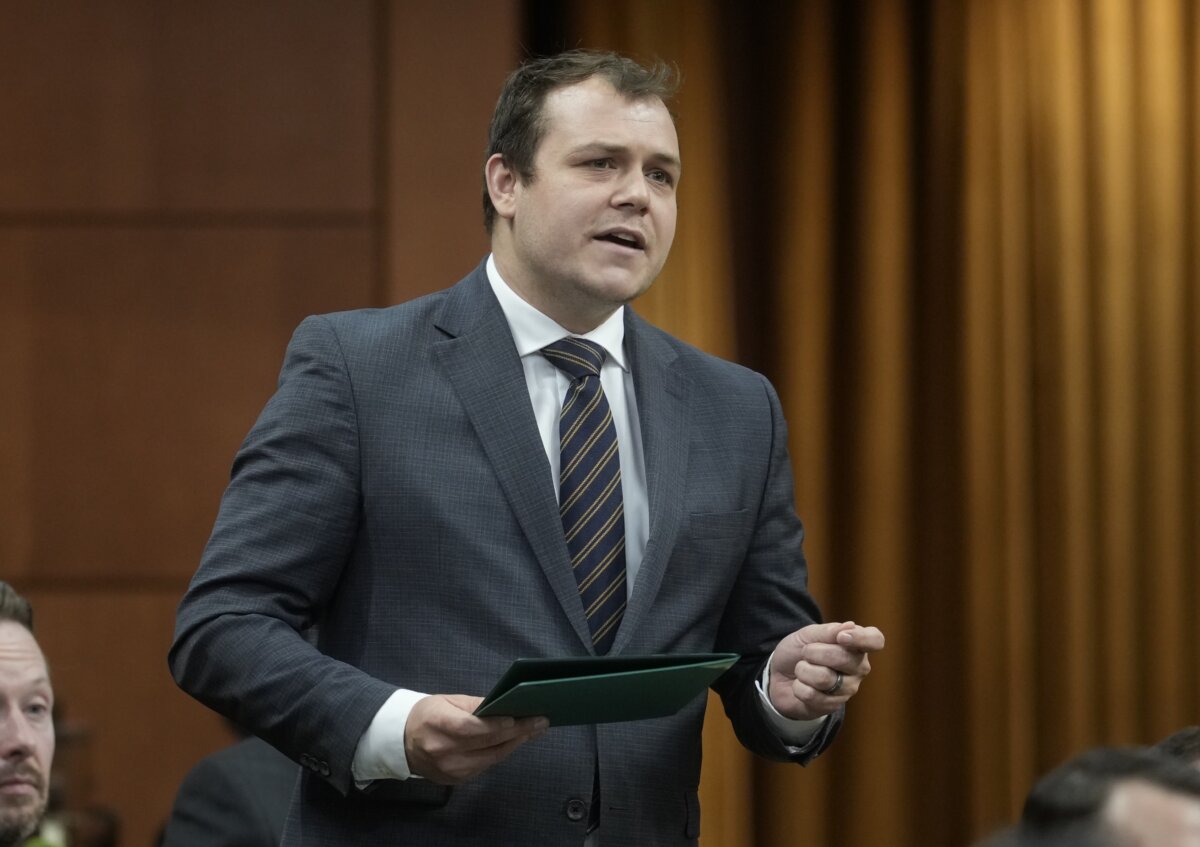
Conservative MP Dane Lloyd is calling on the federal government to reverse its military prayer ban ahead of Remembrance Day.
Lloyd raised the matter during question period in the House of Commons on Sept. 25, objecting to a July 29 instruction issued by the Canadian Armed Forces (CAF) requiring all CAF members and individuals delivering public remarks at official events where prayers or religious observances would traditionally be offered to instead give a “spiritual reflection” without language specific to a particular religion, including references to God.
“A Remembrance Day approaches, military chaplains representing many faiths are deeply concerned about government instructions issued over the summer directing them not to reference God in prayer or spiritual reflections,” Lloyd said.
“This instruction defies a unanimous motion passed by the House in November 2024 that affirmed the rights of chaplains not to be restricted or punished for referencing God in prayer or reflections,” Lloyd added.
Defence Minister David McGuinty responded to Lloyd’s concerns by emphasizing that the decision to issue the instruction was made by CAF leadership, rather than by the minister. He added that the instruction reflects what CAF leadership believes is best for its members.
“The Canadian Armed Forces is strengthened by the diversity of its traditions and the backgrounds and beliefs of its members,” he said.
“The policies to support diversity are a moral and ethical responsibility of the Royal Canadian Chaplain Service, the chief of the defence staff and CAF leadership.”
Prayer Ban
In its July 29 instruction entitled Spiritual Reflections in Military Settings, the CAF expanded an already existing prayer ban for chaplains to apply to all CAF members, Department of National Defence (DND) employees, and others supporting military activities and events.
The instruction mandates that anyone delivering remarks at public military functions, including Remembrance Day, refrain from using any “religious specific language, including references to God.”
The instruction defined spiritual reflections as remarks that reference “lessons learned, beliefs, values, and experiences” in order to encourage “gratitude, remembrance, hope, and integrity.”
Religiously specific prayer remains permitted during private counselling, voluntary religious services, funerals, and requested religious services provided to members by chaplains. The instruction also permits spiritual elements of indigenous practices when presented for “cultural, historical and educational purposes.”
DND spokesperson Maj. Soomin Kim previously told The Epoch Times that the instruction was intended “to better respond to the moral and spiritual needs of all members” and was driven by the intent to ensure all members of the military felt included in the context of the “growing religious and spiritual diversity” of CAF members.
Opposition
An initial directive issued in October 2023 was the first to require chaplains to deliver “spiritual reflections” rather than prayers and to avoid religious-specific terms such as “God” and “Heavenly Father” at military events.
The directive sparked backlash among some chaplains in the CAF and opposition from the Conservatives, particularly about faith-specific prayer being banned for Remembrance Day ceremonies.
In response, Chaplain General Brig.-Gen. Guy Bélisle permitted a one-time exception to the rule, allowing chaplains to use religious prayer and language at 2023 Remembrance Day ceremonies. The exemption was not renewed in 2024, and chaplains were again ordered to give only “spiritual reflections” at public military events.
In the fall of 2024, the House of Commons adopted a unanimous motion asking the government to affirm that chaplains would be permitted to give prayers in accordance with their faith and “will never be restricted on Remembrance Day or any day” for doing so, nor face punishment.
The motion did not change CAF policy, nor revoke the spiritual reflection requirement for chaplains.
Earlier on the day of the motion, Nov. 8, 2024, Parliamentary Secretary to the Defence Minister Marie-France Lalonde said the directive would remain in effect, describing it as an effort to make the CAF more inclusive and rejecting the characterization of it as a “prayer ban.”
In its expanded July 2026 instruction, the CAF says the rules are also intended to uphold its duty of religious neutrality, in accordance with the Supreme Court of Canada’s 2015 decision in Mouvement laïque québécois v. Saguenay.
Bishop Scott McCaig, who is in charge of Catholic ministry for CAF, along with several other chaplains who preferred to remain unnamed, have raised objections to the requirement to deliver “spiritual reflections.”
McCaig told The Epoch Times that the directive is not “neutral” and argues the CAF misinterpreted the Supreme Court of Canada’s decision.
“The Court ruled in favour of an open secularism, the freedom of religious conscience and expression for all rather than limiting rights, and enforcing restrictions.” McCaig said in a previous statement provided to The Epoch Times. “In contrast, this instruction enforces a closed secularism which seeks to hinder and restrict public expressions of belief that some may find offensive.”
McCaig also added that requiring chaplains to omit references to their faith infringes on their freedom of religion and conscience under the Canadian Charter of Rights and Freedoms.
“This instruction is based on a false premise: simply because some belief systems do not profess the existence of God, or some other divine source, does not make them neutral,” he said.
“There is no such thing as reflections on meaning, purpose, and spiritual well-being without philosophical and religious presuppositions. It is not the place of the government to adjudicate between them. That is the opposite of state neutrality.”
The latest available figures on religious affiliation in a 2021 DND Survey found that the majority of CAF members considered themselves part of a Christian denomination, with 27 percent being Catholic, 20 percent Protestant, 7 percent a different Christian denomination, 7 percent belonging to a non-Christian religion, and 39 percent having no religious affiliation.
 Friends Read Free
Copy
Facebook
Tweet
Friends Read Free
Copy
Facebook
Tweet