
Commentary
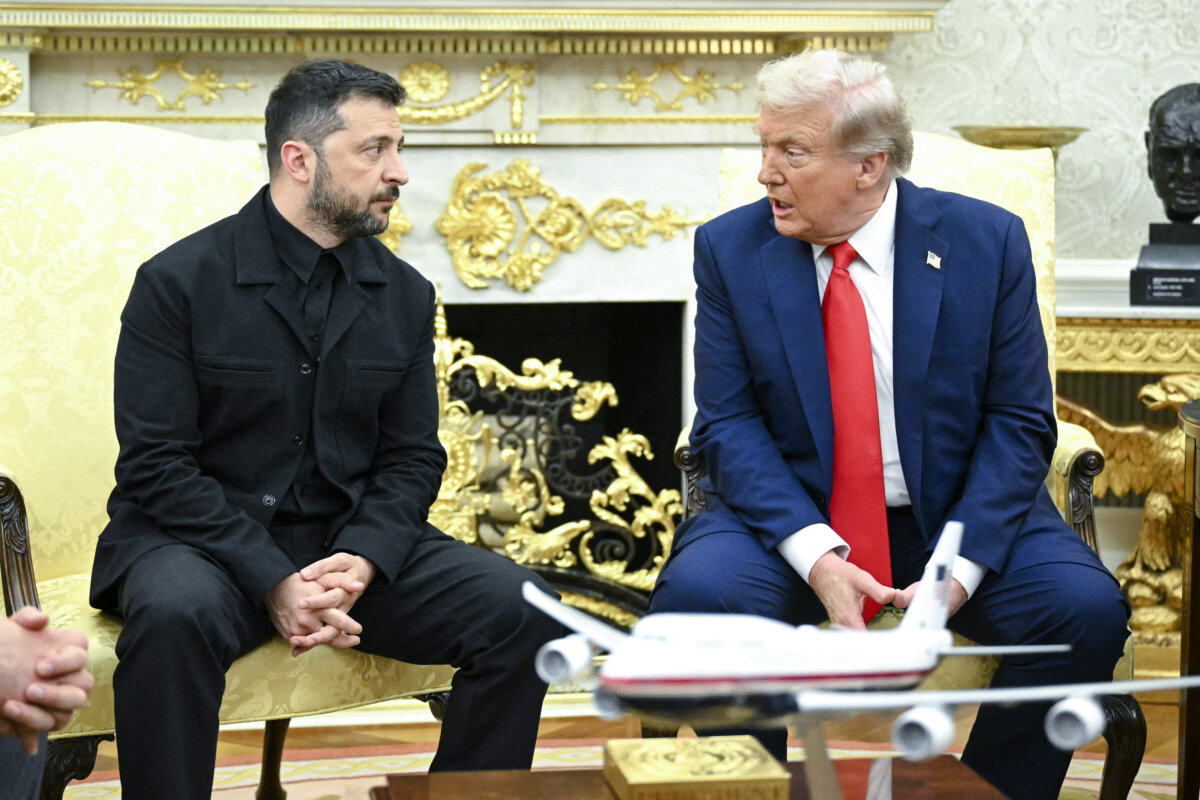
Details of the recently leaked 28-point peace plan for Ukraine and Russia and the White House’s update on Nov. 23 tell us a lot about how President Donald Trump views the state of the war.
The timing of the negotiation efforts that started in late October is likely being driven by the weakening Ukrainian forces in multiple key areas of the battle line and the growing speed at which Russia is taking territory.
That the Trump administration has prioritized negotiating this agreement over moving rapidly forward with the sanctions package authored by Sens. Lindsey Graham (R-S.C.) and Richard Blumenthal (D-Conn.) would seem to suggest that Trump lacks confidence that additional sanctions, alienating valuable geopolitical partners such as India, will have any immediate impact on Russia’s battlefield success.
2 Very Different Narratives
How you view the still-evolving U.S. peace outline will depend almost entirely on which of the two dominant narratives you embrace.
“Narrative One” holds that Russia bears sole responsibility for the war, that U.S. and NATO actions played no causal role, that Russia has suffered catastrophic losses in men and equipment, and that its economy is finally buckling under more than 24,000 sanctions. From this perspective, the leaked plan looks like outright capitulation—an unforgivable snatch of defeat from the jaws of victory that new secondary sanctions could still deliver.
“Narrative Two”—the one I share—starts from a simpler observation: In a pure war of attrition, the side with far more people, artillery, ammunition, missiles, and drones; sophisticated electronic warfare; the largest military-industrial base; and an economy that is nowhere near collapse will almost certainly prevail. If you accept that reality, you will want a peace agreement signed as quickly as possible to stop Ukraine from needlessly bleeding away more lives and more territory every single week.
Vice President JD Vance clearly falls in the Narrative Two camp:
“There is a fantasy that if we just give more money, more weapons, or more sanctions, victory is at hand,” the vice president said in a Nov. 21 X post. “Peace won’t be made by failed diplomats or politicians living in a fantasy land. It might be made by smart people living in the real world.”
Where Trump Is Coming From
Although some of Trump’s earlier rhetoric could be mistaken for sympathy with Narrative One, the speed, aggressiveness, and actual content of the current negotiations—especially the leaked 28-point plan—align unmistakably with a Narrative Two understanding of the war. Any past statements that sounded like Narrative One appear to have been less about ideology and more about frustration that neither side was willing to bend to his deal-making.
Trump made this crystal clear in his Feb. 19 interview with Brian Kilmeade:
“I’ve been watching [Ukrainian President Volodymyr Zelenskyy] for years now … and I’ve been watching him negotiate with no cards. He has no cards. And you get sick of it—you just get sick of it.”
In the same interview, Trump emphasizes that the war would never have started on his watch because he would not have insisted on the open door for future NATO membership for Ukraine as President Joe Biden did and instead taken Russia seriously with regard to its long-stated red line on NATO. He also expressed no doubt that Russia can—and will—achieve its territorial objectives through military means if no agreement is reached. In a Nov. 20 interview with Kilmeade, Trump once again reiterated his belief that Russia is going to gain territory.
These two interviews plus other comments he made over the course of the war, along with recent actions, place him squarely in the Narrative Two camp.
However, the Kilmeade interviews reveal a vital tension. While supportive of the president, Kilmeade voices a concern held by many: that Russia is suffering devastating losses and that if Russia isn’t stopped in Ukraine, the Baltics “will be in trouble.”
Trump disagrees, stating that Russian President Putin “is not looking for more war.” This is important, because Kilmeade articulates what remains the biggest obstacle to achieving a peace agreement: the belief held by a majority of the Western foreign policy establishment that Russia is on the brink of defeat and remains an existential threat to Europe.
Trump Card: Cutting US Intelligence to Force Peace
To call the headwinds facing Trump’s peace plan “strong” would be a massive understatement. Yet he holds one decisive card that no one else can play: the immediate and total cutoff of U.S. real-time battlefield intelligence and targeting data.
Right now, the United States spends many millions of dollars every month providing Ukraine with satellite imagery, signals intelligence intercepts, fused targeting packages, and funding for the NATO Airborne Warning and Control System. It is this support that has allowed Ukraine to survive so long. It is what lets Kyiv detect Russian troop concentrations, track aircraft movements, and cue long-range strikes on refineries and logistics nodes. Europe cannot make up for a loss of U.S. intel.
A full cutoff would not merely hurt Ukrainian morale; it would substantially reduce the Ukrainian military ability to detect and counter Russian troop movements and potential attacks. And it would allow Russian aviation to operate almost at will along the entire line of contact.
Both Kyiv and Brussels know this. That is why a credible, public threat to end U.S. intelligence support would force an instant and painful reevaluation of negotiating positions on both sides of the Atlantic. Europe would suddenly face the prospect of shouldering the full burden of a war it has neither the capability nor the domestic political will to sustain alone. Zelenskyy would be left commanding forces that have lost battlefield awareness they have come to rely on.
Such a move would ignite a firestorm. Many of Trump’s own allies, along with the foreign-policy establishment (which still insists, against mounting evidence, that Ukraine can win), would accuse him of “losing the war to Putin.”
Reuters reported on Nov. 21 that the president was threatening to play this card unless Ukraine accepted the 28-point framework by Nov. 27. According to the White House, the new version of the agreement would provide stronger security guarantees to protect Ukraine from future attacks by Russia.
In the end, the intelligence pipeline is the single most powerful lever that Washington still possesses. If Trump uses it, he will be blamed for losing the war. But then again, the fact that he has not wholeheartedly supported having U.S. taxpayers continue to foot the bill for the additional hundreds of billions of dollars necessary to keep the Ukrainian government solvent and supplied with weapons means he will be blamed anyway.
So does he pull the trigger on the nuclear option by shutting off intel support for Ukraine? Doing so will definitely bring the war to a conclusion much more quickly and save lives in the medium- and long-term, maybe even the short-run. Or does he continue to negotiate until even the most ardent supporters of Narrative One are forced to admit that Ukraine’s very existence is in jeopardy and that Russia actually does have a powerful hand?
Views expressed in this article are the opinions of the author and do not necessarily reflect the views of The Epoch Times.
 Friends Read Free
Copy
Facebook
Tweet
Friends Read Free
Copy
Facebook
Tweet