Commentary
The removal of Iran’s Supreme Leader Ayatollah Ali Khamenei is fracturing a largely unofficial partnership known as the CRINKS (China, Russia, Iran, and North Korea). None of the other countries in the partnership have come to Iran’s material aid with even civilian, much less military, assistance. They have kept their support to a minimum, mostly limited to rhetorical posturing at places like the United Nations. The military successes against Iran, which so shortly followed the capture of Venezuelan President Nicolás Maduro and the overthrow of the Assad regime in Syria, are an increasingly loud wake-up call to dictators everywhere. If you oppose the United States, you are not safe.
The lack of partner assistance is a strategic blow to not only the CRINKS, but to other bilateral and multilateral authoritarian-led groups of which Iran is a part. In 2016, Xi Jinping proposed that China and Iran join together in a “Comprehensive Strategic Partnership” (CSP). In about 2018, Iran joined China’s Belt and Road Initiative (BRI), which is largely a trade and investment group designed to counter the West’s economic “hegemony.” Three years later, the CSP was duly completed by Beijing and Tehran. Then in March 2023, China facilitated a rare meeting between Iran and Saudi Arabia, one of Iran’s top three adversaries along with the United States and Israel. The move was lauded as evidence of the Chinese Communist Party’s (CCP) global clout and improved influence among energy-exporting countries. Then, in 2023, Iran became an official member of China’s Shanghai Cooperation Organization (SCO), a security grouping that the regime in Beijing hoped would one day counter the NATO alliance of democratic countries. But the CSP is now not much in evidence, and Iran is shooting missiles at Saudi Arabia and other Arab countries that are BRI members. Iran has not even bothered to publicly appeal for help to the SCO. Beijing has probably already told Tehran that help is not coming, so any public appeal would just be an embarrassment. And if the U.S. begins controlling Iranian oil exports as it did Venezuelan exports, it is unlikely that BRI countries under attack by Iran will do much in opposition.
The reality is that the authoritarian leaders who join these types of groups are primarily selfish rather than motivated by ideals like democracy and human rights. So, when one of their members needs assistance, there is very little response from the others. In contrast, the types of leaders elected in democracies are more self-sacrificing and good team players. These types are more likely to commit to mutual defense, as is found in the NATO charter. One for all and all for one is a democratic ethos.
Another major difference in a democracy versus autocracy, as demonstrated after the removal of Khamenei by force, is that since his rise to power and tenure depended on force, there was no major ethical concern raised through his removal by force. As they say, live by the sword, die by the sword. Khamenei was not elected and does not rule by the consent of voters. His forced removal by a democracy against which he rails is arguably more democratic than leaving him in place. His removal is a valuable opportunity, as U.S. President Donald Trump has said, for the people of Iran to choose their own form of government and a new leadership that better represents their preferences.
U.S. operations against Iran and Venezuela also have repercussions for global oil markets, and not coincidentally for those in which China purchases its oil at a discount. Both countries have long sold their artificially cheap oil to China due to Western sanctions. With regime change as an option for both countries, this China-bound gravy train is coming to an end. China will now be forced to rely more on Russia, Saudi Arabia, and Iraq for its oil imports. Only Russia has discounted oil for sale, and as a sole supplier of such oil, Moscow may finally be able to raise its price for China. All three countries are closer to the United States than was Iran, raising the risk for Beijing that Washington could coordinate a debilitating oil embargo on China in case of an invasion of Taiwan.
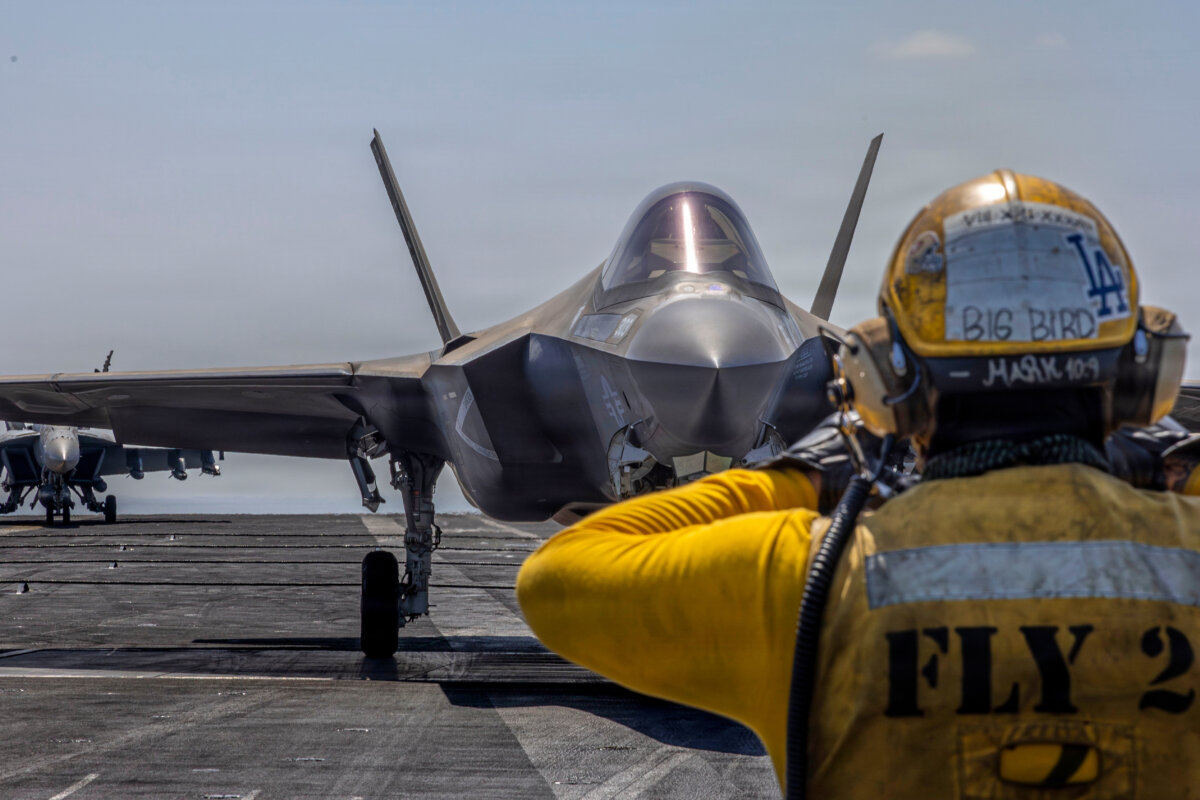
The U.S. attacks on Iran and Venezuela have also demonstrated that Chinese and Russian military exports do not stand much of a chance against U.S. military hardware and tactics of both the kinetic and non-kinetic types. The Venezuelan leader was taken from one of his most fortified locations. Russian surface-to-air missiles and Chinese radars were of little assistance to the Venezuelan leader. Iran’s air defenses, nuclear weapons development, navy, and air force were mostly obliterated within days across two U.S.-Israeli operations in June and the most recent one starting on February 28.
Chinese military exports have fallen from a peak in 2023 of almost $3 billion worth of capabilities, losing ten percent of its military exports by 2024. While the numbers are not perfectly comparable due to China’s opaqueness, U.S. defense exports in 2023 were almost $83 billion. The following year, U.S. defense exports increased by almost 46 percent to nearly $118 billion. As indicated by these numbers, international buyers do not trust China’s weaponry, which decreases the CCP’s global influence relative to the United States.
That the U.S. military successes in Iran are being conducted by a diverse market democracy is no coincidence. Markets are better at allocating scarce capital than are communist systems. Democracies are better at protecting their citizens because democratic leaders are elected to do so. And diverse countries tend to welcome the world’s smartest and wealthiest immigrants, empowering the country and weakening monocultural authoritarian adversaries through a process of brain drain and capital flight.
In sum, the double sacks of Venezuela and Iran are blows to not only the dictators in these two countries, but to dictators everywhere. This is especially the case for dictators who have historically been adversarial in their relations to the democracies. China, Russia, North Korea, Cuba, Myanmar, Vietnam, Laos, and Cambodia will have watched the recent events with concern and perhaps a little shock. Dictators around the world now know without a doubt that they cannot cross the United States and our allies without entailing major risks.
Views expressed in this article are the opinions of the author and do not necessarily reflect the views of The Epoch Times.
 Friends Read Free
Copy
Facebook
Tweet
Friends Read Free
Copy
Facebook
Tweet