
Commentary
The United States is alienating our most important trade partner, Canada.
The country is a NATO ally and G7 member. While the U.S.-UK relationship is often touted as Washington’s most “special,” the Canadian relationship is arguably the most critical to the future of the U.S. economy and soft power.
The projection of U.S. hard power abroad depends in part on the positive global public perception of Washington’s leadership. This stems from the United States being a beacon of freedom and arsenal of democracy in World War I, World War II, crises across the Taiwan Strait, the Korean war, and others. If after all of that, we now treat Canada with a lack of foresight for short-term trade interests, we lose at least some of our moral high ground, which negatively affects our soft power, as well as our long-term national interests.
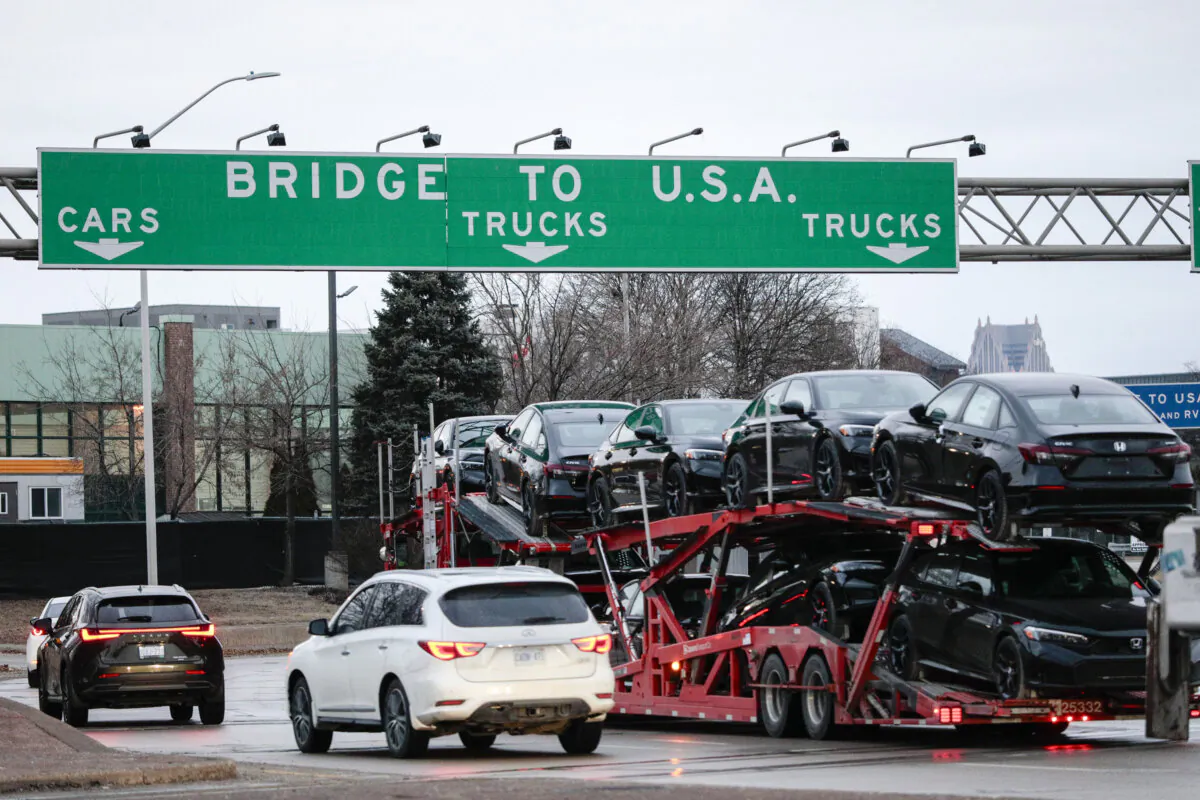
The currently deteriorating U.S.-Canada relationship entails threats and counter-threats of tariffs, and a possible 35 percent tariff imposed on Canada by Washington after the Aug. 1 negotiating deadline. This will raise prices in the United States and decimate Canada’s auto industry, which depends on parts that traverse the border multiple times in the process of manufacturing a car.
Pre-existing U.S. tariffs on steel and aluminum have already hit Canada particularly hard. There is no good national security rationale for maintaining tariffs on Canada, due to its democracy and geographic proximity. The probability of an interruption in U.S.-Canada trade in steel and aluminum is next to zero, unless self-imposed.
As a result, Canadian public opinion of the United States is at its lowest since at least 2002, with recent polls indicating 64 percent of Canadians now have an unfavorable view. Canadians are understandably upset after perceived questioning of the economic and military viability of their sovereignty, and unwanted proposals of Canada becoming the 51st U.S. state.
Canada has largely done the right thing by pledging 5 percent of its GDP for defense, aligning with U.S. tariffs on China, and appointing a fentanyl czar. There is more that Ottawa can do against the Chinese Communist Party, including on organized crime, terrorists, and fentanyl. But, Ottawa’s lapses are no longer enough to justify roiling the U.S.-Canada relationship with additional tariffs.
Relations between the two NATO allies are now so bad that they are both looking for more trade as far away as China. Provincial premiers and some media outlets are pressuring Ottawa in this direction. Yet, China ought to be the last place with which our democracies trade.
Beijing has no respect for either democracy, and seeks to conquer large parts of the Arctic, over which both the United States and Canada have legitimate and complementary claims. Neither capital can trust the communist regime of China, which breaks all of its most important agreements, steals hundreds of billions worth of intellectual property annually, detains citizens from both our countries, is an international aggressor against Taiwan, India, and the South China Sea claimants, violates the U.S.-led international order with impunity, and is ultimately after the destruction of both U.S. and Canadian democracies. Yet, Washington and Ottawa are handing Beijing a golden opportunity to pursue a divide-and-conquer strategy. It is already working because of our own national cleavages.
The likely response from Canada is to practice Aikido, not karate, with U.S. tariffs. Ottawa is already doing this by finding new bilateral trade partners in Mexico, India, Japan, and the European Union. It will likely reach out to key G7 allies in London, Paris, Berlin, and Tokyo for yet closer security ties to defend against China and Russia in the Arctic.
Conversely, if Canada were to try playing hardball with Washington, for example through Canadian retaliatory tariffs, or worse, embargoes on critical U.S. imports like water, energy, and uranium, the United States could consider its worst-case option: a northerly invasion to secure necessary resources. While this would have been unimaginable a decade ago, U.S. invasions were recently mooted against Greenland and Panama, in part due to the risk of their takeover by China. Another threat of a U.S. invasion, this time against as close and friendly an ally as Canada, would erode U.S. global soft power, which would erode the stability of global democracies.
Canada is known the world over as eminently reasonable and polite. Our ongoing trade spat has not been America’s finest moment. So, it’s time to take a long deep breath, make compromises on both sides of the U.S.-Canada border in the interest of shared values, and again extend our hands in friendship. No short-term trade advantages by either side are worth risking our warm relations and commitment to the common principles upon which our nations, and the international system, were founded. Free trade among free nations has for centuries been an important goal of our political and international systems. To that end, let’s be the adult in the room and improve relations with Canada now.
Views expressed in this article are the opinions of the author and do not necessarily reflect the views of The Epoch Times.
 Friends Read Free
Copy
Facebook
Tweet
Friends Read Free
Copy
Facebook
Tweet