
Commentary
Since the advent of the anti-ship cruise missile in the mid-1960s, there has been a cottage industry in predictions about the end of the aircraft carrier.
That chorus began on Oct. 21, 1967, when two Egyptian Navy Soviet-made Komar fast-attack ships launched Styx anti-ship missiles, sinking the Israeli destroyer INS Eilat. It grew louder after the 1982 Falklands War, when Argentine-launched French-made Exocet anti-ship missiles sank the British destroyer HMS Sheffield and the container ship Atlantic Conveyor.
It gained a further strategic dimension at China’s first major international airshow at Zhuhai in November 1996, when a Chinese missile guidance engineer revealed to this analyst that China was working on some form of precision guidance for its medium-range, hypersonic-speed DF-21 solid-fuel ballistic missile.
By the early 2000s, the U.S. Intelligence Community had concluded that China was developing the 1,000-mile range DF-21D anti-ship ballistic missile (ASBM), which this analyst deduced—and a U.S. source later confirmed—was aided, in part, by China’s acquisition, as scrap, of components related to the radar-guidance system used in the U.S. Pershing II precision missile.
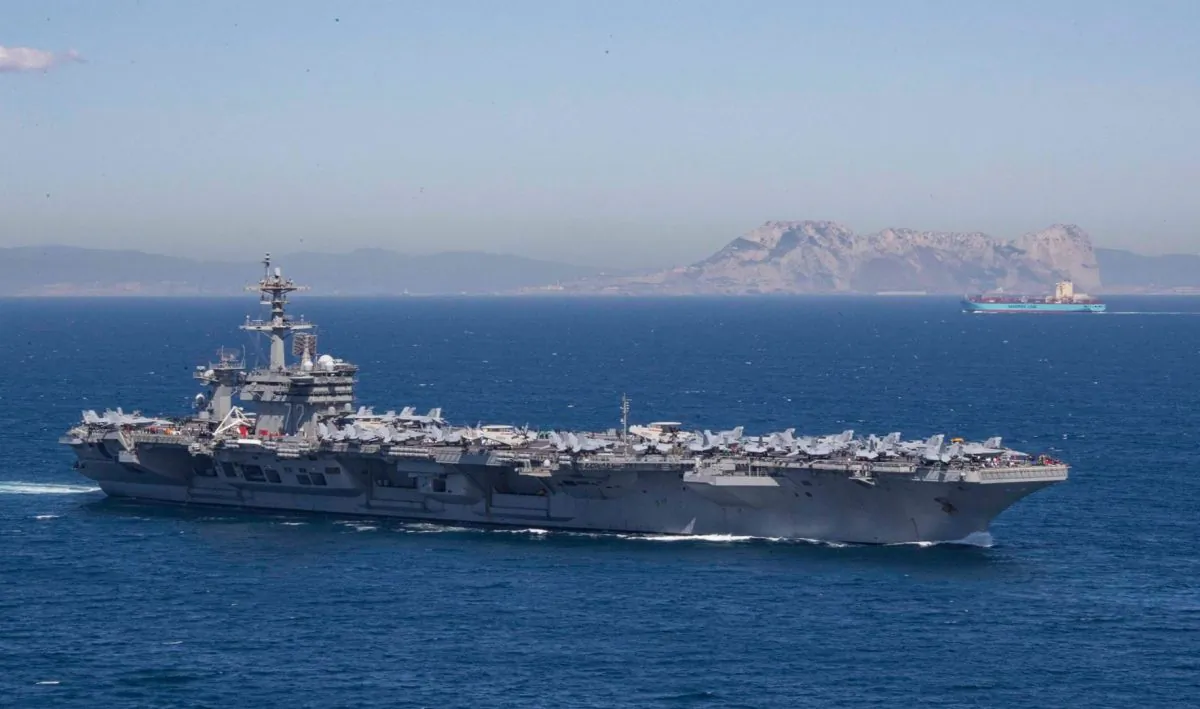
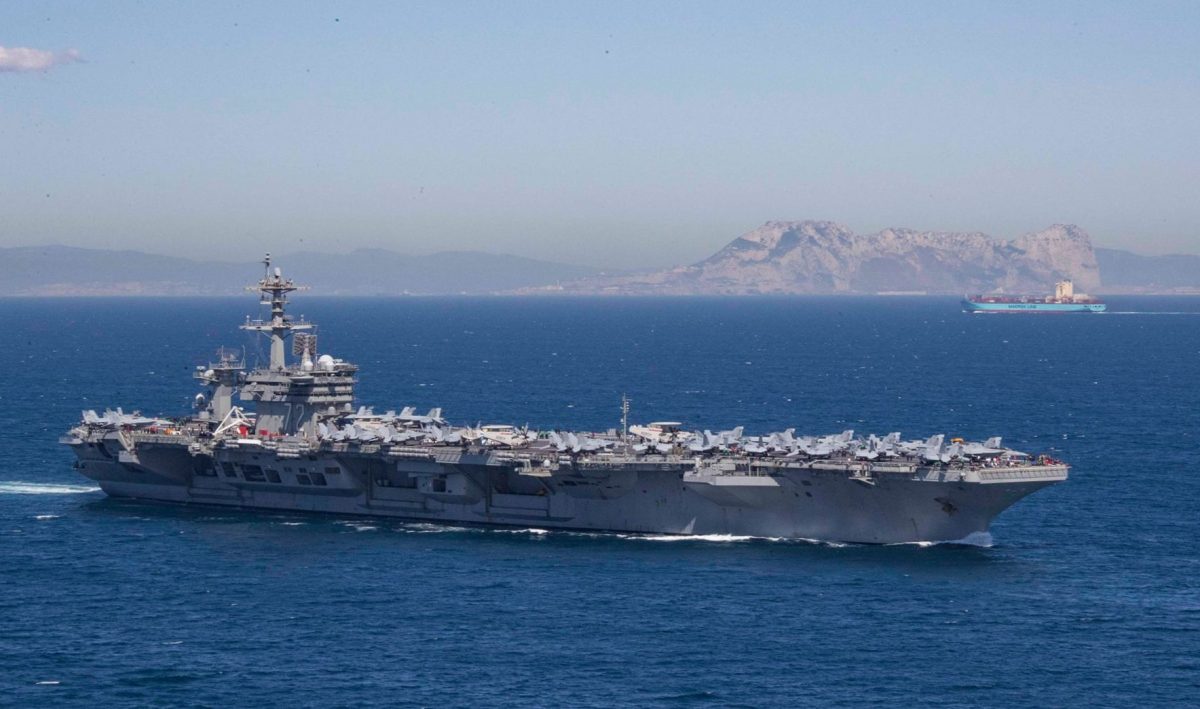
However, according to limited information provided by U.S. President Donald Trump and U.S. War Secretary Pete Hegseth, the U.S. Navy may have demonstrated that even a major Iranian missile threat against a nuclear-powered aircraft carrier—in this case, the USS Abraham Lincoln—can be defeated.
In his March 25 remarks, Trump referred to an “element” or target of importance that he declined to identify:
“One hundred missiles going 2,000 miles an hour were coming at this element of importance, tremendous power and importance. And of the 100 missiles coming at us, 100 missiles were immediately shot down, shot out of the air, fall into the sea. Not one missile got through.”
Then, during an April 8 Pentagon press conference, Hegseth appeared to provide additional details:
“Iran shot hundreds and hundreds of missiles and attack—one-way attack drones at our aircraft carrier. They were obsessed with it, and they never got even close. Every single one of those shots, easily shot down miles and miles away from the Abe Lincoln. They were blowing ammo into fantasy land.”
These official statements suggest that the USS Abraham Lincoln and its escorts won a historic naval battle against a yet-to-be fully revealed large Iranian missile-and-drone attack.
But key questions remain unresolved. Were the reported 2,000-mile-per-hour missiles ballistic or cruise missiles? Were the attacks launched in a single wave or in multiple waves? What proportion of the threat consisted of one-way attack drones? And what defensive systems accounted for the interceptions?
Those questions matter because, if the missiles were cruise missiles, that could indicate that Iran had obtained a new class of high-speed anti-ship weapon. From open sources, Iran has not been known to possess an indigenous anti-ship cruise missile capable of high supersonic speed.
For example, the China Aerospace Science and Industry Corp. (CASIC) C-802 anti-ship missile, co-produced by Iran, flies at about 680 miles per hour, or roughly Mach 0.9, just below the speed of sound.
But on Feb. 24, Reuters, citing “six people with knowledge of the negotiations,” reported that Iran was “close to a deal with China” to purchase the CASIC CM-302, a 170-mile-range export version of the YJ-12 anti-ship missile, a roughly 300-mile-range weapon in service with the Coastal Defense Force of the People’s Liberation Army (PLA) Navy.
The CM-302/YJ-12 family uses ramjet propulsion derived from Russian technology to achieve speeds greater than 2,000 miles per hour, which would track with the missile speed cited by Trump.
If so, one possibility is that Iran had already obtained CM-302-class capabilities—or perhaps the longer-range YJ-12 itself—before the start of hostilities on Feb. 28 in violation of U.N. and other sanctions restricting the arming of Iran.
Such a transfer could have taken place weeks or months earlier, since Iranian forces would likely have required training to operate and maintain the missile.
A more serious possibility is that the missiles may have been employed with direct Chinese technical assistance—something Beijing has been willing to risk in past proxy contests, including support for North Vietnam during the war against South Vietnam and the United States.
What U.S. sources have not yet clarified is whether Iran also employed solid-fuel anti-ship ballistic missiles, such as the optically-guided 430-mile-range Zolfaghar. Nor have U.S. officials specified the types and number of one-way attack drones used against the Lincoln, although these would have been slower, subsonic missiles.
The U.S. Navy has had decades to prepare for the problem of defending carriers against high-speed missile attack—a challenge that began with advanced Soviet ship-, submarine-, and air-launched supersonic anti-ship missiles in the 1960s.
During the Cold War, a large share of that burden fell to U.S. Navy nuclear-powered attack submarines tasked with destroying Soviet missile-launch platforms, while carrier-based McDonnell-Douglas F-4 Phantom and later Grumman F-14 Tomcat fighters, supported by E-2 Hawkeye radar aircraft, were expected to intercept Soviet bombers and their missiles.
Today, carrier-based Boeing F/A-18E/F Super Hornet and Lockheed Martin F-35C Lightning II fighters, operating alongside the far more capable E-2D radar aircraft, remain an important first layer of defense.
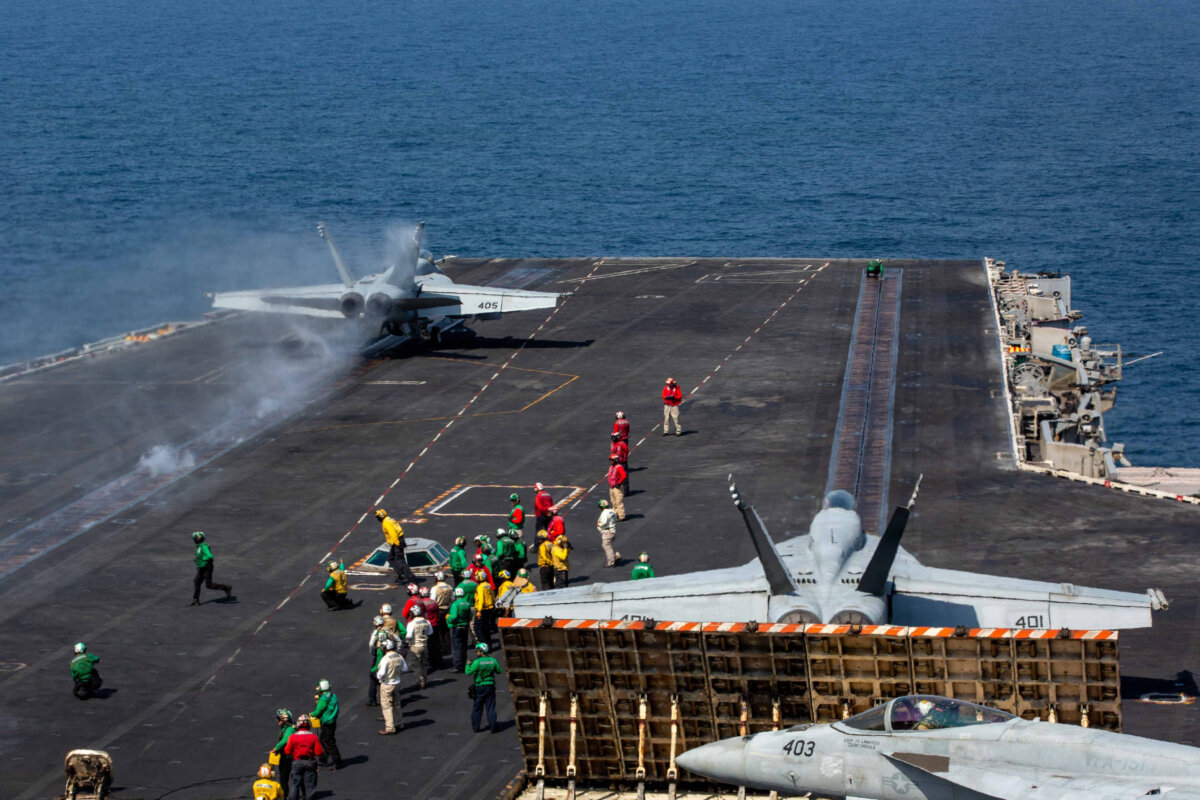
But U.S. Navy destroyers, armed with an array of long-range Raytheon SM-3/SM-6 long-range surface-to-air missiles, shorter-range Sea Sparrow variants, and Close-In Weapon Systems (CIWS), likely provide much of a carrier strike group’s direct defense against ballistic and cruise missile attack.
If the CASIC CM-302 or YJ-12 was, in fact, used against the USS Abraham Lincoln, then the U.S. Navy may have already gained valuable combat experience against a missile family highly relevant to a future war in the Western Pacific. The PLA Air Force fields an air-launched version of the YJ-12 on its Xian H-6K, H-6J, and H-6N bombers, which possess a combat radius of roughly 2,000 miles.
In a Taiwan contingency, the YJ-12 would be only one part of a much larger Chinese anti-access strike complex that could also include the DF-21D ASBM, the roughly 2,500-mile-range DF-26B ASBM, and the roughly 1,800-mile-range DF-17 armed with a maneuvering hypersonic glide vehicle.
While U.S. Navy carrier battle groups still face formidable threats from the PLA, this incident may already suggest that such formations can be defended against at least some modern missile attacks—and that long-standing claims of the carrier’s obsolescence remain easier to make in theory than to prove in combat.
The incident may also help explain Trump’s determination to deter future arms transfers to Iran. On April 8, Trump posted on Truth Social:
“A Country supplying Military Weapons to Iran will be immediately tariffed, on any and all goods sold to the United States of America, 50%, effective immediately.”
If subsequent reporting confirms Chinese missile transfers to Iran, then the encounter involving the USS Abraham Lincoln will matter far more than the Iran war. It will also bear directly on how the United States assesses the real-world performance of a class of missile threat, which would likely figure prominently in any future Chinese campaign against Taiwan.
Views expressed in this article are the opinions of the author and do not necessarily reflect the views of The Epoch Times.
 Friends Read Free
Copy
Facebook
Tweet
Friends Read Free
Copy
Facebook
Tweet