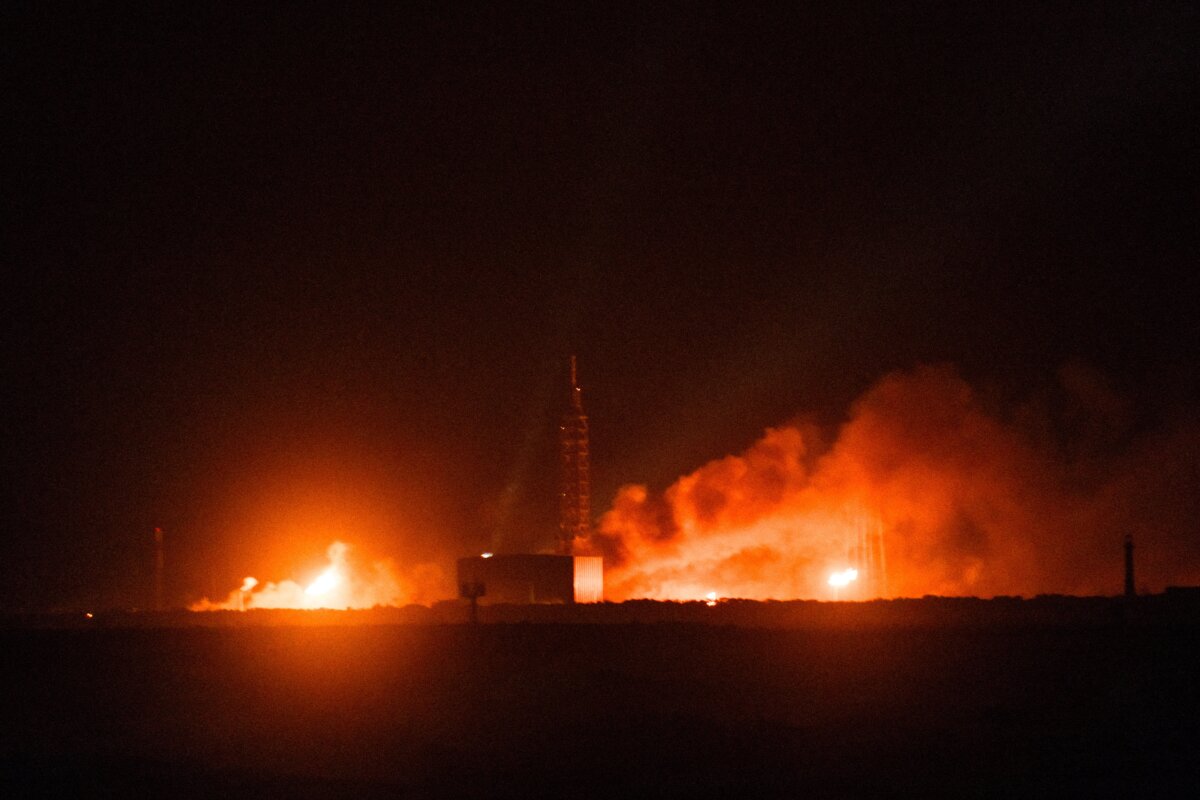
A Blue Origin New Glenn rocket exploded into a massive fireball on its launch pad in Florida on Thursday night.
The blast occurred about 9 p.m. ET at Cape Canaveral’s Space Launch Complex 36 during a planned engine-firing test. Blue Origin, the space company founded by Jeff Bezos, said no one was hurt.
“We experienced an anomaly during today’s hotfire test,” Blue Origin said in a statement. “All personnel have been accounted for. We will provide updates as we learn more.”
The rocket had just been fueled for the static-fire test of its seven BE-4 engines.
The 48 Amazon satellites it was to carry on a planned June 4 mission were not yet loaded. It remained unclear how much damage the pad and support equipment sustained or how long repairs might take. Complex 36 is Blue Origin’s only facility capable of launching the New Glenn.
The company has not said what caused the explosion, but Bezos, in an X post, said his company was working to determine the cause.
“It’s too early to know the root cause, but we’re already working to find it,” he wrote. “Very rough day, but we’ll rebuild whatever needs rebuilding and get back to flying. It’s worth it.”
This setback comes weeks after Blue Origin’s third New Glenn flight.
The rocket was grounded after launching a satellite into the wrong orbit. The recycled first-stage booster performed well and landed on an ocean platform, but the upper stage failed to place its payload correctly. That mission highlighted ongoing challenges with the vehicle’s orbital insertion accuracy despite progress on booster reuse.
Blue Origin had hoped to fly the fourth mission as early as June, delivering 48 satellites for Amazon’s Project Kuiper broadband constellation. The program competes directly with SpaceX’s Starlink. The explosion now delays that timeline and raises questions about the readiness of the single pad at Complex 36.
Blue Origin’s New Glenn program traces its roots to the company’s long-term goal of building a heavy-lift rocket to rival SpaceX’s Falcon Heavy and Starship.
In January 2025, the rocket reached orbit on its first attempt—the primary test objective—though the first-stage booster’s landing attempt failed. That debut flight marked a major milestone for the 320-foot-tall methane-fueled vehicle, which is designed to carry large payloads to low-Earth orbit and beyond.
The company, owned by Bezos, has positioned New Glenn as a key part of its vision for frequent, affordable access to space, including NASA lunar lander contracts and commercial satellite deployments.
The Thursday explosion represents the latest test of that ambition. Blue Origin has not yet commented on next steps or a revised launch schedule.
 Friends Read Free
Copy
Facebook
Tweet
Friends Read Free
Copy
Facebook
Tweet