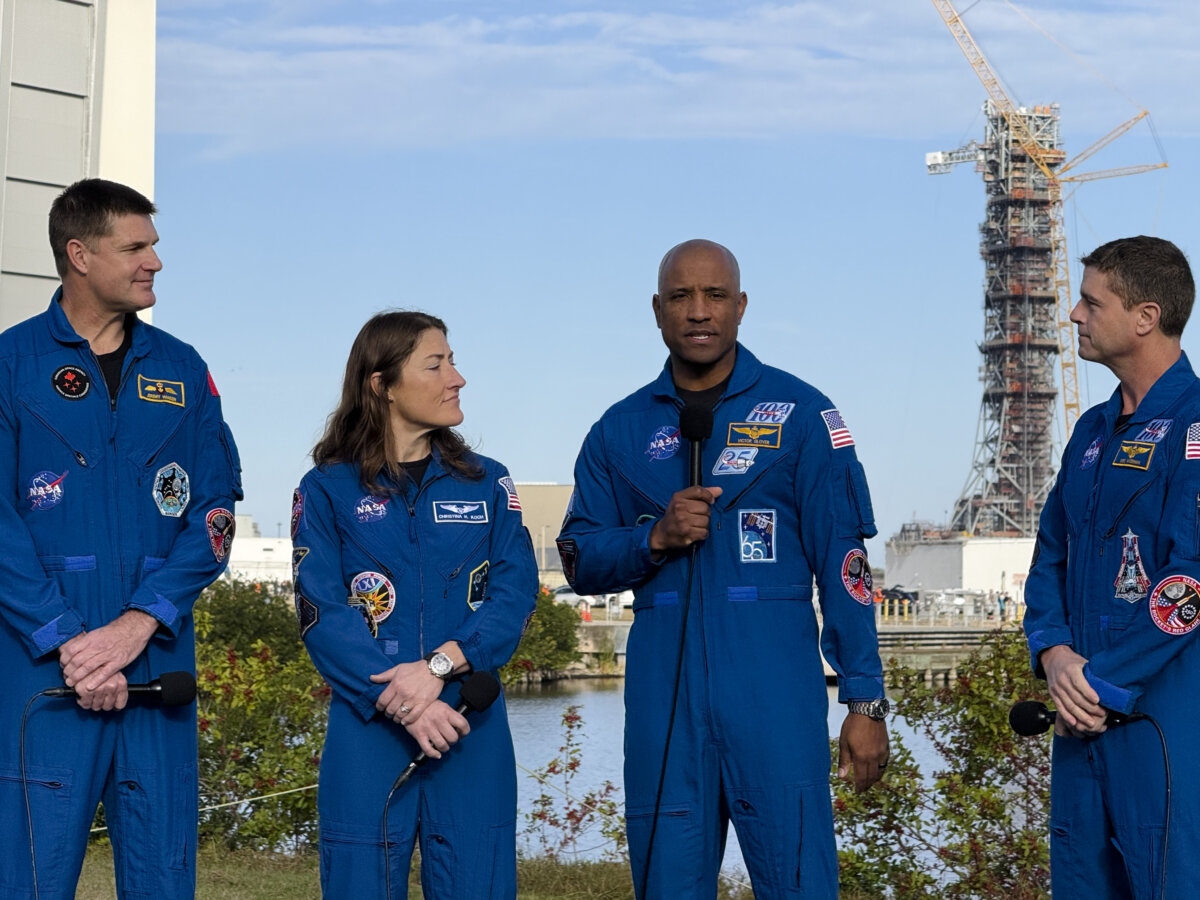

CAPE CANAVERAL, Fla.—NASA Astronaut Victor Glover will be the first person to manually fly the Orion spacecraft when he and his crewmates launch their Artemis II mission.
The two demonstrations planned at the beginning and end of his 10-day flight would put him in league with Apollo astronauts who manually controlled a spacecraft built to take humanity to the moon and back. But the manual element of today’s Artemis program—and any future space activities—will remain on some level but change due to the continuing onset of advancing technologies and the execution of more and more complicated missions in deep space.
“We’re just talking about an evolution in terms of what are truly the manual inputs, right?” NASA Administrator Jared Isaacman told The Epoch Times.
He made the comparison to the evolution of aircraft. Instead of performing like the astronauts’ T-38 jets, which still feature a direct flight control surface, human-piloted spacecraft will be more like F-22 and other modern aircraft with fly-by-wire technology.
“You’re telling the airplane what you’d like to do, and then the computer is interpreting it and saying, ‘This is what I’ll give you.’ And I think you’re going to just naturally see that evolution in spacecraft,” he said. “We’re not taking the human out of the loop, right?
“There can be some pre-planned way points as we navigate around the moon, and then perhaps a human is directly inputting, ‘This is the actual target location I would like to land.’ And for some reason, the computer is taking that manual input and saying, ‘Now, I’ll put you there.’ And I think that’s probably the evolution we’re looking at.”
Glover described himself as “a little bit of a Luddite,” a term describing someone who is resistant to technological change, preferring controls he can put his hands on when he flies compared to the touch screen systems of the SpaceX Crew Dragon. But he said that the last five years since flying that spacecraft has taught him that “the tool needs to be designed for the task.”
“I think it is something that we have to think more about, because the state of technology is where it is, and we’re not going to undo all of that,” he said. “So [we’re] finding ways to integrate software and hardware. But the thing that hasn’t changed as far back as we can read the record—we are still the same stuff.”
He recalled reading a journal put together by astronauts of the Projects Mercury, Gemini, and Apollo programs, and noticing they were saying the same things back then that astronauts were saying today.
“You know, having a window is important, having the ability to do critical functions is important, and just how we implement that, though, is going to change with the state of technology,” he said.
Exemplified by spacecraft like those from SpaceX and Blue Origin, the state of technology allows for automated systems that can fly whole missions on their own.
Isaacman dug deeper on how current and future technology could be implemented in NASA’s future plans to the moon and beyond, including autonomous rovers to extract minerals, help build a permanent settlement, as well as unmanned missions.
But he emphasized that when it comes to crewed missions, the machine will never mute the man.
“I think in terms of what we want to achieve in space, you’re going to incorporate more autonomy in our robotic missions,” he said.
“We’re looking at a mission to Venus right now that could have some onboard AI capabilities in it. So this is the way we’re going to go.
“But I’ll tell you, if humans are on a spacecraft, they’ll always have a vote. They’ll always have a say, and how that may look today could be very much like the F-22 versus the T-38 of the past.”
 Friends Read Free
Copy
Facebook
Tweet
Friends Read Free
Copy
Facebook
Tweet