Topics in this episode:
Teachers, Medical Workers Stage Protests in China
Beijing Hands Out Rescue Loans onBelt and Road Debt
U.S. '10-20 Years Behind Asia' on Batteries: Lawmakers
More Wealth Flow from China to Hong Kong: HSBC CEO

Talent
The OneBelt, OneRoad (OBOR, also known as Belt and Road) initiative is aimed at building a vast network of infrastructure connecting China to Central Asia, Southeast Asia, Europe, and beyond, much like the ancient Silk Road.
"China's business pressure on the Czech Republic proves that 'OneBelt, OneRoad' is a predatory policy tool, bringing only counter-effects to the global business order," Foreign Ministry spokeswoman Joanne Ou said.
"My understanding from London (is) that an investigation has been announced into apparent leaks from the NSC meeting earlier this week," said Hammond, speaking on the sidelines of a summit on China's "OneBelt, OneRoad" (OBOR, also known as Belt and
He views China's spending on its Belt and Road Initiative (BRI, also known as OneBelt, OneRoad) that Morgan Stanley recently predicted could reach $1.2–1.3 trillion by 2027, as exemplifying “an era that has already turned to dust.”
Beijing established OneBelt, OneRoad (OBOR, also known as Belt and Road) in 2013 to build up geopolitical influence via investments across Southeast Asia, Africa, Europe, and Latin America.
The Epoch Times has obtained several documents, issued by various Chinese regime agencies, detailing their accomplishments in “exporting culture” via the Belt and Road Initiative (BRI, also known as “OneBelt, OneRoad”).
In 2017, Beijing included Arctic sea routes in its so-called "OneBelt, OneRoad" (OBOR, also known as Belt and Road) initiative, which seeks to strengthen China's ties to the rest of the world through infrastructure projects and research.
Chinese leader Xi Jinping says he drew inspiration for BRI (also known as OneBelt, OneRoad) from the Silk Road established 2,000 years ago during the Han Dynasty to connect China with the Mediterranean.
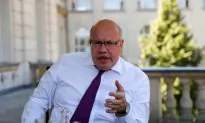
Altmaier said the Chinese regime was pushing ahead with policies aimed at securing its economic interests around the globe for the coming decades, pointing to infrastructure programs such as China's OneBelt, OneRoad (OBOR, also known as Belt and Road
Despite continued efforts such as launching yuan-denominated overseas bonds, establishing yuan exchange linkages, and the OneBelt, OneRoad infrastructure investment initiative, very little progress has been made in the international usage of the yuan
But the DFC’s total funding—$60 billion—pale in comparison to the $1 trillion that China has earmarked for its “Belt and Road” initiative (BRI, also known as OneBelt, OneRoad) to expand influence around the world.
Commentary
With great fanfare, Chinese leader Xi Jinping launched two strategic initiatives in 2013 aimed at building a worldwide colonial empire and restoring China to world leadership: the Belt and Road Initiative (also known as "OneBelt, OneRoad
China wants to accomplish its science and tech development goals by solidifying the Chinese Communist Party’s (CCP) grasp of the education system, while exporting its influence overseas through education initiatives in "OneBelt, OneRoad" partner countries
China’s BRI, also referred to as "OneBelt, OneRoad" or the "New Silk Road," is one of the world’s most ambitious and controversial development programs.
“The world is waiting for the ‘OneBelt, OneRoad’ grand blueprint to move from dream to reality,” Barton and his colleagues wrote in a report published on the company’s Chinese website in May 2015, reported The New York Times, adding that McKinsey holds
The U.S. government recently put export limits on 44 Chinese entities that all happen to have major roles in China’s “OneBelt, OneRoad” infrastructure project.
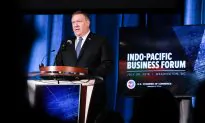
National Defense Authorization Act and the Trump administration’s Indo-Pacific strategy to counter “OneBelt, OneRoad” are clear signs of strategic changes in the U.S. perspective on Communist China.
This move is of iconic significance as it marks the stranded OneBelt, OneRoad Initiative in Europe. Italy had joined the initiative in 2019, the first member of the G-7 to do so.
To wield greater influence along what it refers to as the 4,000-mile “Polar Silk Road,” China committed to funding major port and energy development infrastructure through expansion of its “OneBelt, OneRoad” (OBOR, also known as Belt and Road Initiative
Experts also pointed out that China has been striving to increase the number of Chinese nationals serving in the U.N., and asking them to openly support Beijing’s policies, such as the "OneBelt, OneRoad" (OBOR, also known as Belt and Road) initiative
In a move that worries the United States and its allies, Xi is set to sign an accord to make Italy the first major democracy to join China’s massive OneBelt, OneRoad initiative.
Geopolitical Partners commented that China over the last two years sought to offset trade losses from the trade war by heavily investing to expand trade across its “OneBelt, OneRoad” (OBOR, also known as Belt and Road Initiative).