
The international governing body of gymnastics has defended its decision to immediately lift all restrictions on Russian and Belarusian athletes, stating the move is about fairness and separating sport from politics.
World Gymnastics announced on Monday that athletes from both countries could return to international competitions under their national flags, reversing a ban in place since March 2022 following Russia’s escalation of its ongoing conflict with Ukraine. Belarus is a close ally of Moscow.
Gymnasts from Russia and Belarus had been barred from international events until late 2024, when the rule was changed to allow them to compete as individual, neutral participants.
The reversal allows them to wear their national colors and have their national anthems played on the medals rostrum, following recent similar moves in wrestling and swimming.
Ukraine to Challenge Decision
On Thursday, the Ukrainian Gymnastics Federation put out a statement expressing its “deep concern” regarding the decision over the admission of athletes from what it termed “the aggressor country and its satellite to international competitions under their national attributes.”
“We will challenge the decision … as having been adopted in excess of statutory powers, violating the basic principles of non-discrimination and endangering the ethical integrity of international competitions,” the statement added.
World Gymnastics told Reuters in a statement, “The Executive Committee’s decision to lift all restrictions imposed on Russian and Belarusian athletes is based on the principle of equal treatment for all athletes regardless of nationality.”
“World Gymnastics firmly believes that sport and politics must remain separate and that unity and solidarity should prevail at all sporting events.”
The federation added that competitions should serve as a “neutral platform that brings athletes and nations together in a spirit of fairness, mutual respect and solidarity.”
Olympic Cold War Politics
The decision comes two years ahead of the next Olympic Games, which will take place in Los Angeles in 2028. The last time the Olympics were in Los Angeles in 1984, Cold War politics cast a shadow over the event, with the Soviet Union and its allies boycotting it in retaliation for the U.S. boycott of the 1980 Moscow Olympics.
Gymnastics is one of the most popular Olympic sports, with a number of epic battles between American and Russian gymnasts drawing huge audiences over the years.
Russia has for decades remained a powerhouse in the sport, following on from the dominance of the Soviet Union, of which Belarus was a part.
The Soviet Union’s sporting machine produced some of the most famous and decorated Olympic gymnasts in history. Famous names include Olga Korbut, who revolutionized the sport with her sensational performances at the 1972 Munich Olympics. Nicknamed the sparrow from Minsk, Korbut was Belarusian.
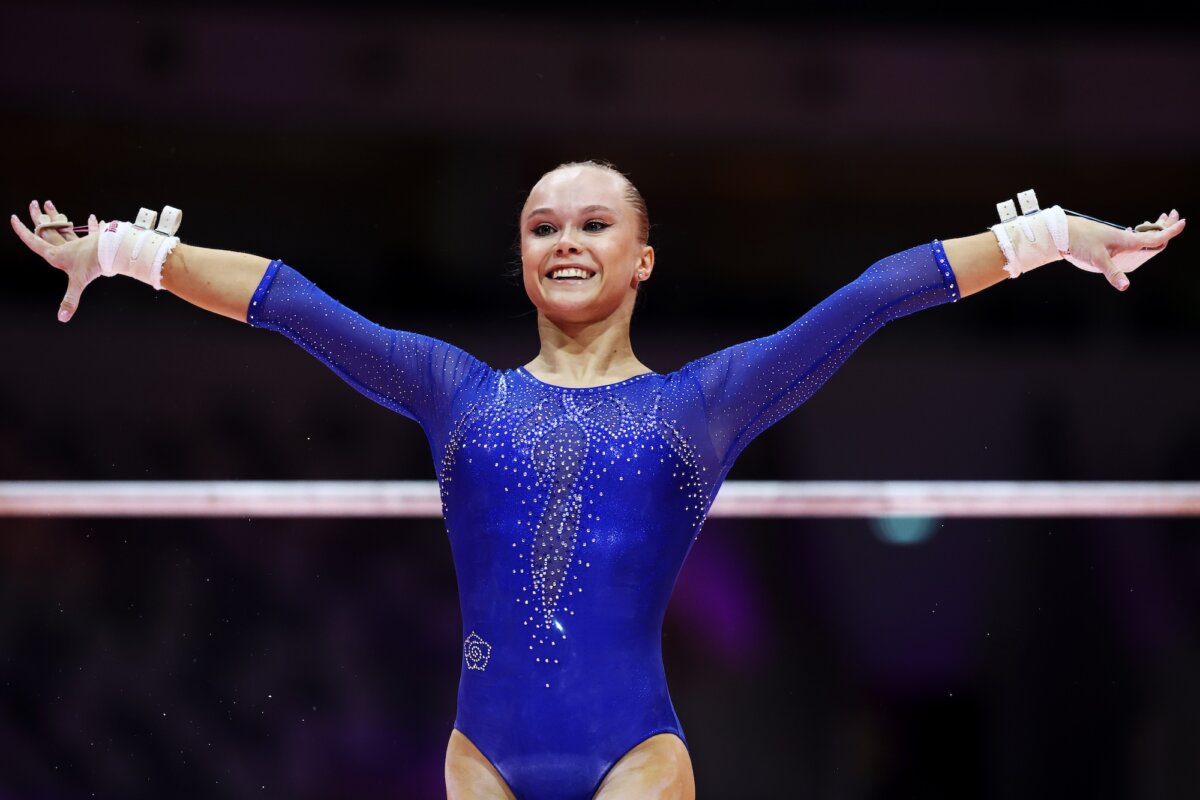
Russian gymnasts competing today and affected by the ban include world champion and four-time Olympic medalist Angelina Melnikova. Made to compete as a neutral athlete, the 25-year-old won the all-around world title in Jakarta in October, in the absence of U.S. superstar gymnast Simone Biles.
Melnikova’s return to international gymnastics edged out American Leanne Wong, marking a long climb back to the top of the podium after she did not compete outside of Russia for three years.
The Russian star dabbled briefly in politics before removing herself from consideration in an effort to maintain the “neutral athlete” designation under International Gymnastics Federation guidelines.
Melnikova stood for local government in her hometown of Voronezh, under the banner of President Vladimir Putin’s ruling United Russia party, before withdrawing as a candidate. She has been accused by critics, including Ukrainian media, of being “pro-war” after liking and sharing posts seen as celebratory of Russian military action on her social media.
Ukrainian gymnasts to have criticized the decision to allow Russian and Belarusian gymnasts to compete as neutral athletes include retired 1996 Olympic all-around champion Liliya Podkopayeva, who is now a United Nations ambassador.

‘Anything But Neutral’
Podkopayeva wrote an open letter in 2023 when it was announced that Russia and Belarus would be allowed to send athletes to the 2024 Paris Olympics.
“Sport is anything but neutral and filled with more politics than anyone will admit,” she wrote. “We cannot allow their athletes to compete during the ongoing war, period. Russia must be pressured from every direction to end the war and withdraw from Ukraine as soon as possible.”
Russia was previously hit by restrictions over a doping scandal relating to 22 different sports, which did not include gymnastics.
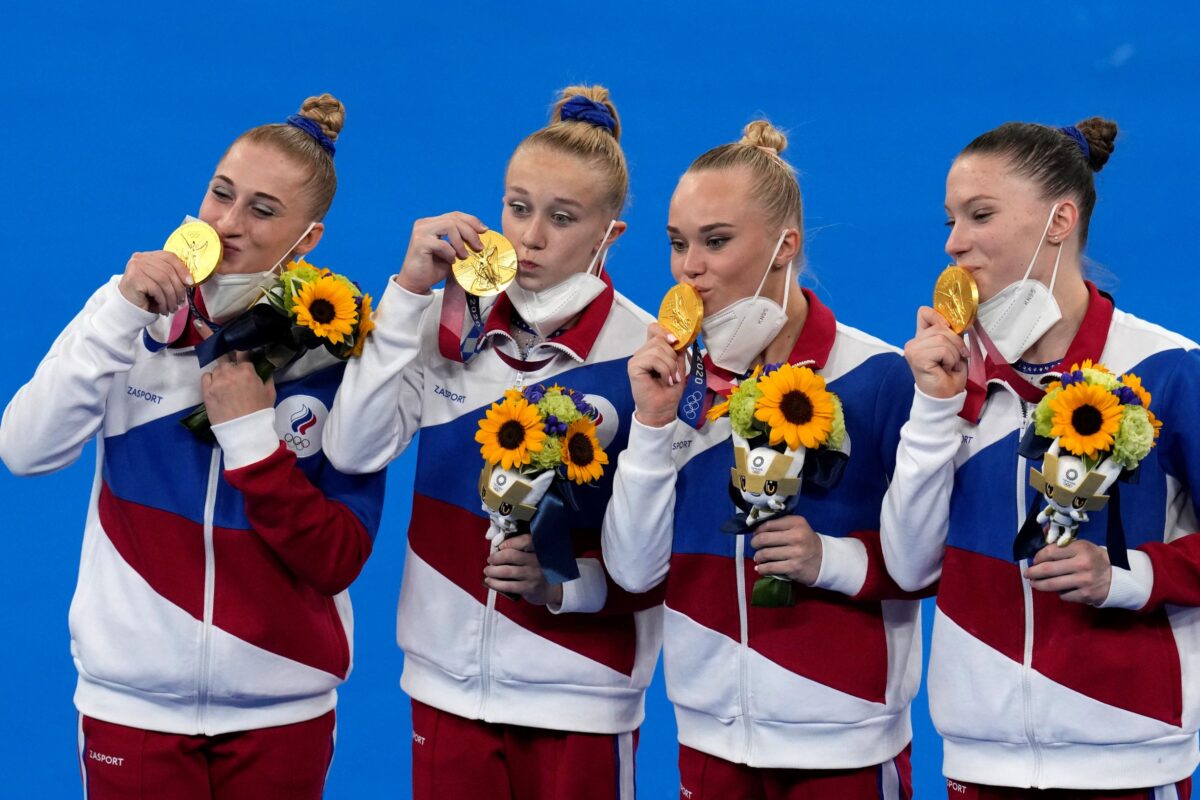
The punitive restrictions impacted all sports, however, and the entire Russian team was made to compete under the banner of the Russian Olympic Committee, not the Russian flag or name, at the delayed 2020 Tokyo Olympics. The gymnastics team won a haul of 10 medals, including gold in both the men’s and women’s team events.
The decision to lift the ban applies to all disciplines of gymnastics, including artistic, rhythmic, acrobatic, and aerobic gymnastics, as well as trampolining.
Russian Sports Minister and President of the Russian Olympic Committee (ROC) Mikhail Degtyarev welcomed the decision. He said that without the participation of Russian and Belarusian athletes, global sport was “lacking,” according to Russian state media agency TASS.
European Gymnastics is expected to announce its own decision on whether to lift restrictions on Russian athletes by the end of the week. The next European Artistic Gymnastics Championships will take place in Zagreb, Croatia, in August, while the next World Championships will take place in Rotterdam in the Netherlands in October.
 Friends Read Free
Copy
Facebook
Tweet
Friends Read Free
Copy
Facebook
Tweet