
Thirty-three alleged members of a “violent drug trafficking organization” operating in Philadelphia’s Kensington section have been indicted on charges of conspiring to distribute controlled substances and other offenses, the Department of Justice said in an Oct. 24 statement.
The indictment, filed at the District Court for the Eastern District of Pennsylvania on Oct. 22, was aimed at individuals accused of being members of the Weymouth Street Drug Trafficking Organization (DTO). The defendants were charged with 41 counts in total.
From roughly January 2016 through October 2025, the group allegedly “distributed fentanyl, heroin, crack cocaine, and cocaine on the 3100 block of Weymouth Street, one of the most prolific drug blocks in the city, functioning as an open-air drug market where illegal narcotics are sold every day and at all hours,” the department said.
A report released in May by the Pennsylvania Department of Health said that Philadelphia County had the second-highest fatal drug overdose rate in the state among all counties in 2023.
Although Weymouth Street remains the core of the gang’s alleged operation, their activities have expanded to other areas, including 3000 Potter Street, the corner of F Street and Clementine Street, and the corner of E Street and Wishart Street, according to the report.
The Weymouth DTO allegedly used violence to enforce its territorial claims, including via physical assaults, shootings, and murder, the department stated.
The gang is allegedly headed by Jose Antonio Morales Nieves, 45, from Luquillo, Puerto Rico. Out of the 33 defendants charged, 24 were arrested in multiple operations on Oct. 24, and eight were already in state or federal custody. One person is still at large, according to the department.
The indictment was announced by David Metcalf, United States attorney for the Eastern District of Pennsylvania, one of the most populous districts in the country, with almost 6 million residents.
“This indictment is, by defendant, the largest federal case of this century prosecuted by our office, and it attacks the very heart of the opioid crisis in the neighborhoods of Kensington,” Metcalf said.
“We are committed to returning these neighborhoods to their residents and reclaiming them from drug dealers who profit from the misery of others.”
It is unclear whether the defendants were assigned legal representation.
In a May 14 report, the Centers for Disease Control and Prevention said there were an estimated 80,391 drug overdose deaths in the United States in 2024. Deaths involving opioids, such as fentanyl, made up the majority.
In July, President Donald Trump signed the Halt All Lethal Trafficking of Fentanyl Act, which reclassifies substances related to fentanyl as Schedule 1 narcotics, which is the strictest designation established by the Controlled Substances Act.
The bill mandated 10-year minimum jail terms for people convicted of distributing fentanyl or derived drugs in quantities of 100 grams or more.
“It’s a big deal,” Trump said at the time.
“We’ll be getting the drug dealers, pushers, and peddlers off our streets, and we will not rest until we have ended the drug overdose epidemic. … We’re going to end it once and for all.”
Disrupting Drug Trafficking
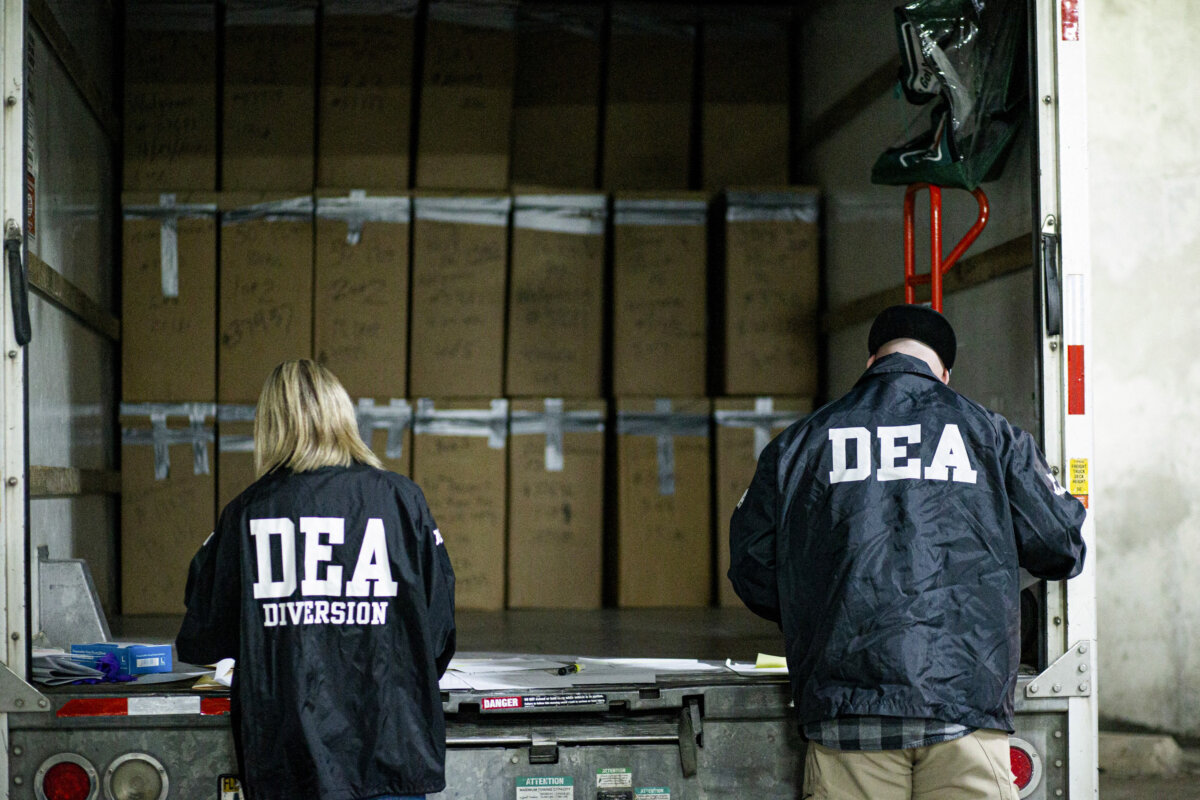
Transnational criminal organizations produce large quantities of illicit drugs and traffic them into the United States, according to the 2025 National Drug Threat Assessment report from the Drug Enforcement Administration.
Mexican cartels “work with U.S. drug trafficking organizations (DTOs) and violent gangs to distribute drugs throughout the country,” the report said.
On Oct. 24, War Secretary Pete Hegseth said that the U.S. military conducted its 10th strike on a drug trafficking boat in the Caribbean Sea.
The boat was operated by Tren de Aragua, a U.S.-designated terrorist organization, Hegseth said in an Oct. 24 post on X.
“If you are a narco-terrorist smuggling drugs in our hemisphere, we will treat you like we treat Al-Qaeda,” Hegseth said.
“Day or NIGHT, we will map your networks, track your people, hunt you down, and kill you.”
During a Sept. 9 speech at the Senate, Sen. Jack Reed (D-R.I.) criticized these actions, saying he was “deeply concerned” about U.S. military activities in the Caribbean.
He said that the activities were conducted without any clear legal justification or without securing congressional authorization and that the administration failed to provide evidence showing that such actions are necessary to protect the United States from an imminent threat.
Trump said on Oct. 23 that he would notify Congress about intensifying the administration’s fight against international drug cartels by carrying out operations on land. The United States has been targeting drug-trafficking vessels in the Caribbean and the eastern Pacific.
“Now [drugs] are coming in by land. … The land is going to be next,” Trump said.
He justified the actions taken against drug vessels, saying that his team has full legal authority to destroy such suspected vessels at sea without a formal declaration of war.
“We’re allowed to do that, and if we do it by land, we may go back to Congress,” the president said.
Based on data from the U.S. Sentencing Commission, out of the 61,678 cases reported to the commission during fiscal year 2024, 18,029 involved drug trafficking.
Seven types of drugs were responsible for 98.3 percent of drug trafficking offenses. Methamphetamine accounted for the largest share of drug trafficking cases, followed by fentanyl and its analogues, and powder cocaine.
 Friends Read Free
Copy
Facebook
Tweet
Friends Read Free
Copy
Facebook
Tweet