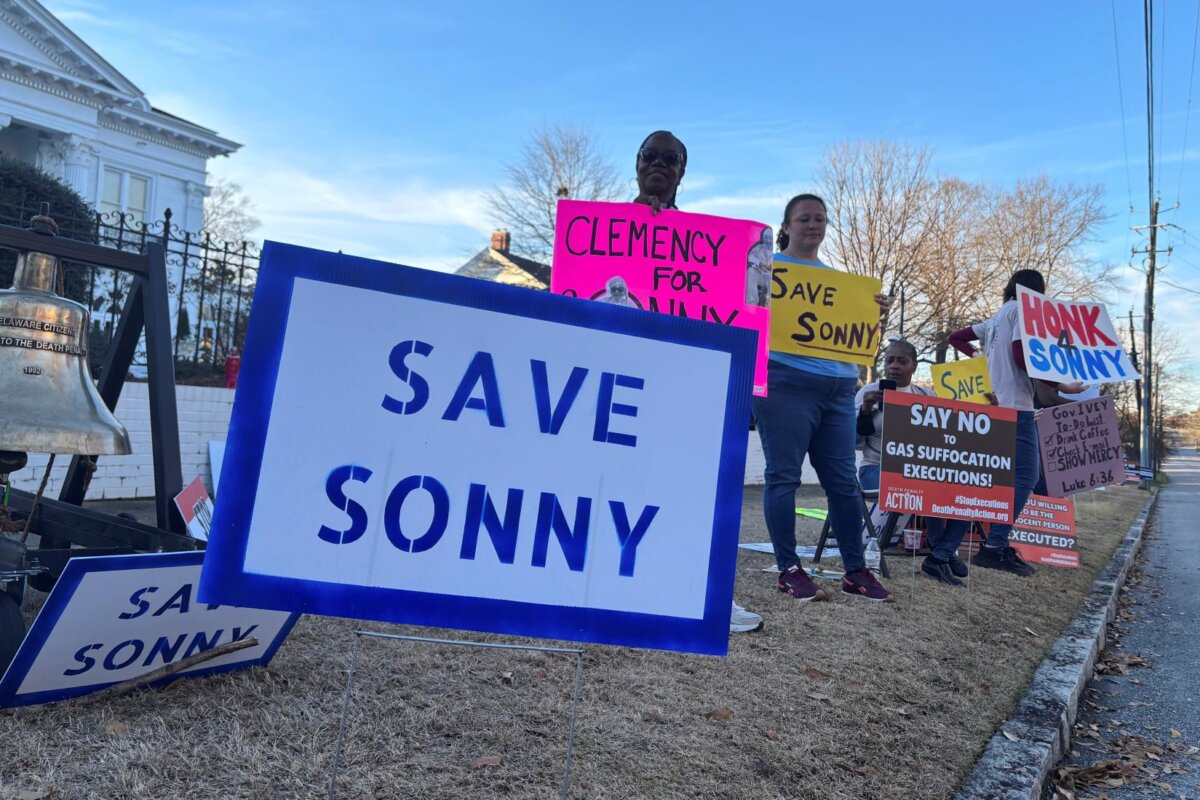

Alabama Gov. Kay Ivey on March 10 commuted the death sentence of a 75-year-old inmate scheduled to be executed this week, citing the fact that he was outside the building when the victim died in a 1991 robbery.
Ivey changed Charles “Sonny” Burton’s punishment to life in prison without the possibility of parole. The move marks the second time that the Republican governor has granted clemency to a death row inmate since assuming office in 2017.
Burton was convicted of the shooting death of customer Doug Battle during the robbery of an AutoZone auto parts store in Talladega. Burton had already exited the store before another man, Derrick DeBruce, killed Battle. Nonetheless, prosecutors argued that Burton had led the robbery, and a jury convicted him as an accomplice.
Both DeBruce and Burton were found guilty of capital murder. DeBruce’s death sentence was later overturned on appeal, and he was resentenced to life in prison before dying behind bars.
Ivey, who has overseen 25 executions, noted that she still supports the death penalty as “just punishment for society’s most heinous offenders.” She added, however, that the punishment must be applied fairly and proportionately.
“I believe it would be unjust for one participant in this crime to be executed while the participant who pulled the trigger was not,” Ivey said in a statement. “To be clear, Mr. Burton will not be eligible for parole and will rightfully spend the remainder of his life behind bars for his role in the robbery that led to the murder of Doug Battle. He will now receive the same punishment as the triggerman.”
Burton had been scheduled for a March 12 execution by nitrogen gas, which Alabama adopted as its method of execution in 2024.
Family members and supporters of Burton, who uses a wheelchair, requested that Ivey grant him clemency, and numerous jurors from his 1992 trial joined the plea, accompanied by a letter from Battle’s daughter questioning the logic of executing someone who did not fire the shot.
“I’m just so happy, so happy. It’s just tears of joy,” Burton’s daughter, Lois Harris, said through sobs during a telephone interview.
Alice Marie Johnson, whom President Donald Trump had selected last year as his “pardon czar” after commuting her sentence for federal drug and money laundering charges, praised Ivey. She said the governor “showed what courageous and common sense leadership looks like.”
“By commuting the death sentence of Charles “Sonny” Burton, she ensured that justice—not technicalities—guides the most serious decision a state can make,” Johnson wrote on Instagram.
Alabama Attorney General Steve Marshall criticized the decision.
“There has never been any doubt that Sonny Burton has Douglas Battle’s blood on his hands,” Marshall said in a statement released on March 10.
Burton organized the armed robbery and “held a gun to the store manager’s head” before splitting the proceeds, Marshall said.
Burton heard of the commutation at Holman Correctional Facility in Atmore as officials prepared for the March 12 execution. He had already chosen a final meal and was writing a will to distribute his belongings.
Matt Schulz, an assistant federal defender who represented Burton, said he told his client of the news in person.
“This was absolutely the right decision for the governor to make for any number of reasons,” Schulz said. “The biggest one is the fact that this dichotomy of executing a non-shooter who did not even see the shooting take place after the state itself had resentenced the shooter to life without parole.”
Burton thanked the governor.
“Just saying thank you doesn’t seem like much,” he said. “But it’s what I can give her.”
Burton said last month that no one was supposed to be hurt in the robbery and that he didn’t know until afterward that Battle had been shot and killed.
“I didn’t know anything about nobody getting hurt until we were on the way back. No, nobody supposed to get hurt,” Burton said in a telephone interview from the Holman Correctional Facility.
Burton apologized to Battle’s family. “I’m so sorry. If I had the power to bring him back, I would,” he said.
The Associated Press contributed to this report.
 Friends Read Free
Copy
Facebook
Tweet
Friends Read Free
Copy
Facebook
Tweet