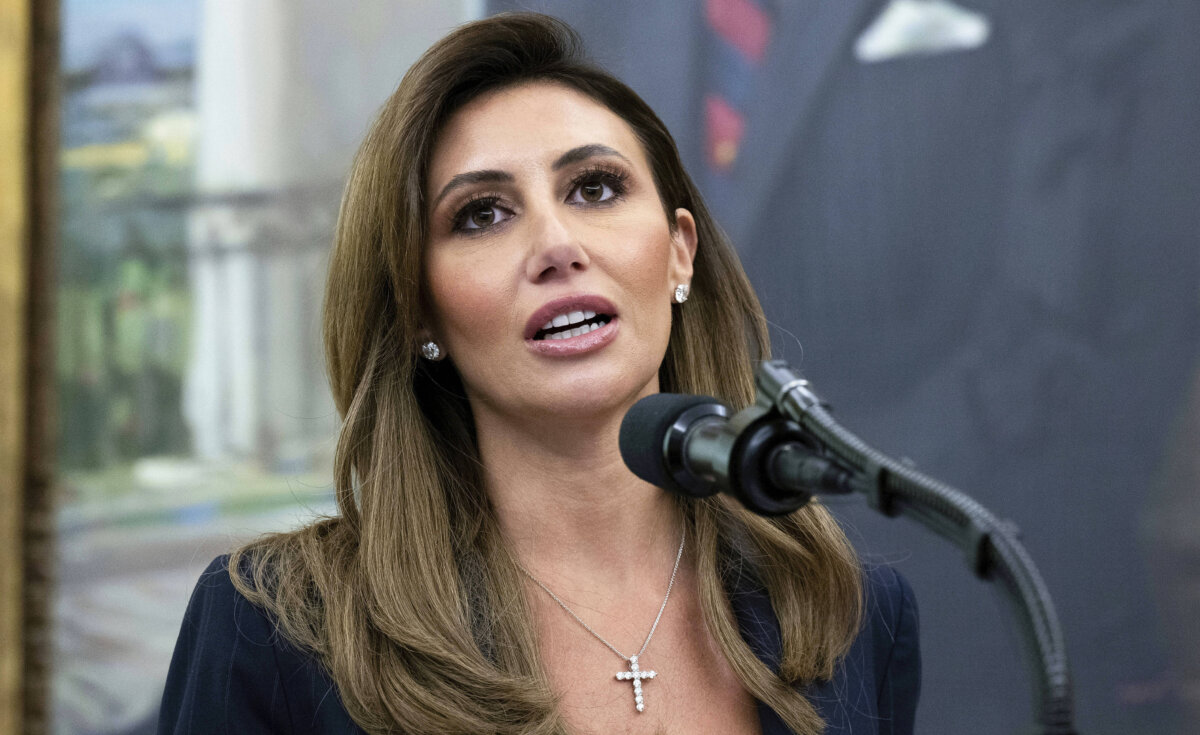
An appeals court seemed skeptical about the Trump administration’s arguments on Oct. 20 that Alina Habba could legally continue as acting U.S. Attorney for the state of New Jersey.
She had been removed from the position and replaced, but the administration fired her replacement before reinstalling her as top prosecutor for the state.
The hearing stems from lawsuits by three New Jersey defendants facing prosecution under Habba. They allege that she holds the position unlawfully, and seek to have their cases dismissed.
In August, a lower court agreed, and President Donald Trump’s administration appealed.
Judge D. Brooks Smith, one member of a three-judge panel for the Third Circuit Court of Appeals, questioned the fact that Habba was listed on court filings as both “acting U.S. attorney” and “Special Attorney.”
“And of course, the usual question that a judge would ask is: which, what, who is this person? What actual position are they serving?”
Smith also said the steps Trump’s administration went through to keep Habba in the U.S. attorney slot were “a complete circumvention, it seems, of the appointments clause.”
The judge recounted the complex timeline of events for the court at a hearing on Monday.
Trump appointed Habba as interim U.S. Attorney in March, and later submitted her nomination to the Senate.
That nomination was blocked and never came up for a vote; when her term expired after 120 days, a court appointed the next-in-command to fill the role on July 22: first assistant to the U.S. Attorney Desiree Grace.
The same day, Trump wrote on Truth Social that Grace had been fired; Grace later protested she was removed unfairly, and filed an appeal with the Merit Systems Protection Board.
The administration then employed various tactics to put Habba back into the position.
First, Trump withdrew Habba’s nomination, and she resigned her claim to the U.S. Attorney spot. Attorney General Pam Bondi then appointed Habba as “Special Attorney to the Attorney General,” and then named her as first assistant to the U.S. Attorney. Bondi then moved Habba into the empty U.S. Attorney position once more.
Henry Whitaker, arguing for the government, told the court that the Trump administration had “colored inside the lines” even though it used “complicated steps” to keep Habba in her position.
“In this case, the executive branch admittedly took a series of precise, and precisely timed steps, not to evade or circumvent those mechanisms, but rather to be scrupulously careful to comply with them,” he said.
At one point, Smith asked Whitaker if he could point to an example where a U.S. Attorney was appointed using identical circumstances to Habba’s. Whitaker said he could not but also said the executive branch had made similar moves, “in substance,” in other instances.
Attorney Abbe Lowell, arguing on behalf of one of the defendants facing prosecution under Habba, said the government had cobbled together a complex legal theory to justify Habba’s reappointment.
“How can you construct the very carefully crafted set of statutes which presumes that you’re trying to put somebody in place with the advice and consent of the Senate … to say that there is some way that the Attorney General can appoint somebody to the important job of U.S. Attorney forever, or at least as long as the president’s term stands?” he asked.
Habba’s previous nomination had been blocked by a Senate tradition called the “blue slip,” which lets senators veto the nomination of officials appointed to their state.
In this instance, New Jersey Sens. Cory Booker and Andy Kim, both Democrats, opposed Habba’s appointment. Trump sought to overturn the blue slip tradition itself but that plan met with pushback—including from Republicans Thom Tillis (R-N.C.) and Chuck Grassley (R-Iowa).
Habba was in attendance at Monday’s hearing, and afterwards posted to X that she has not yet spoken to either senator.
“That is not how the process should work in a functioning democracy,” she said. Habba also said she intended to advocate for the 26 U.S. Attorney candidates whose nominations had also been blocked.
Booker and Kim previously issued a statement opposing Habba’s reappointment.
“This is another attempt by the Trump Administration to install Alina Habba as U.S. Attorney for the District of New Jersey by bypassing the court’s lawful authority and ignoring the required advice and consent of Congress,” they said on July 24.
 Friends Read Free
Copy
Facebook
Tweet
Friends Read Free
Copy
Facebook
Tweet